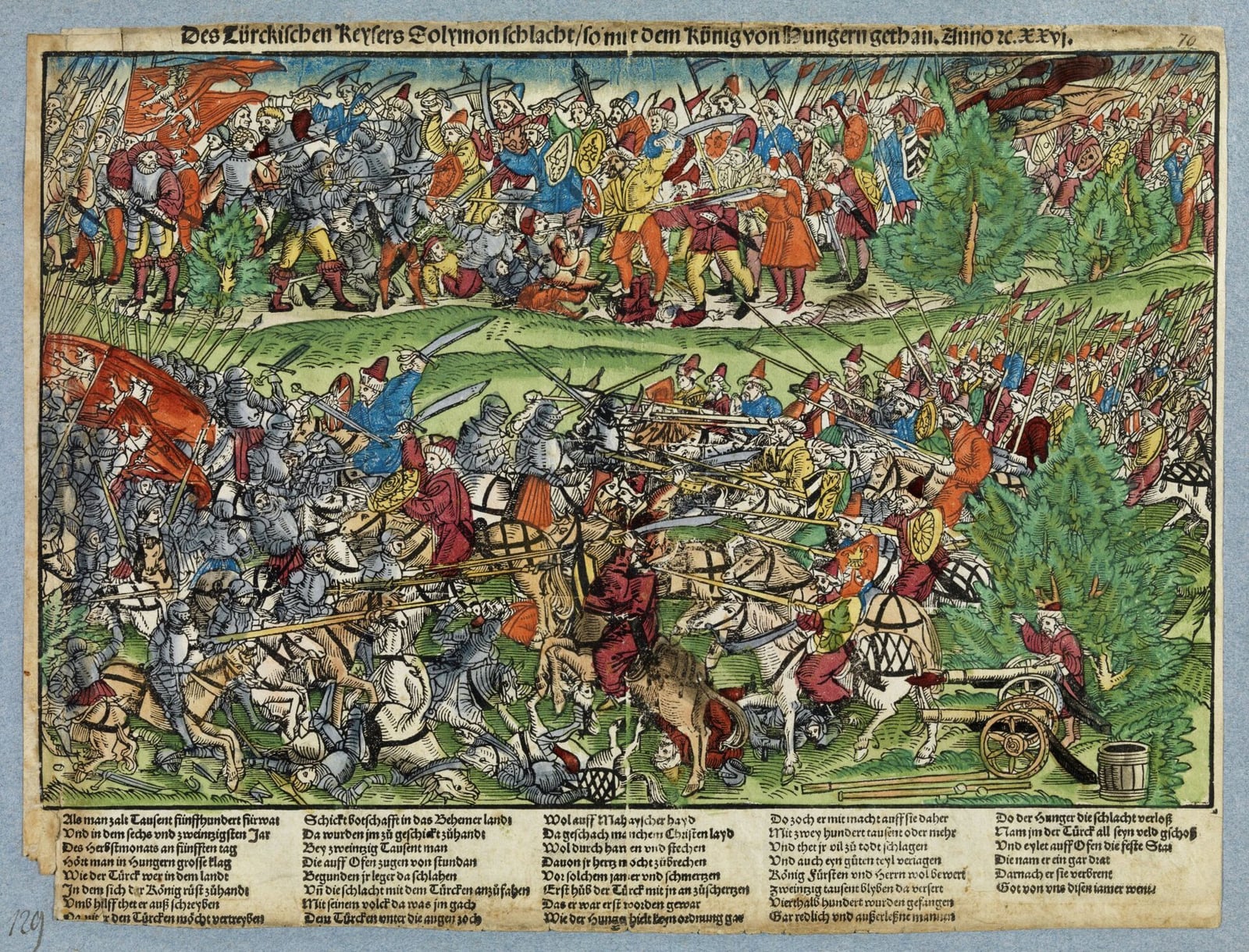
The Ottomans Defeat Hungary at Mohács
King Louis II died and the Hungarian kingdom broke apart.
On 29 August 1526, the armies of the Kingdom of Hungary and the Ottoman Empire met on an uneven, waterlogged plain near Mohacs, close to the Danube River. Hungarian monarch Louis II had taken the field with a force of roughly 25,000 to 30,000 men, composed of noble cavalry, royal retainers, and various mercenaries. Facing them was Sultan Suleiman the Magnificent, who had led an expeditionary force up the Danube valley from the Ottoman capital of Constantinople. Estimates of the Ottoman army vary widely, from about 60,000 to 100,000 men, and it was supported by a formidable artillery park put by historians at anywhere from about 150 to 300 guns.
The Hungarian kingdom had entered the conflict severely weakened by decades of internal political drift and fiscal decay. Following the reign of Matthias Corvinus, the nobility had curtailed central taxation and dismantled the standing mercenary army, leaving southern border fortresses neglected. The Ottoman capture of the strategic bastion of Belgrade in 1521 opened southern Hungary to direct invasion. When Suleiman began his offensive in the spring of 1526, appeals for foreign aid yielded little practical assistance beyond small contingents of troops and papal subsidies. Key regional armies, including forces from Transylvania under John Zapolya and a Croatian force led by Christoph Frankopan, were operating at a distance and failed to combine with the royal army in time.

Keep reading in Yester
Coming soon to the App Store
Keep following the story
Sources
Image: unknown