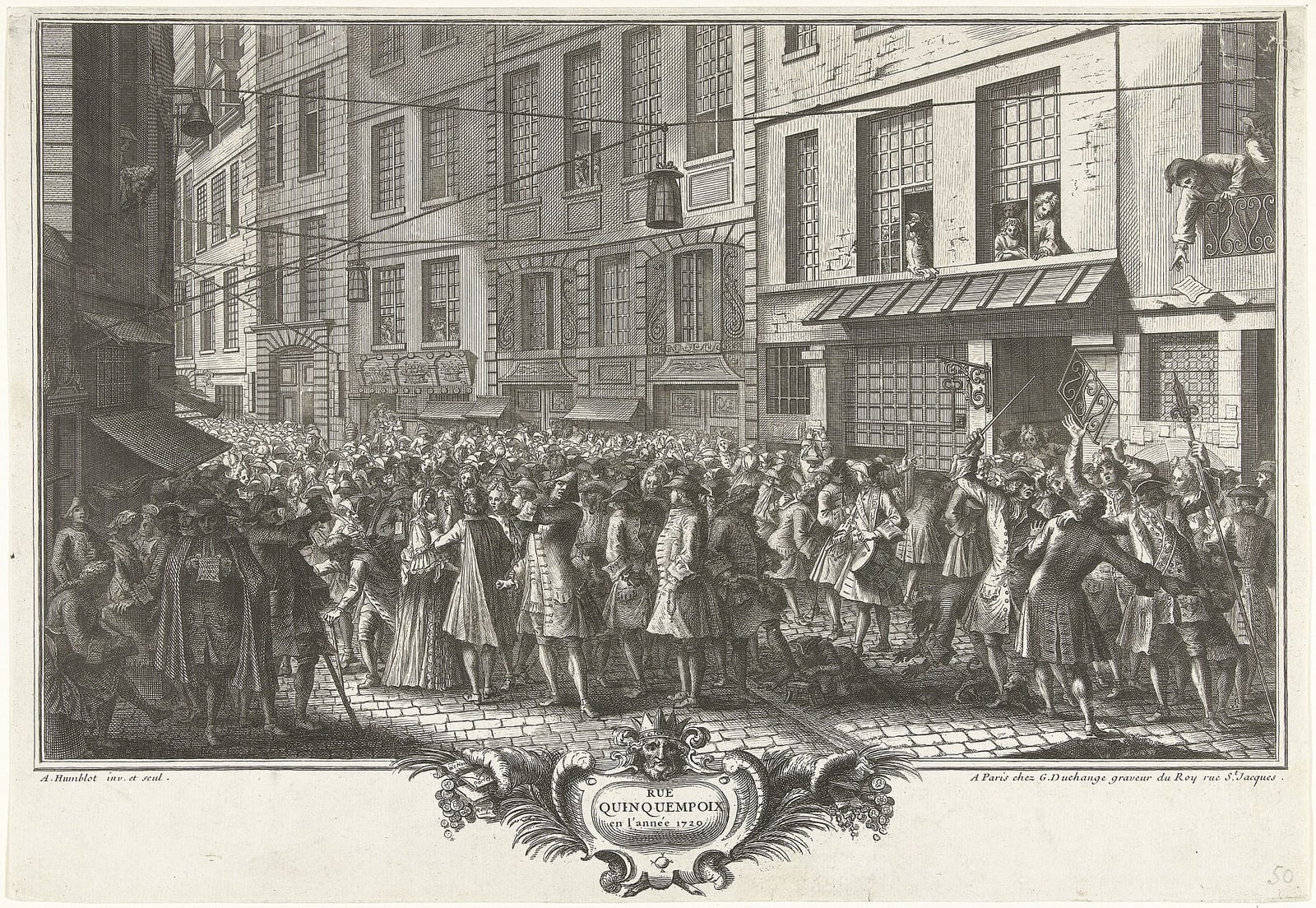
John Law’s Mississippi Bubble Bursts
Shares in a French colonial company soared and collapsed, wrecking France’s paper money.
In August 1717, the French Regency Council sanctioned a venture designed by the Scottish financier John Law to stabilize the depleted treasury of the French kingdom. Organized formally as the Compagnie d'Occident, the enterprise received proprietary control over the Louisiana territory alongside a twenty-five-year monopoly on trade between Louisiana and mainland France. The state also granted the enterprise exclusive rights to the Canadian beaver fur market. To attract capital, shares carrying a face value of 500 livres were offered payable in depreciated state debt certificates accepted at par value. The initial subscription drew 100 million livres, with substantial blocks taken by the Crown, high-ranking state officials, and Law himself.
The enterprise immediately organized overseas activities while constructing domestic commercial support. Jean-Baptiste Le Moyne de Bienville began establishing New Orleans in the spring of 1718, and several hundred new settlers soon sailed from Europe to Louisiana. Colonial development, however, quickly became secondary to domestic financial maneuvers. In 1718, the company secured France's tobacco monopoly, followed later that year by the acquisition of the Compagnie du Sénégal. By May 1719, Law absorbed the East Indies and China ventures, officially renaming the corporation the Compagnie des Indes. This merger secured mainland maritime facilities at Lorient, providing the company with dockyards, arsenals, and harbor infrastructure.

Keep reading in Yester
Coming soon to the App Store
Keep following the story

Sources
Image: Rijksmuseum