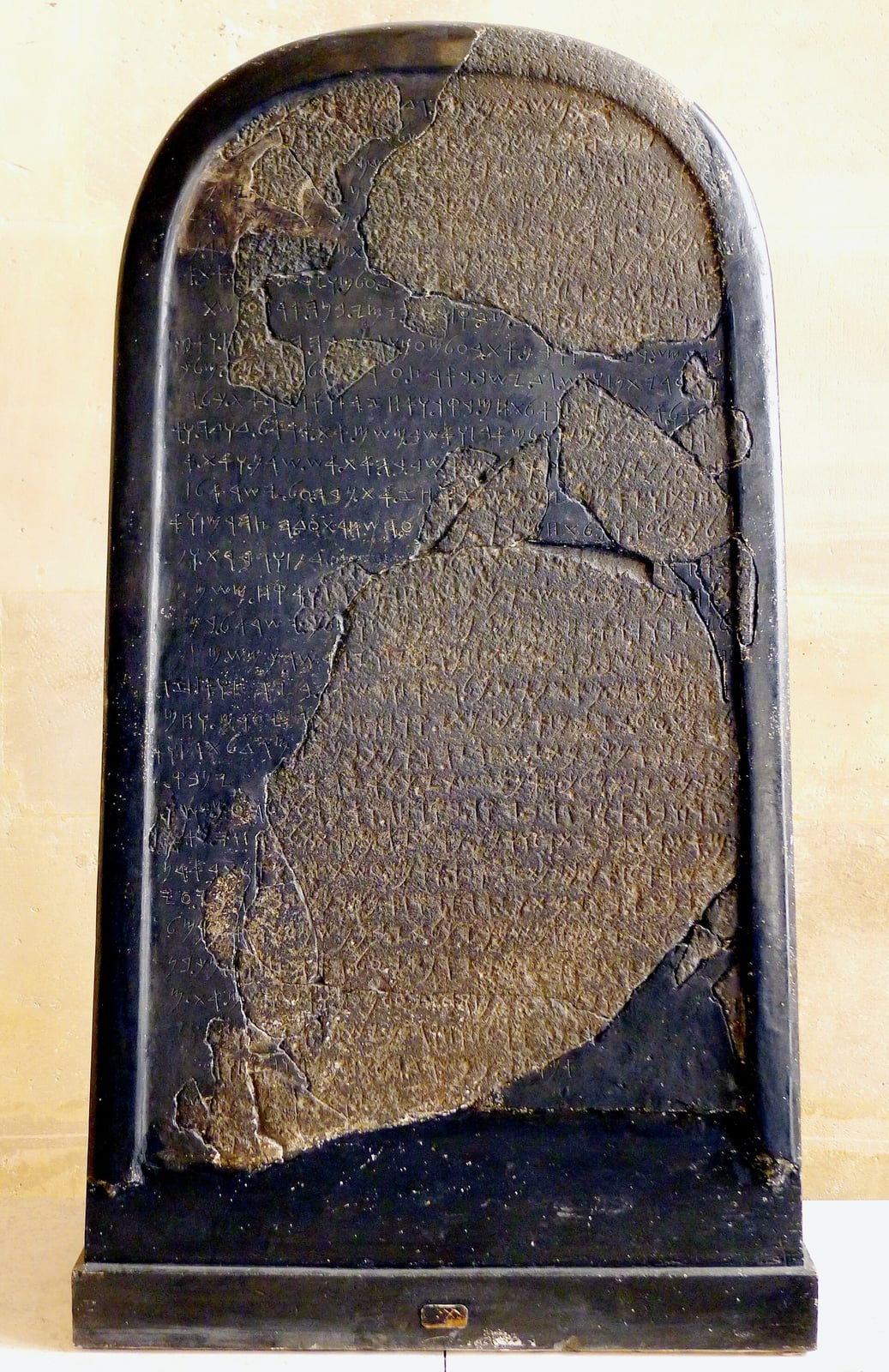
King Mesha of Moab Carves His Victory in Stone
The basalt stele is one of the oldest known inscriptions to name the kingdom of Israel.
In August 1868, Anglican missionary Frederick Augustus Klein was led to an exposed basalt slab resting among the ruins of Dhiban, east of the Dead Sea. The smoothed stone measured more than a meter tall and between sixty and seventy centimeters across, displaying thirty-four lines of ancient writing. Klein had been escorted to the site by Sattam Al-Fayez, the son of a local emir, though neither man could read the text. The discovery soon sparked intense competition among French, British, and German interests eager to acquire artifacts connected to the Levant.
Tensions escalated the following year as Ottoman authorities pressured local residents to surrender the monument so it could be transferred to Germany. In November 1869, members of the Bani Hamida tribe heated the basalt in a bonfire, poured cold water over it, and smashed it with boulders to prevent its confiscation. Fortunately, before this destruction, an Arab named Yacoub Caravacca had made a damp paper squeeze of the text for French consular archaeologist Charles Simon Clermont-Ganneau. Clermont-Ganneau later recovered pieces containing 613 of the original thousand letters, allowing the inscription to be reconstructed alongside the cast.

Keep reading in Yester
Coming soon to the App Store
Keep following the story
Sources
Image: Unknown artist Unknown artist