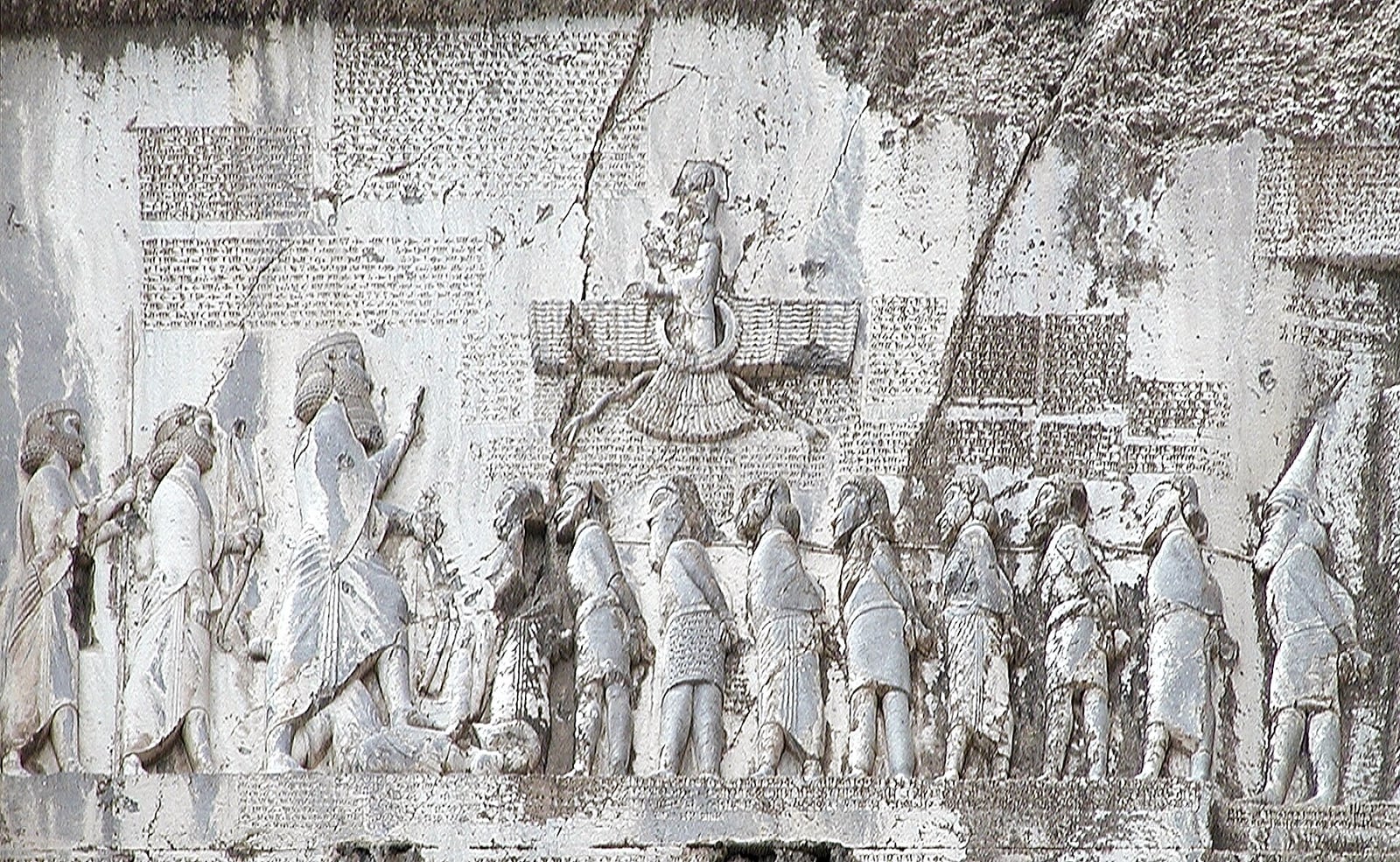
Darius Carves His Deeds on the Behistun Cliff
A trilingual inscription later became the key to reading cuneiform.
High on a limestone cliff in western Iran, roughly one hundred meters above an ancient road connecting Babylon and Ecbatana, Darius the Great ordered a monumental proclamation to be chiseled into the rock. Carved after his accession to the throne of the Achaemenid Empire in 522 BC, the monument combines narrative texts with a life-sized bas-relief of Darius holding a bow, resting his foot upon a supine figure identified as the pretender Gaumata, while nine bound captives stand before him beneath a hovering winged figure identified as the god Ahura Mazda.
The written proclamation was recorded in three separate scripts and languages: Old Persian, Elamite, and Babylonian, which is a dialect of Akkadian. In its opening passages, Darius recites his royal lineage through his ancestor Achaemenes, asserting that he was the ninth in a succession of kings. The text then recounts the widespread instability that followed the death of Cambyses II. According to Darius, various figures across the empire falsely claimed royal titles, forcing him to fight nineteen battles over the course of a single year ending in December 521 BC. He attributed his ultimate success over these rebellions to the grace of the deity Ahura Mazda.

Keep reading in Yester
Coming soon to the App Store
Keep following the story
Sources
- Bisotun (UNESCO World Heritage Centre)
- BISOTUN iii. Darius's Inscriptions (Encyclopaedia Iranica)
- BISOTUN ii. Archaeology (Encyclopaedia Iranica)
- Behistun (Livius.org)
- Behistun (3): Old Persian text, translation (Livius.org)
- Behistun (2) (Livius.org)
- GROTEFEND, Georg Friedrich (Encyclopaedia Iranica)
- Behistun inscription
Image: Unknown artist Unknown artist