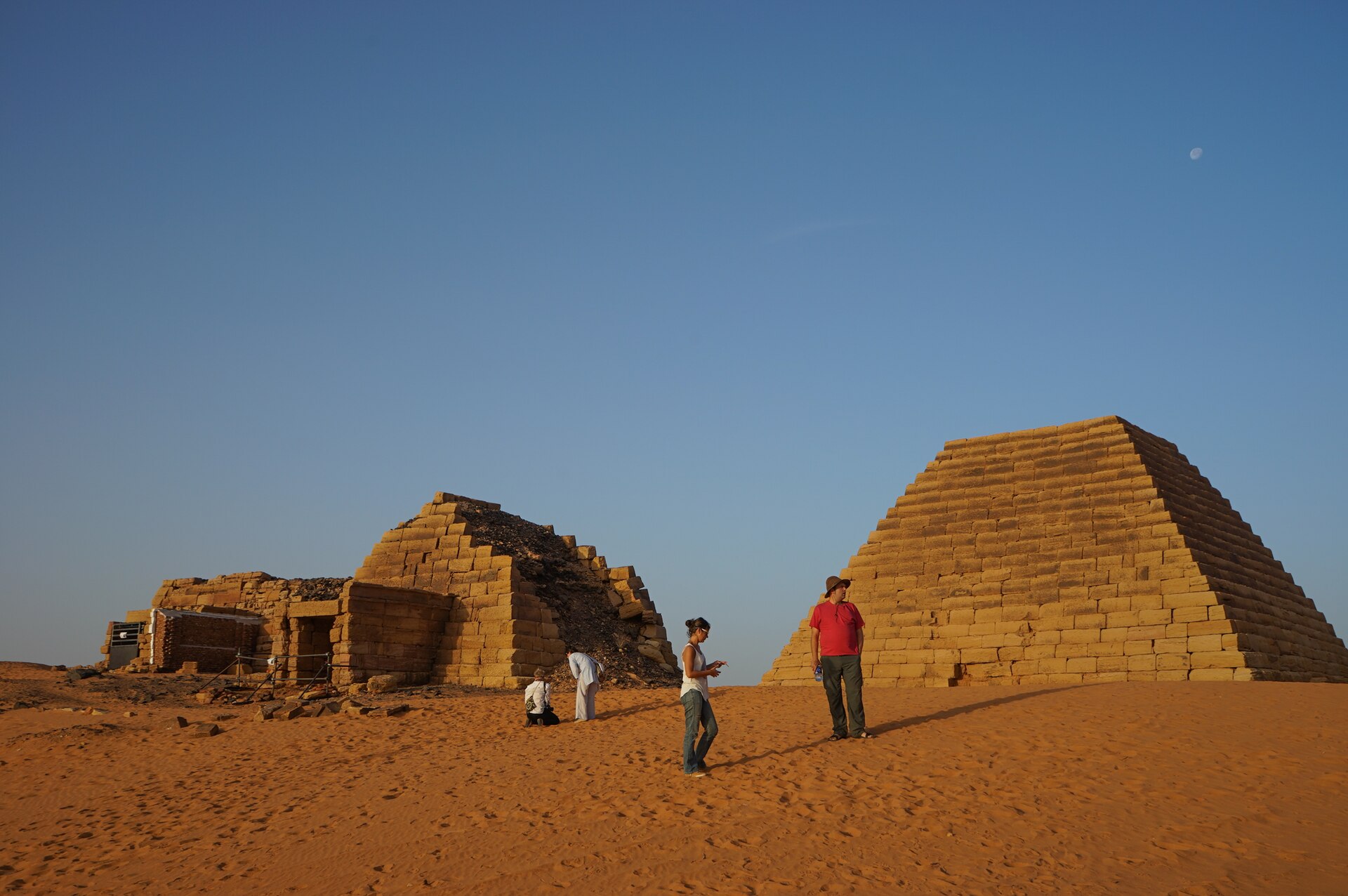
Meroë’s Pyramids Tell a Kushite Story
The monuments of Meroë belong to an African kingdom with its own rulers, writing and connections. Their history is not simply an appendix to ancient Egypt.
On the eastern bank of the Nile in northern Sudan, more than two hundred steep-sided stone pyramids mark the ruins of Meroë. The city served as the southern capital and administrative heart of the Kingdom of Kush, which governed lands along the middle Nile for over a millennium. Kushite royal burials originally clustered farther north at Napata. Over time, Meroë acquired greater political importance, a gradual shift that cannot be explained by a single invasion. Around 280 BC, under King Arakamani, royal entombments formally transferred to Meroë, inaugurating centuries of monumental construction across three primary necropolises.
The southern location placed Meroë near the fringe of the summer rainfall belt, where abundant iron ore deposits and hardwood forests supported extensive metalworking. Scholars continue to debate the full industrial scale of these workshops, but metal production, paired with decorated pottery, helped secure Kushite economic independence. The kingdom controlled trade routes connecting the African interior to the Red Sea, exporting textiles, ebony, ivory, animal products, and gold. Agricultural yields were sustained across savannah lands through irrigation devices such as the sakia, anchoring an empire that stretched across more than one thousand linear kilometers of the Nile Valley.

Keep reading in Yester
Coming soon to the App Store
Keep following the story
Sources
Image: Nina R from Africa