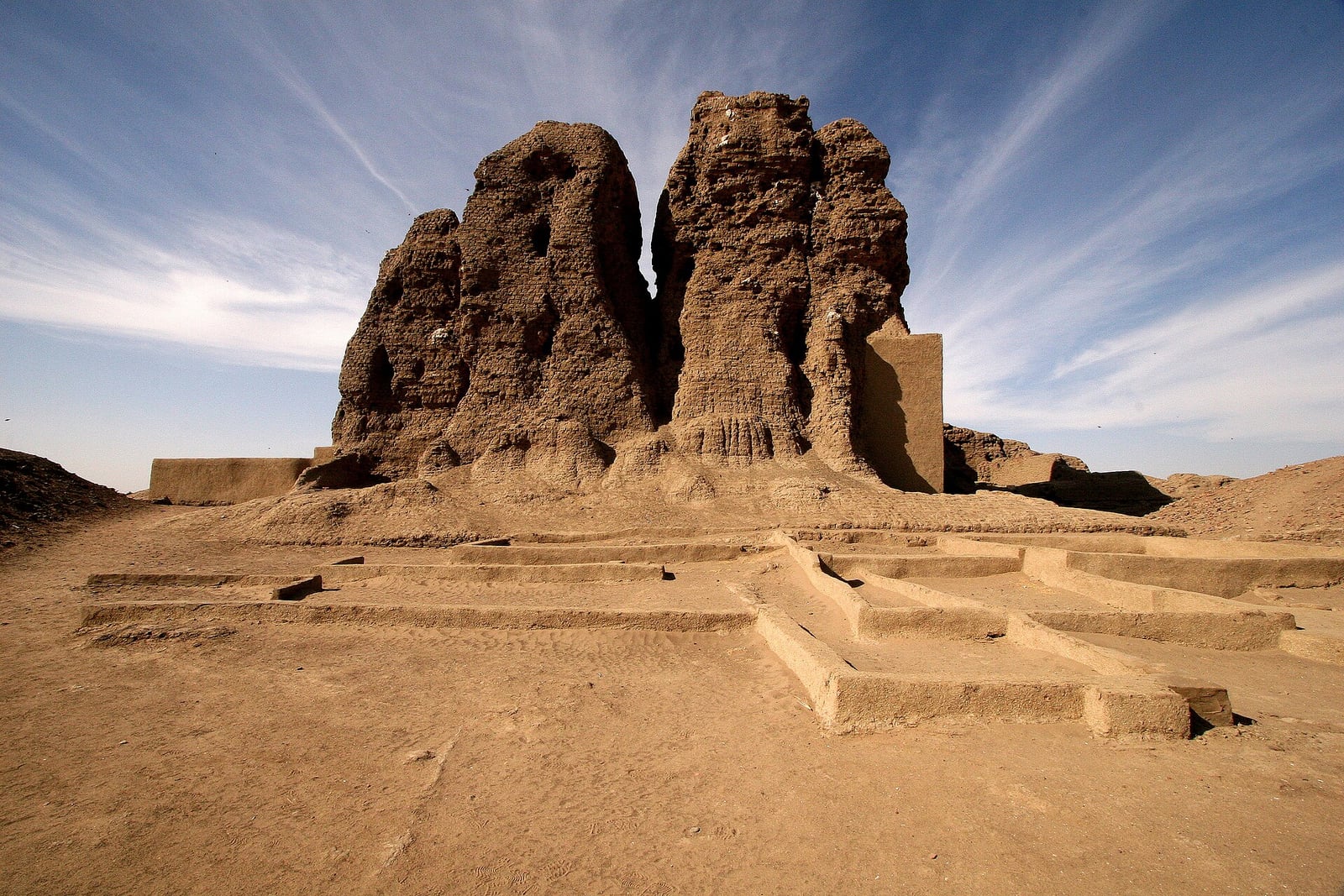
Kerma Becomes the Capital of a Nubian Kingdom
A city on the Nile built massive mud-brick temples and rivaled Egypt.
In Upper Nubia along the Nile, the settlement of Kerma expanded from an early fortified community into the political hub of an independent kingdom. Although an earlier pre-Kerma society had inhabited the area from roughly 3500 BC, the development recognized as the Kerma culture began around 2500 BC. By roughly 1750 BC, entering what modern archaeologists classify as its Classic phase, Kerma had grown into a fully urban, fortified capital. It stood as the center of a powerful realm whose rulers extended their influence north into Lower Nubia.
At the heart of the capital rose the Western Deffufa, a massive monumental temple built of mud brick. The city featured linear-walled architecture, administrative complexes, and extensive residential areas. Beyond the urban core, large royal tumuli anchored the necropolis. These royal burials contained hundreds of human and animal sacrifices. Excavators also discovered thousands of cattle bucrania deposited around elite tombs, pointing to cattle as central tokens of wealth and royal tribute gathered from outlying farming districts across the kingdom.

Keep reading in Yester
Coming soon to the App Store
Keep following the story
Sources
- History: Kingdom of Kerma, chronology (Swiss-Franco-Sudanese Archaeological Mission of Kerma)
- Site: Dukki Gel and City of Kerma (Kerma archaeological mission)
- A Nubian Kingdom Rises (Archaeology Magazine, Archaeological Institute of America)
- Kerma, 1913 (The Past / Current World Archaeology)
- Nubia in the New Kingdom: The Egyptians at Kurgus (Digital Epigraphy, on the SARS-British Museum project)
- Kerma culture
Image: walter callens