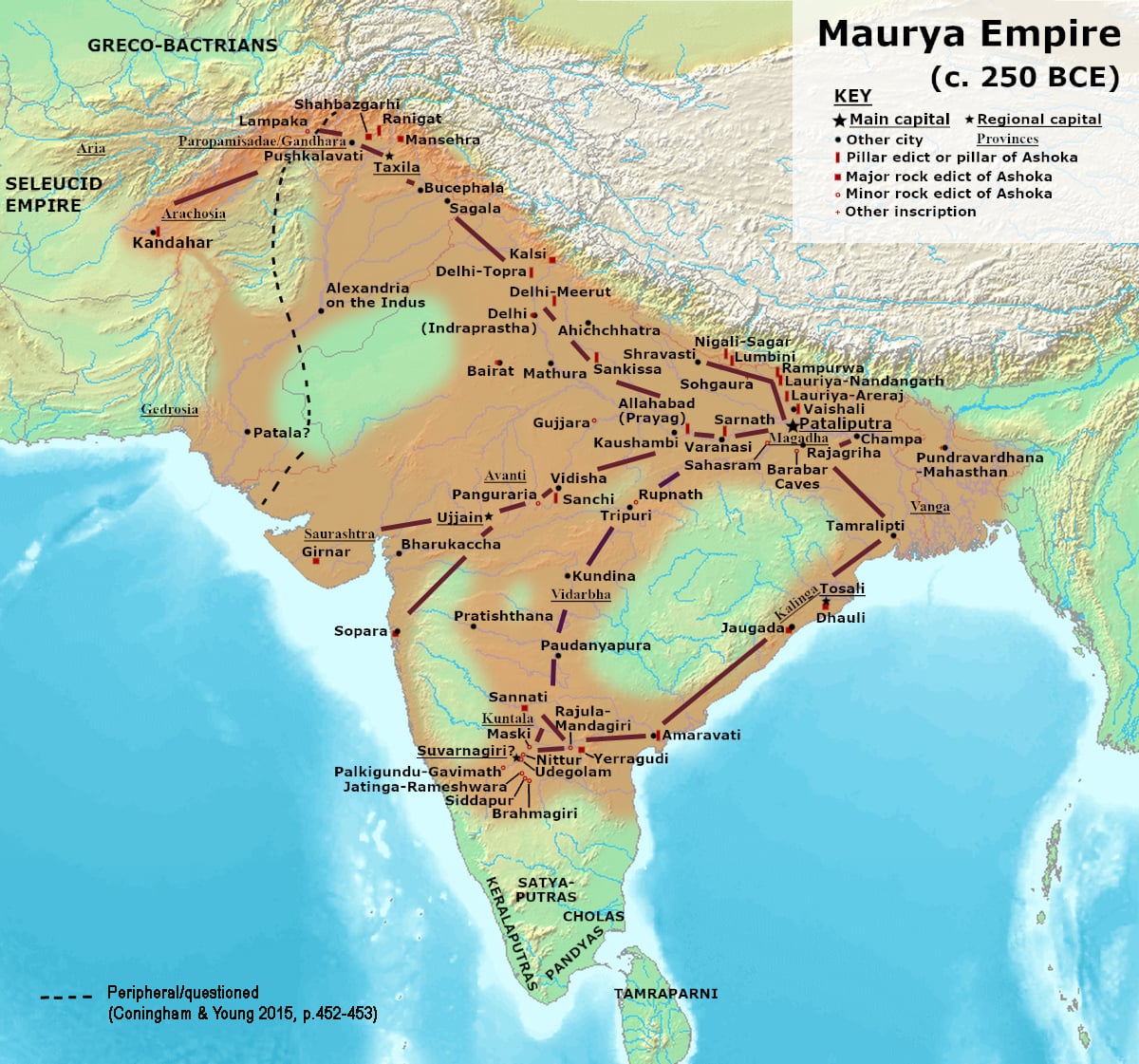
Chandragupta Founds the Maurya Empire
A new dynasty united most of the Indian subcontinent.
Around 320 BCE, the political landscape of northern South Asia shifted dramatically as Chandragupta Maurya challenged and overthrew the dominant Nanda dynasty. Centered in the fertile region of Magadha, the newly formed Maurya Empire began with the capture of the Nanda capital of Pataliputra, located at modern Patna. While later texts from Buddhist, Jain, and Hindu traditions present conflicting details about the sequence of battles and the role of the counselor Chanakya, they agree that Chandragupta dismantled Nanda authority. Surviving Roman accounts, drawing upon earlier Greek recollections, trace his initial rise to upheaval in the Punjab following the departure and death of Alexander the Great, where local forces revolted against Macedonian governors.
Chandragupta expanded his realm through both armed force and strategic diplomacy. His western campaigns culminated in a confrontation with Seleucus I Nicator around 303 to 302 BCE. Rather than engaging in prolonged warfare, the two monarchs concluded an agreement sealed by a dynastic marriage alliance. In exchange for five hundred war elephants, which Seleucus deployed to great effect in his western conflicts, the Seleucid monarch transferred several eastern provinces to Chandragupta, stretching Mauryan influence into areas of eastern Afghanistan and Gedrosia. This pact opened continuous diplomatic ties, bringing Greek ambassadors like Megasthenes directly to the imperial court at Pataliputra.

Keep reading in Yester
Coming soon to the App Store
Keep following the story
Sources
- The Mauryan Empire, essay by Jason Neelis (Silk Road Seattle, University of Washington)
- Strabo, Geography, Book XV, chapter 2 (Loeb translation, LacusCurtius, University of Chicago)
- Strabo, Geography, Book XV, chapter 1, sections 39-73 (Loeb translation, LacusCurtius, University of Chicago)
- Maurya Empire
Image: Joshua Jonathan