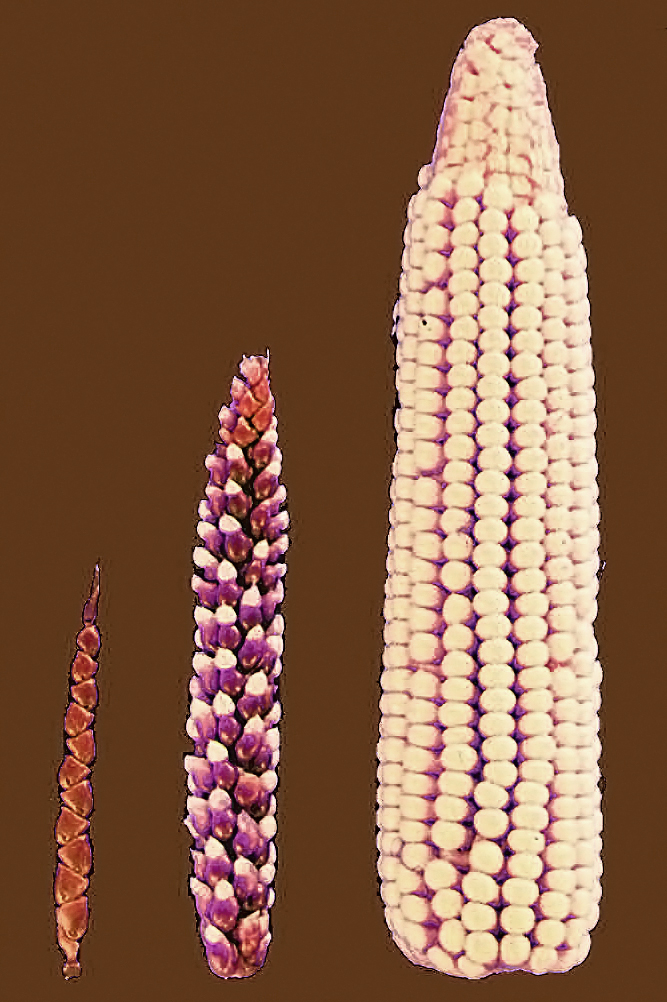
Farmers in Mexico Turn Teosinte into Maize
A wild grass with tiny ears became one of the world’s great staple crops.
About nine thousand years ago in the Balsas River valley of southwestern Mexico, indigenous gatherers began cultivating Balsas teosinte, a wild grass with slender branching stems and brittle seed spikes. Unlike domesticated cereal grains, teosinte kernels dispersed naturally when mature, falling away from the plant to seed the next generation. Hunter-gatherers initially utilized the grass as a flexible dietary supplement that adapted well to ecological fluctuations. Over generations of deliberate cultivation, farmers selected plants whose seeds remained attached to the cob, initiating a biological transformation that rendered the resulting crop entirely dependent on humans for its propagation.
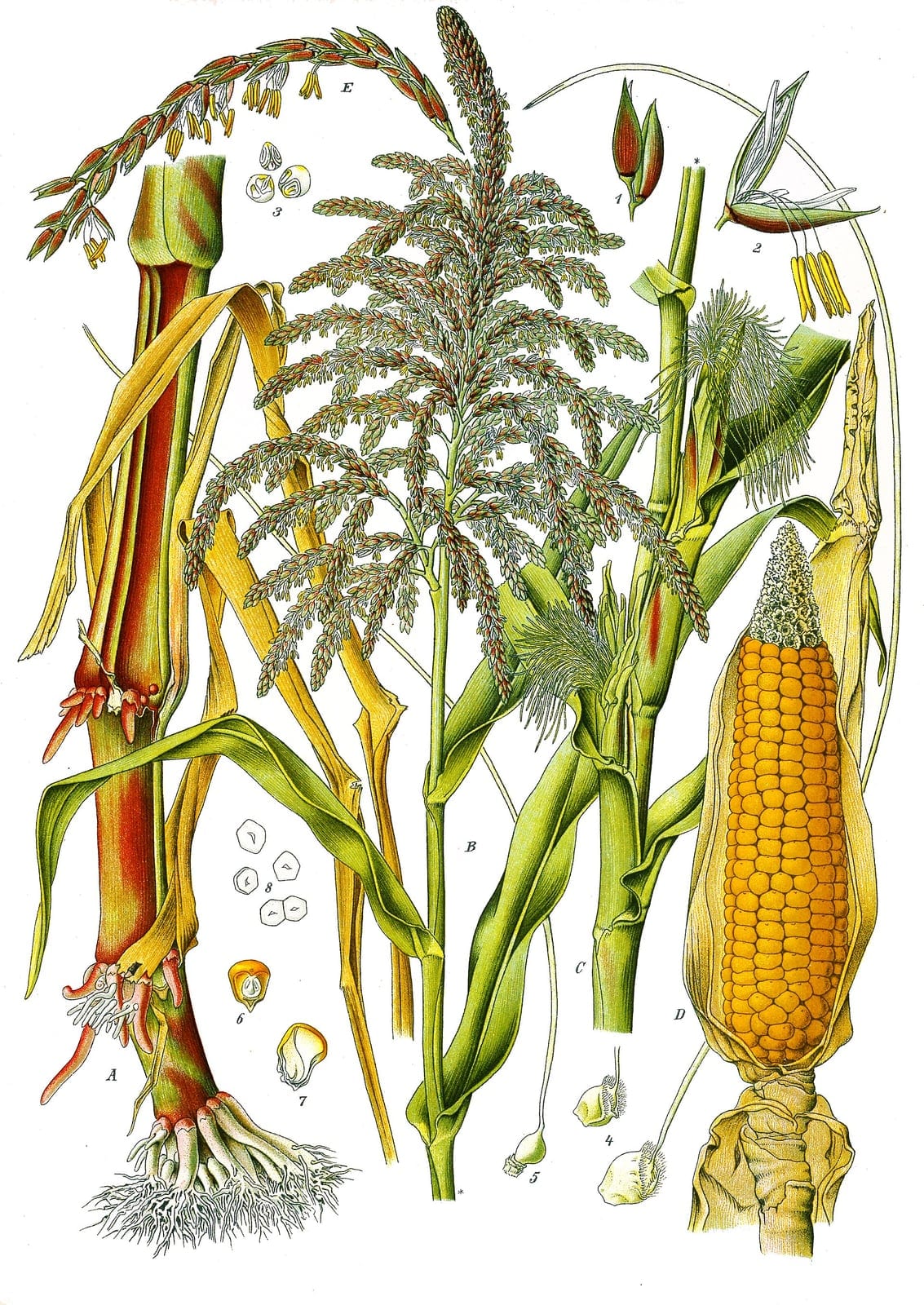
Botanists initially struggled to connect the wild ancestor with the domesticated crop because the two plants look remarkably distinct. Teosinte grows as a short, bushy plant with multiple grain-bearing branches, whereas domesticated maize forms a stout, single stalk ending in a pollen-producing tassel above protected ears of grain. In the 1930s, Russian botanist Nikolai Vavilov and American geneticist George Beadle proposed that teosinte was the direct ancestor of maize, countering later theories of complex hybridization. Modern genetic research confirmed their proposals, establishing that this vast anatomical shift was driven largely by changes in just two key genes, designated teosinte branched1, which suppresses side branching, and teosinte glume architecture1, which freed the kernel from its hard casing.

Keep reading in Yester
Coming soon to the App Store
Keep following the story
Sources
- Starch grain and phytolith evidence for early ninth millennium B.P. maize from the Central Balsas River Valley, Mexico (PNAS, via PubMed Central)
- The earliest archaeological maize (Zea mays L.) from highland Mexico (PNAS, via PubMed Central)
- Domestication of Plants in the Americas: Insights from Mendelian and Molecular Genetics (Annals of Botany, via PubMed Central)
- The evolution of apical dominance in maize (Nature)
- The origin of the naked grains of maize (Nature)
- Maize
Image: John Doebley