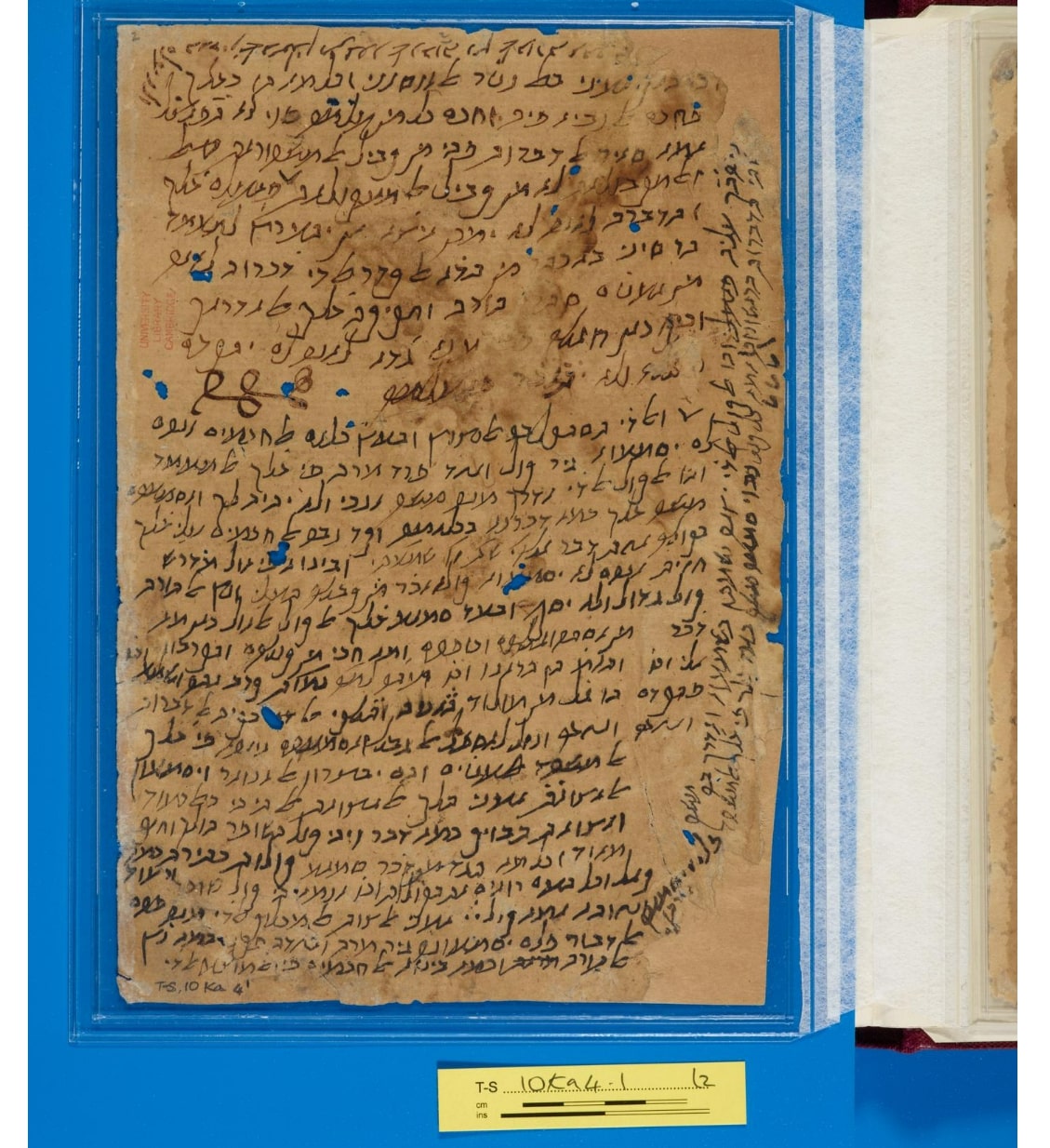
Maimonides Writes The Guide for the Perplexed
A physician-philosopher in Egypt tried to reconcile faith and reason.
By about 1190, the Jewish philosopher and physician Moses Maimonides had completed The Guide for the Perplexed in Fustat, Egypt. Written in Judeo-Arabic, which used Arabic grammar rendered in Hebrew script, the work was structured as an extended pedagogical epistle sent in successive installments to his former student, Rabbi Joseph ben Judah of Ceuta. Maimonides designed the treatise for educated believers who observed Jewish law yet found themselves troubled by apparent contradictions between traditional religious texts and the principles of rational philosophy.
The first of the work's three parts concentrates on the unity, omnipresence, and incorporeality of God. Challenging literal readings of biblical descriptions that attribute physical form or human traits to the divine, Maimonides argued that such expressions are metaphors or homonyms whose divine meaning is entirely distinct from earthly usage. He insisted that human language can only define God through negative terms, describing what the divine is not rather than attributing positive traits. Maimonides equated the failure to recognize divine incorporeality with idolatry, while also criticizing the speculative methods of Islamic and Jewish Kalam.

Keep reading in Yester
Coming soon to the App Store
Keep following the story
Sources
- Maimonides (Stanford Encyclopedia of Philosophy)
- Maimonides (Internet Encyclopedia of Philosophy)
- Samuel Ibn Tibbon (Stanford Encyclopedia of Philosophy)
- Basel, Universitätsbibliothek, Cod. A IV 37 (e-codices, Virtual Manuscript Library of Switzerland)
- Solomon ben Abraham ben Samuel (Jewish Encyclopedia)
- Abraham Ben David of Posquieres (Jewish Virtual Library)
- Tabrizi, Mahomet Abu-Bekr-at-ben Mahomet (Jewish Virtual Library, from Encyclopaedia Judaica)
- The Guide for the Perplexed
Image: Cambridge University Library