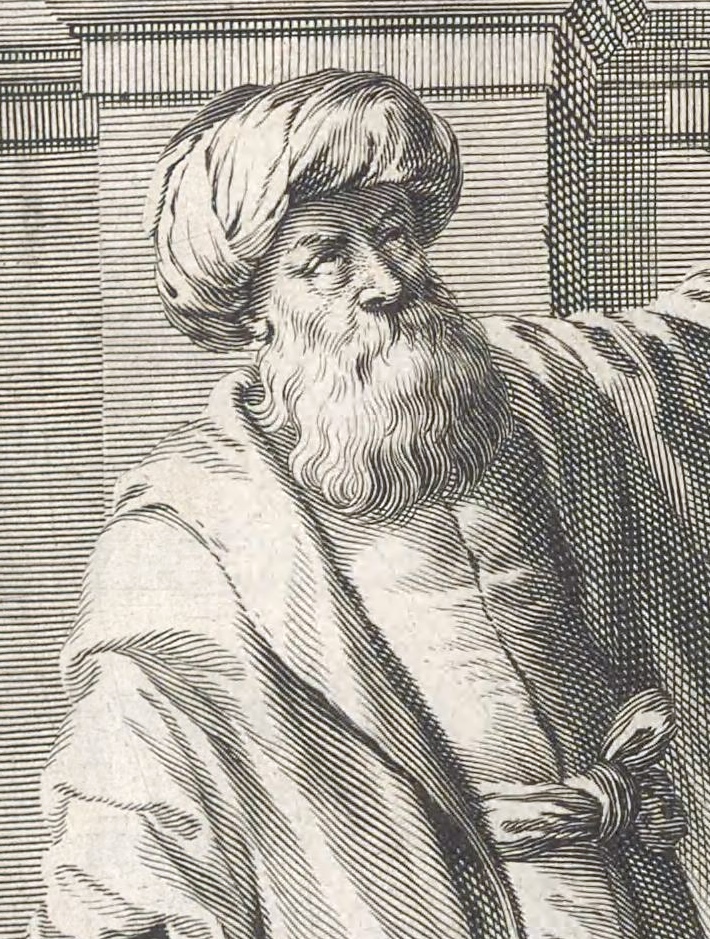
Ibn al-Haytham Investigates How We See
Work on light and vision challenged inherited explanations and linked observation with mathematical reasoning.
During the early eleventh century in Cairo, the mathematician and physicist al-Hasan Ibn al-Haytham undertook an extensive investigation into the nature of light and vision. Born in Basra around 965, he had moved to the Fatimid capital, where he served in an administrative capacity before turning his energies to independent scientific writing. Between 1011 and 1021, he compiled his most celebrated work, the seven-volume Book of Optics, known in Arabic as Kitab al-Manazir. In this treatise, Ibn al-Haytham synthesized classical traditions while challenging long-standing explanations of how human beings perceive the physical world.
Ancient natural philosophers had offered competing frameworks for sight. Mathematicians such as Euclid and Ptolemy advocated an emission model, arguing that visual perception was produced by rays originating within the eye and projecting outward toward objects. In contrast, Aristotelian thinkers promoted an intromission model, maintaining that physical forms traveled from an object into the eye. Drawing upon the anatomical writings of Galen alongside the geometric ray analysis of the Euclidean tradition, Ibn al-Haytham concluded that vision occurs because light reflects off the points of an illuminated object and travels directly into the observer's eye, refuting the emission hypothesis.

Keep reading in Yester
Coming soon to the App Store
Keep following the story
Sources
Image: Adolph Boÿ, engraved by Jeremias Falck. Used as the frontispiece to Johannes Hevelius, Selenographia, 1647