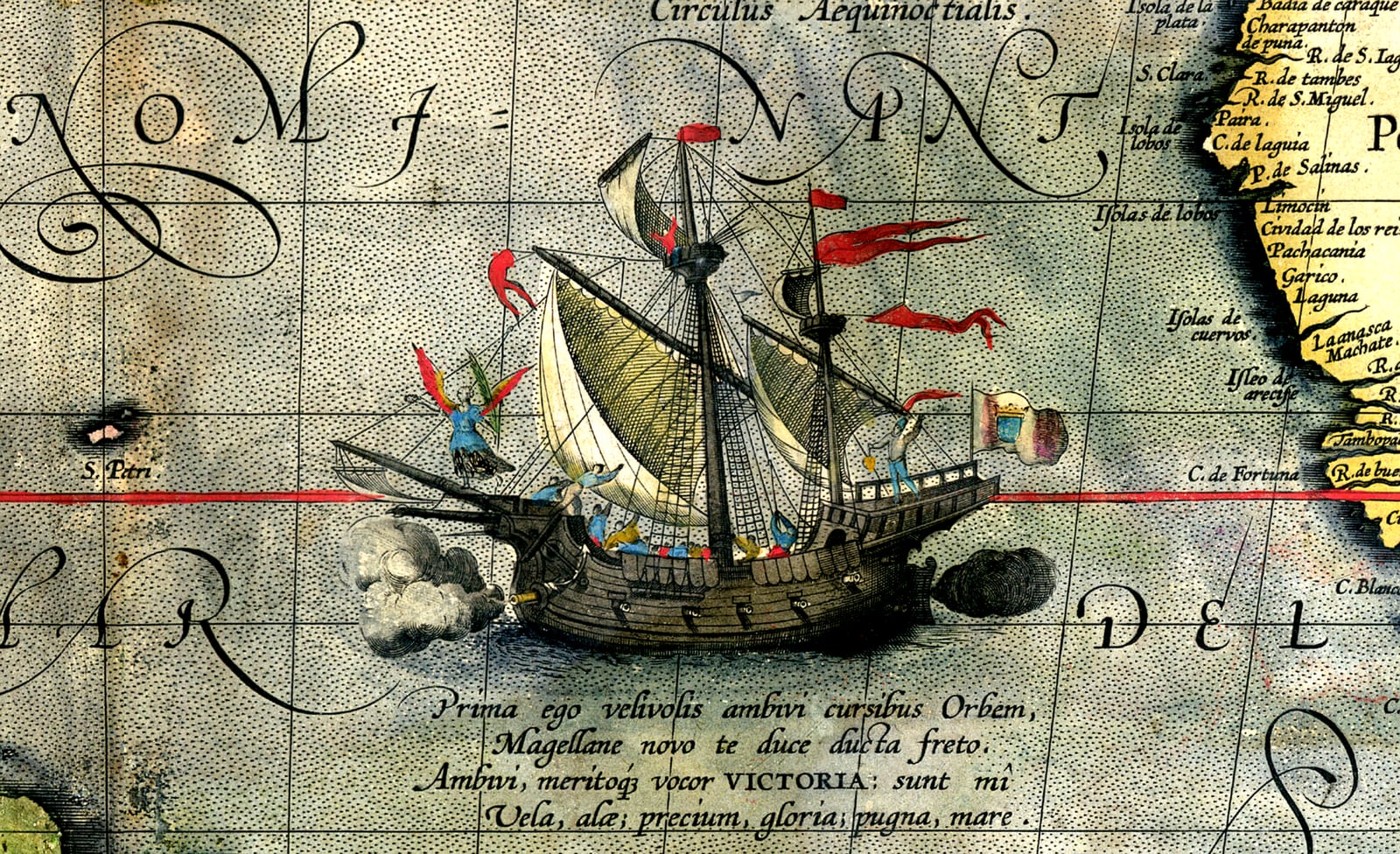
Magellan’s Fleet Sets Out on a Voyage Around the World
Only one ship and a fraction of the crew completed the first circumnavigation.
On 10 August 1519, five ships commanded by Ferdinand Magellan departed Seville and descended the Guadalquivir River to Sanlúcar de Barrameda, where they spent more than five weeks making final preparations. Setting sail into the open Atlantic on 20 September 1519, the fleet carried roughly 270 men on a voyage intended to establish a Spanish maritime trade route to the Moluccas, the valuable Spice Islands located in modern Indonesia. King Charles I of Spain backed the enterprise after Magellan, who had left Portuguese service, proposed reaching Asia by sailing westward and thereby circumventing Portuguese maritime routes around Africa.
The transatlantic passage immediately tested the fleet's stability. After pausing at Tenerife to load supplies, Magellan chose a southerly course along the African coast, a route that provoked arguments with his Spanish officers. Disagreements intensified, and the fleet's inspector general, Juan de Cartagena, openly disputed Magellan's authority. Magellan placed Cartagena under restraint, but internal strife resurfaced with greater force after the ships reached South America, explored the mouth of the Río de la Plata, and docked at Port St. Julian to endure the southern winter.

Keep reading in Yester
Coming soon to the App Store
Keep following the story

Sources
- Magellan's Expedition and Elcano's First Circumnavigation of the Globe (Fundación Elkano, Google Arts and Culture)
- Magellan's expedition circumnavigates globe (HISTORY)
- Juan Elcano, Scientist of the Day (Linda Hall Library)
- The Battle of Mactan, according to Pigafetta (Philippine Daily Inquirer)
- An eyewitness account of the Battle of Mactan (Philippine Daily Inquirer)
- The Discovery of the Calendrical Date Line (Utrecht University)
- Magellan expedition
Image: Abraham Ortelius