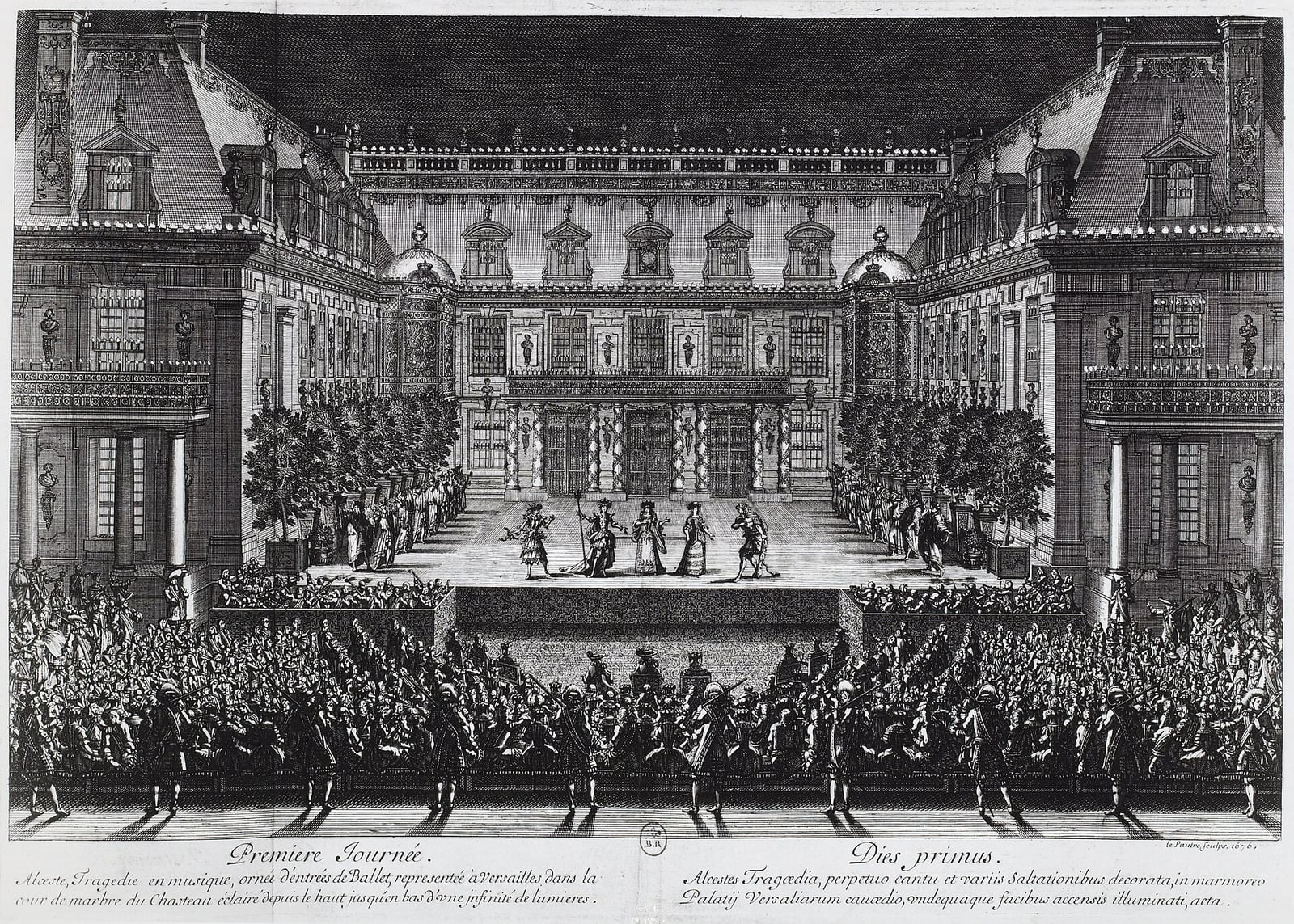
Lully Creates French Opera for Louis XIV
An Italian-born composer gave France its own operatic style.
In the spring of 1673, audiences in Paris witnessed the premiere of Cadmus et Hermione, an elaborate theatrical spectacle staged on a converted indoor tennis court at Bel-Air. Composed by the Florentine-born court musician Jean-Baptiste Lully with a libretto by playwright Philippe Quinault, the production marked a decisive turning point in European stage music. Lully had acquired the royal monopoly on operatic production the previous year, placing himself at the head of the Academie Royale de Musique. Determined to build an indigenous alternative to Italian models, he presented a unified dramatic work that established the conventions of French lyric tragedy.
Born Giovanni Battista Lulli in 1632 into a Tuscan family of millers, the musician was brought to France as a boy in the mid-1640s by the Chevalier de Guise to serve as an Italian conversationalist and chamber boy for the cousin of Louis XIV, Mademoiselle de Montpensier. During his years in her household, he developed his abilities as a violinist, guitarist, and dancer. After petitioning to leave her service following the political turmoil of the Fronde, Lully secured a place at the royal court. By February 1653, he was dancing alongside the young king in the Ballet royal de la nuit, earning an appointment as royal composer of instrumental music only weeks later.

Keep reading in Yester
Coming soon to the App Store
Keep following the story

Sources
- Salle du Jeu de Paume de Béquet ou Salle du Bel-Air (Opéra national de Paris)
- Jean-Baptiste Lully, The Sun King's musician (Château de Versailles)
- Lully, Jean Baptiste (Encyclopedia.com, from Baker's Biographical Dictionary of Musicians and New Catholic Encyclopedia)
- Jean-Baptiste Lully: the Baroque composer who died of gangrene after stabbing his foot with a conducting stick (Classic FM)
- Jean-Baptiste Lully
Image: Jean Le Pautre