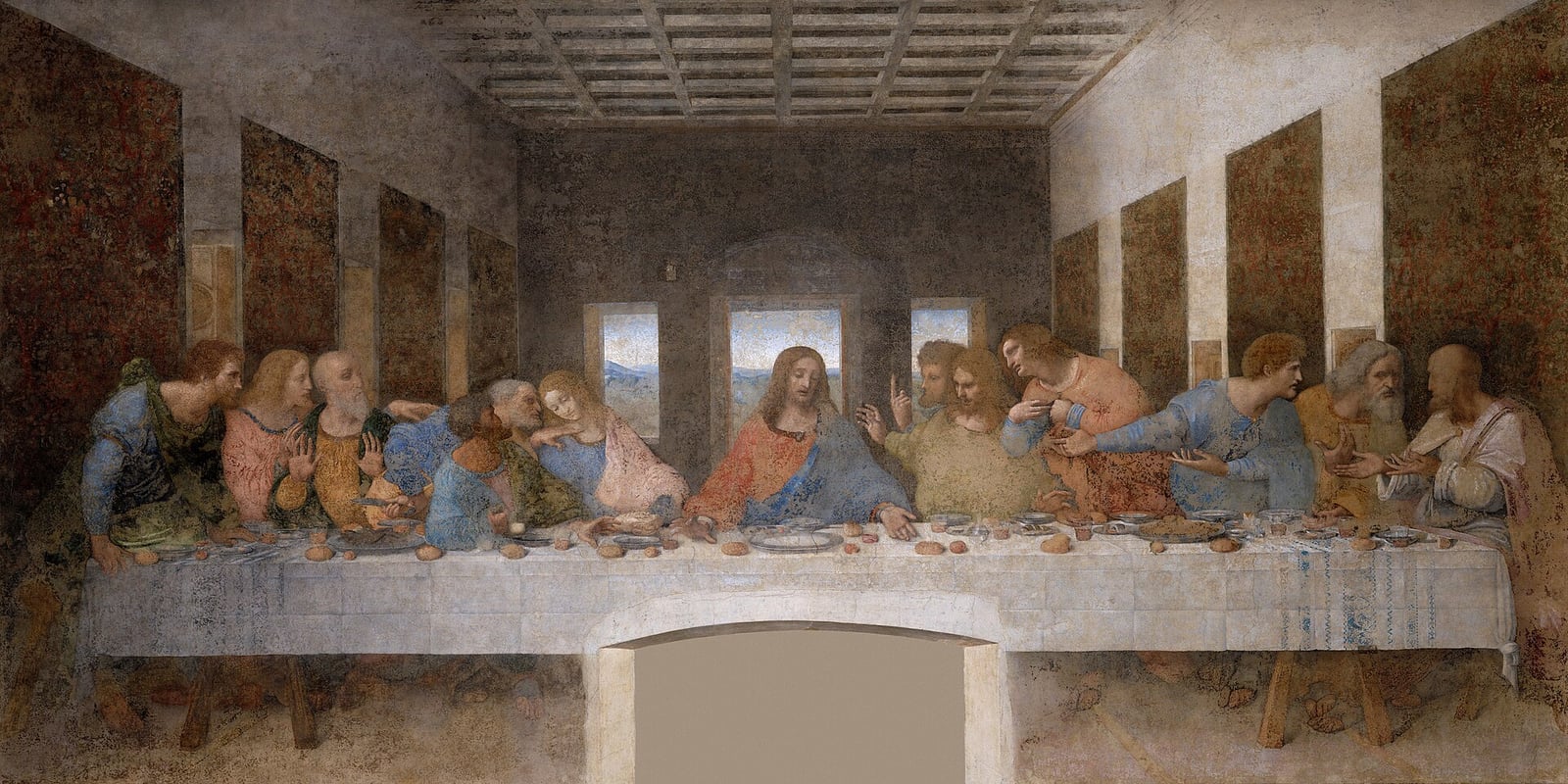
Leonardo Finishes The Last Supper in Milan
His experimental paint on a refectory wall began flaking within decades.
Between roughly 1495 and 1498, Leonardo da Vinci executed a monumental painting across an end wall of the dining hall at the convent of Santa Maria delle Grazie in Milan. Commissioned by Ludovico Sforza, Duke of Milan, the work formed part of a grand renovation scheme intended to convert the Dominican church into a family mausoleum. Sforza chose the traditional monastic subject of the Last Supper, but Leonardo broke sharply from convention in both dramatic staging and technique, creating an expansive scene measuring 460 by 880 centimeters.
Rather than adopting the durable practice of true fresco, which required applying water-based pigments rapidly onto wet plaster, Leonardo sought a medium that permitted deliberate revision, subtle transitions in light and shade, and luminous color. He sealed the masonry wall with an undercoating of gesso, pitch, and mastic, followed by a layer of white lead, and then painted with tempera. A similar experimental approach had been cautioned against in the fourteenth century by writer Cennino Cennini, who noted that painting across dry surfaces carried severe hazards. Leonardo's deliberate process permitted adjustments, but the moisture-retaining masonry beneath the wall quickly proved catastrophic for the paint film.

Keep reading in Yester
Coming soon to the App Store
Keep following the story
Sources
Image: Leonardo da Vinci