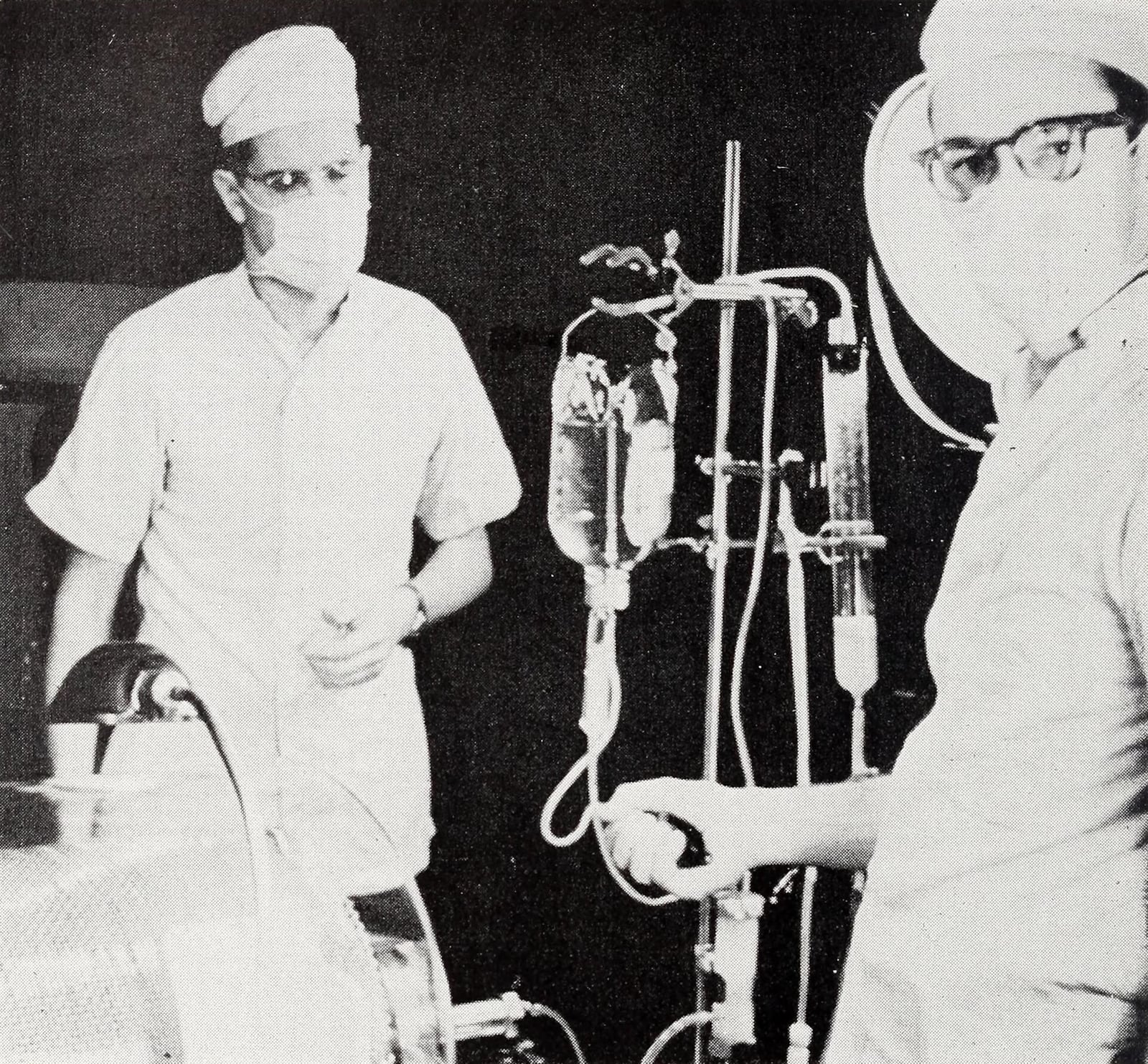
Willem Kolff Saves a Patient with an Artificial Kidney
A dialysis machine built in wartime kept a patient alive.
During the German occupation of the Netherlands in the Second World War, physician Willem Johan Kolff worked under difficult clinical conditions in the small city of Kampen. Kolff, who had studied medicine in Leiden and conducted his residency in internal medicine at the University of Groningen, had watched a young patient die of chronic renal failure. The experience convinced him that medical science required a way to substitute for failed kidneys, leading him to construct experimental blood-filtering equipment from salvaged household and mechanical components.
Kolff assembled his first working prototype dialyzer in 1943. Because specialized medical manufacturing was virtually nonexistent under wartime restrictions, he built the apparatus using cellophane sausage casings to serve as semipermeable membranes, wooden slats, a water tank from a local enamel factory, and parts from a Ford car. Blood drawn from the patient passed through the long casing wound around a rotating wooden drum submerged in a bath of dialysate fluid, which washed away accumulated waste products such as urea through simple diffusion.

Keep reading in Yester
Coming soon to the App Store
Keep following the story
Sources
- Hemodialysis for treating end-stage kidney disease, 2002 Lasker Award (Lasker Foundation)
- Artificial kidney (Rijksmuseum Boerhaave)
- Willem J. Kolff, historical vignette (PubMed Central)
- Mount Sinai's Role in Hemodialysis: From the First Treatment in the United States to Continuing Innovations (Mount Sinai Health System)
- Willem J. Kolff (National Inventors Hall of Fame)
- Kolff, Willem J. (Encyclopedia of Cleveland History, Case Western Reserve University)
- Willem Johan Kolff
Image: United States Army