The Iron Lung Breathes for Polio Patients
A metal respirator kept paralyzed patients alive.
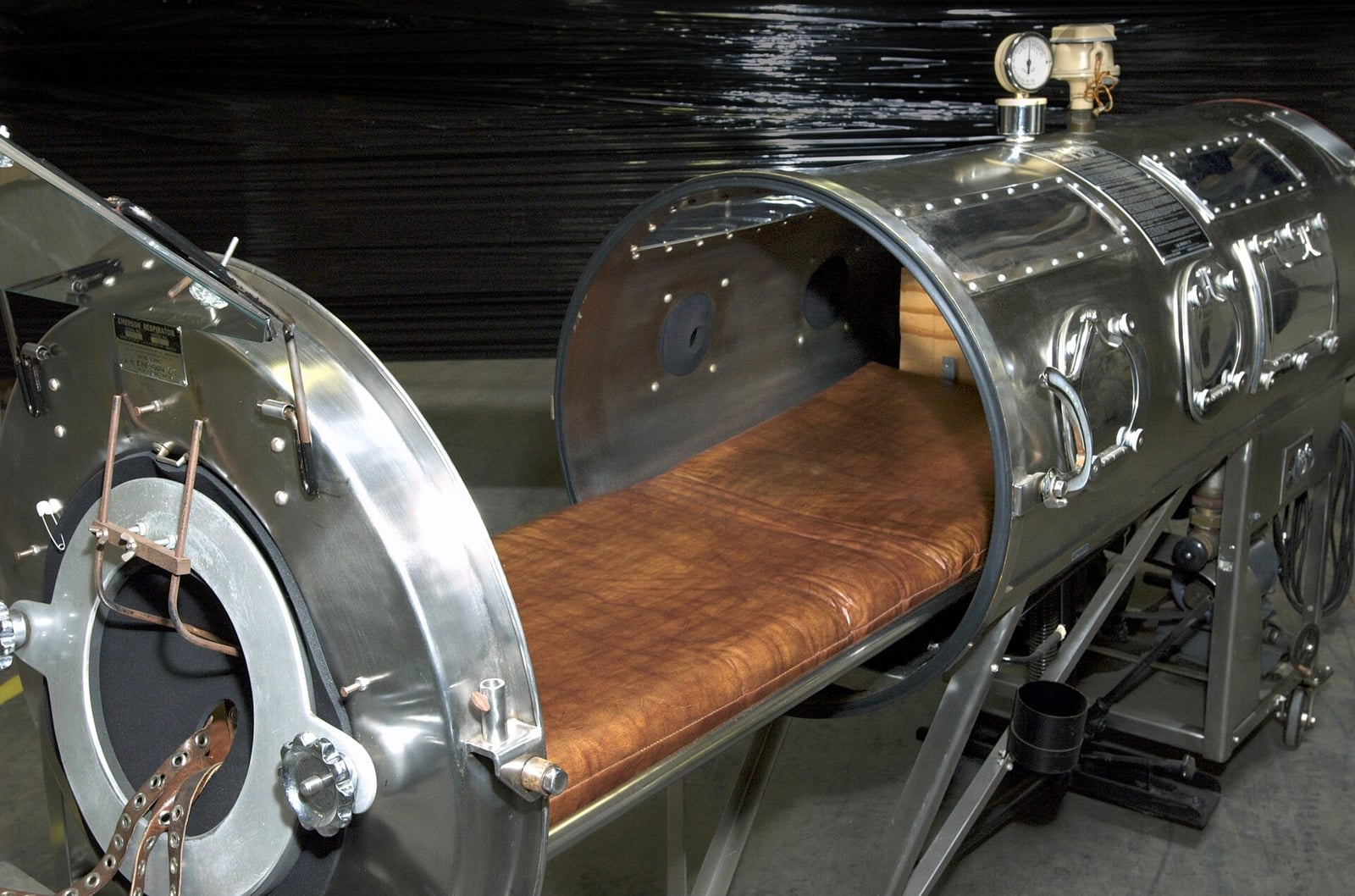
In October 1928, physicians at Boston Children's Hospital placed an eight-year-old girl suffering from respiratory failure into an experimental metal chamber. Paralyzed by poliomyelitis and close to death, her breathing improved once the machine began to run. The apparatus had been designed by Philip Drinker and Louis Agassiz Shaw Jr., two professors of industrial hygiene at the Harvard School of Public Health. Powered by an electric motor connected to vacuum-cleaner pumps, their device mechanically altered the interior air pressure to move air into and out of the patient's lungs. Following this dramatic initial test, Boston manufacturer Warren E. Collins initiated commercial production of the machine, which soon entered widespread medical use under the popular name of the iron lung.
The iron lung functioned by external negative pressure ventilation, a concept rooted in seventeenth-century experiments by English scientist John Mayow and nineteenth-century designs by physicians such as John Dalziel. The apparatus placed the patient inside a large, airtight horizontal cylinder, leaving only the head protruding through a sealed opening into ambient room air. To induce inhalation, the mechanical pump drew air out of the cylinder, producing a partial vacuum that forced the patient's chest and abdomen to expand. When the machine compressed the air inside or restored normal atmospheric pressure, the chest collapsed and forced air out through the nose and mouth. This cycle closely simulated normal human respiration, making it effective whenever paralysis incapacitated the diaphragm and surrounding muscular structures.

Keep reading in Yester
Coming soon to the App Store
Keep following the story

Sources
- Negative Pressure Ventilation (American Association for Respiratory Care Virtual Museum)
- How a Polio Outbreak in Copenhagen Led to the Invention of the Ventilator (Smithsonian Magazine)
- Breathing free (Shaastra, IIT Madras)
- 11 Lowell Road (Brookline Historical Society)
- The Both Brothers and the Iron Lung (South Australian Medical Heritage Society)
- Paralysis and Profits (Disability History Museum)
- Iron lung
Image: Photo Credit: Content Providers(s): CDC/GHO/Mary Hilpertshauser