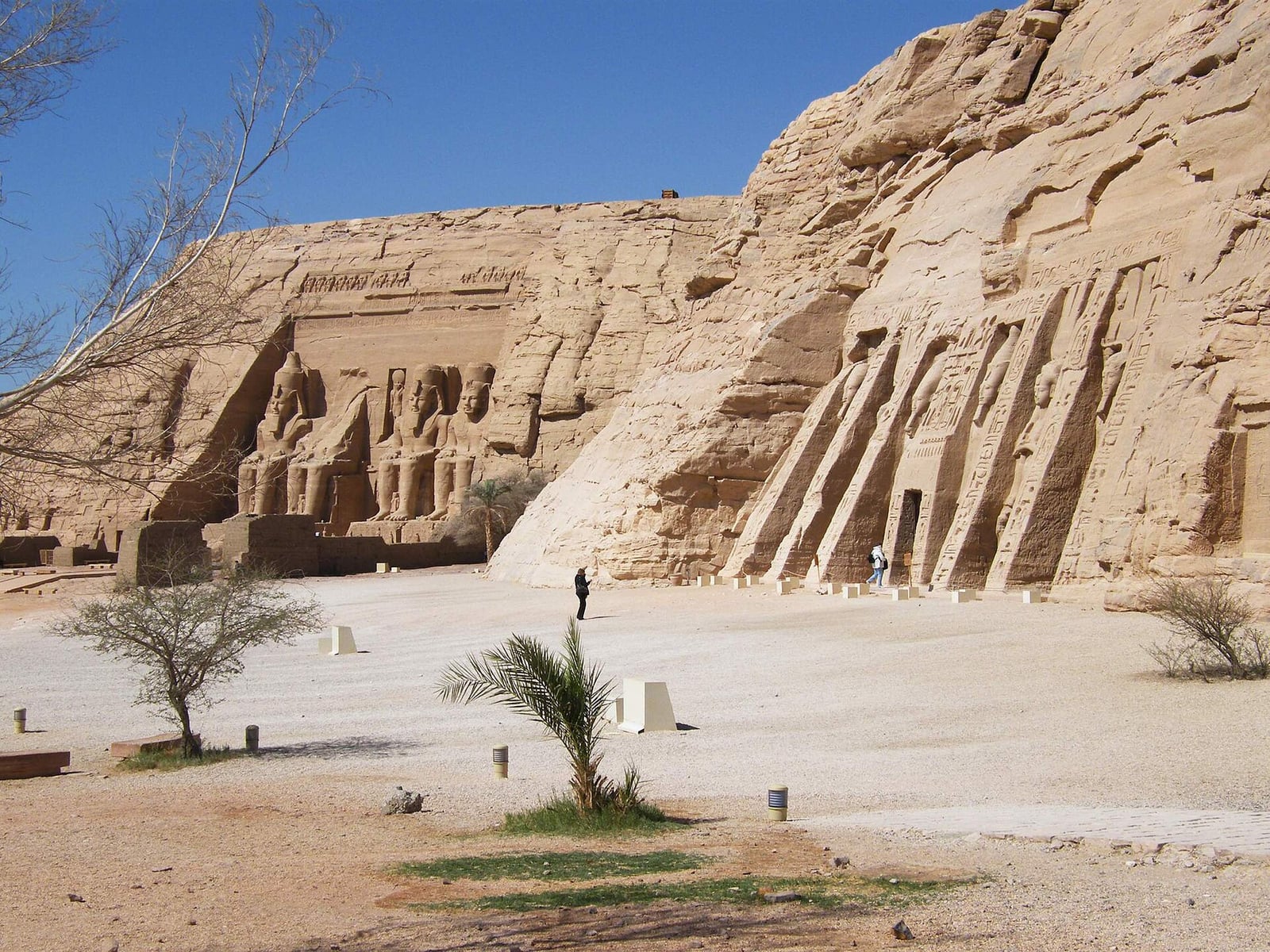
Abu Simbel Moves Above the Rising Water
An international rescue dismantled and reassembled monumental temples threatened by the Aswan High Dam.
Carved directly into the sandstone cliffs of Upper Egypt during the thirteenth century BC, the twin temples of Abu Simbel were designed as enduring assertions of imperial dominance. Constructed over roughly two decades during the Nineteenth Dynasty reign of Ramesses II, the complex marked the frontier between Lower and Upper Nubia near the Second Nile Cataract. Nubia functioned as a crucial source of gold and prestige goods for the Egyptian state, prompting Ramesses to project divine power along the river through monumental architecture. The Great Temple celebrated the deified ruler alongside prominent deities, displaying reliefs of military actions such as the Battle of Kadesh, while the adjacent Small Temple honored Hathor and Queen Nefertari.
Over subsequent millennia, shifting desert winds altered the landscape, and disuse allowed drift sand to accumulate against the cliff face. By the sixth century BC, advancing dunes reached the knees of the external seated colossi, leaving graffiti left on the statues by passing mercenaries and travelers as evidence of the site's gradual burial. By the time Swiss explorer Johann Ludwig Burckhardt reached the spot in March 1813, the Great Temple had vanished almost entirely beneath sand, with only its upper frieze and the heads of the exterior figures visible. Burckhardt reported what he had observed to other travelers, prompting a sequence of early nineteenth-century European attempts to clear the doorway.

Keep reading in Yester
Coming soon to the App Store
Keep following the story
Sources
- Working Together: Abu Simbel (UNESCO World Heritage Centre)
- Nubian Monuments from Abu Simbel to Philae (UNESCO World Heritage Centre)
- The rescue of Abu Simbel: A history of restoration, exploration, and resurrection (The Past / Ancient Egypt magazine)
- Temple of Abu Simbel (Lowe Art Museum, University of Miami)
- Abu Simbel
- UNESCO: Working Together, Abu Simbel
Image: youssef_alam