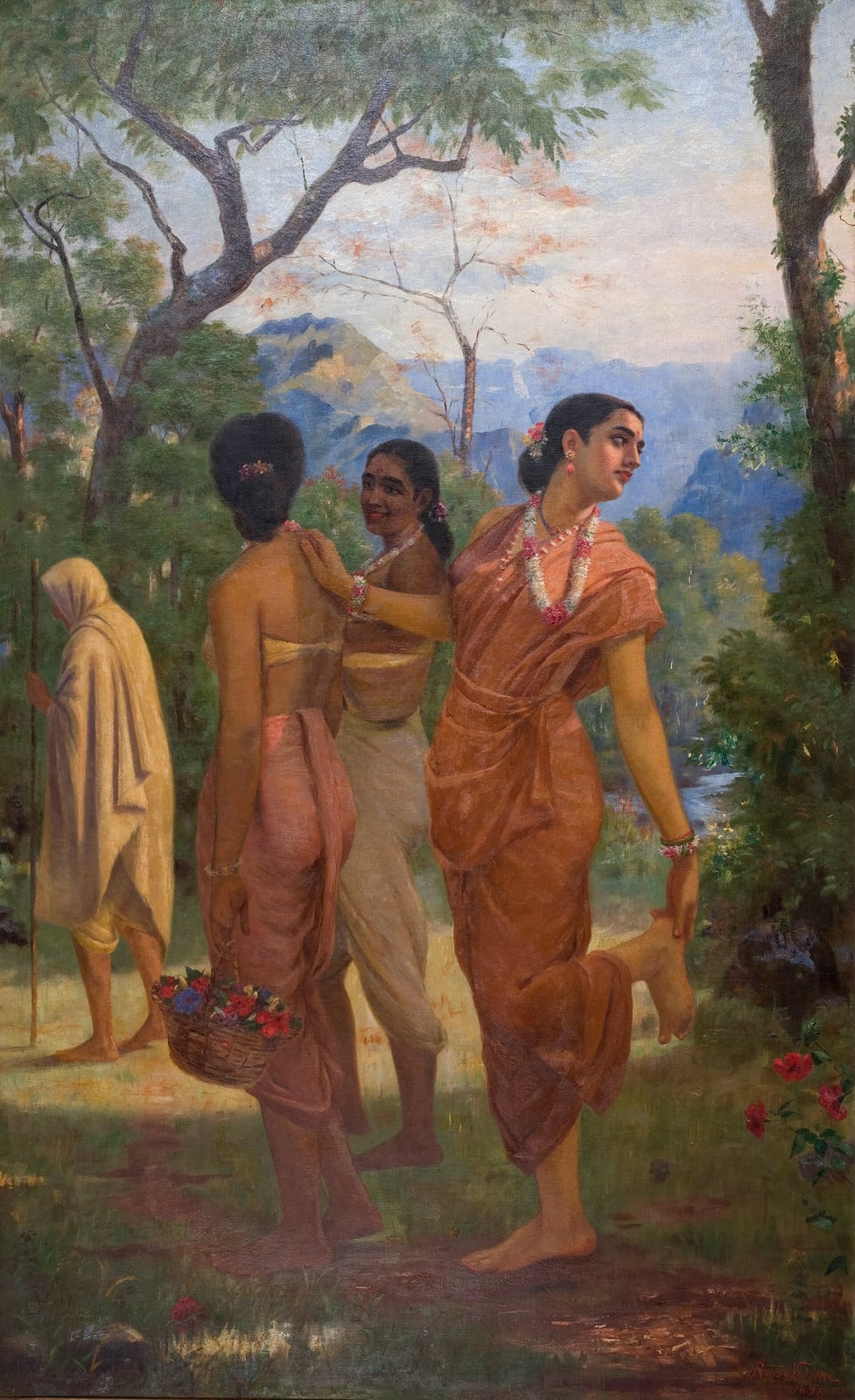
Kalidasa Gives Shakuntala a Lasting Dramatic Life
A Sanskrit play reworked an older story through recognition, separation and reconciliation.
The ancient Indian poet Kalidasa, whose life is frequently placed by scholars in the fourth century CE, transformed an established narrative tradition into the Sanskrit drama Abhijnanashakuntalam. The tale of Shakuntala had earlier formed an episode in the epic Mahabharata as well as appearing in Buddhist Jataka stories. In that broader epic context, the romance between King Dushyanta and the forest-dwelling maiden served primarily as the origin story for their son Bharata, the legendary ancestor of the rival Pandava and Kaurava lineages. Kalidasa rearranged these foundational materials into a theatrical work centered on romantic estrangement, memory, and recovery.
The dramatic action begins when King Dushyanta travels to a forest on a royal hunt and enters the hermitage of the sage Kanva. Approaching the sacred grounds dressed in modest garments to avoid disturbance, the king meets Shakuntala, who was raised by Kanva after being abandoned at birth by the sage Vishvamitra and the apsara Menaka. Dushyanta quickly woos and marries her before departing for his capital of Hastinapura. Upon his departure, he leaves her with a signet ring intended to prove her status when she travels to his court.

Keep reading in Yester
Coming soon to the App Store
Keep following the story

Sources
Image: Raja Ravi Varma