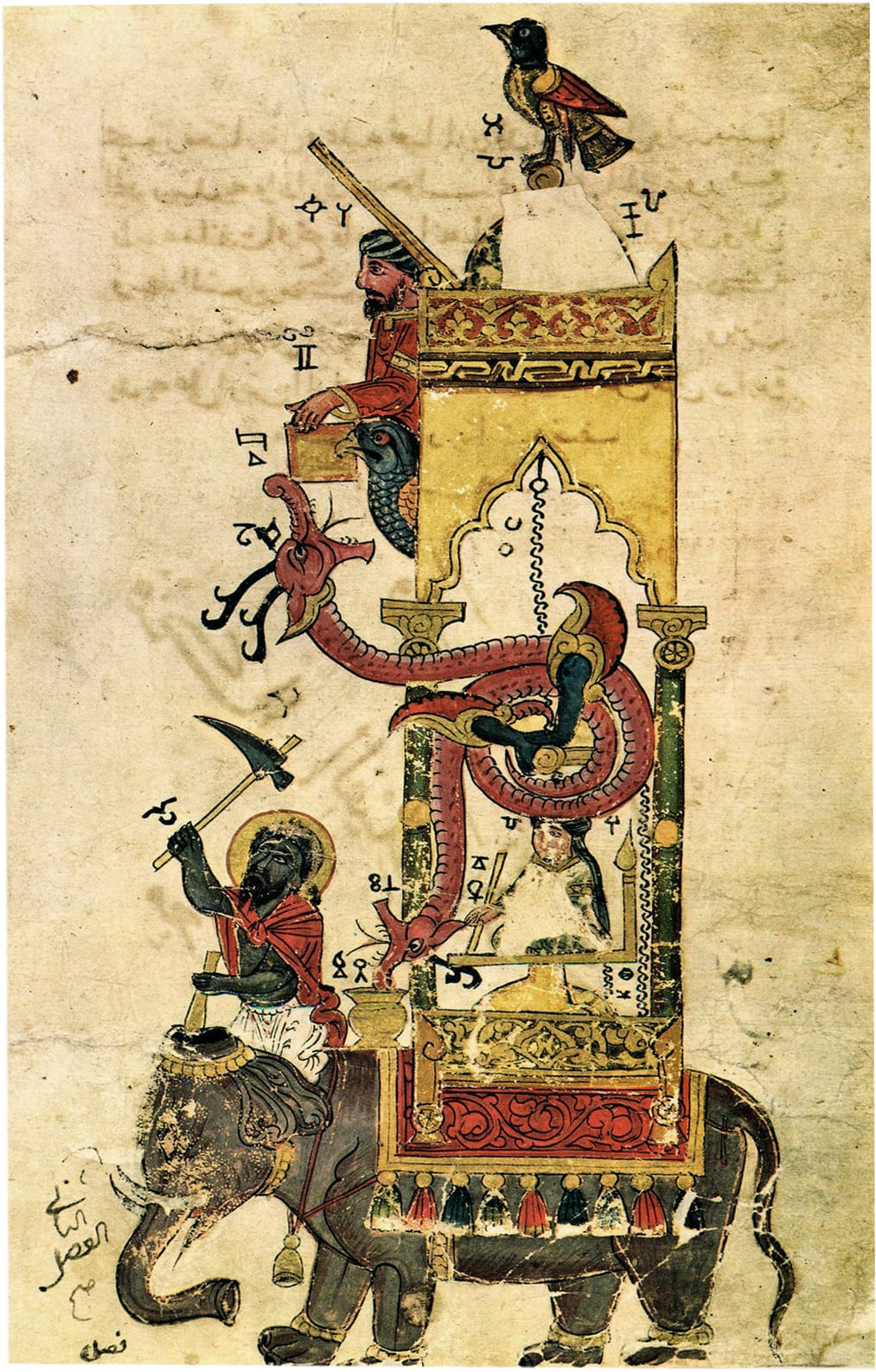
Al-Jazari Records a World of Ingenious Machines
Illustrated mechanisms joined practical water engineering with elaborate courtly displays of motion and time.
In the spring of 1206, the artisan and engineer Badi al-Zaman Abu al-Izz ibn Ismail ibn al-Razzaz al-Jazari completed an illustrated compendium of fifty mechanical apparatuses at the Artuqid court in Upper Mesopotamia. Commissioned by the Artuqid ruler Nasr al-Din Mahmud, the treatise, commonly known as The Book of Knowledge of Ingenious Mechanical Devices, drew directly upon decades of hands-on palace service. Al-Jazari followed in his father's footsteps as chief engineer at the Artuklu Palace, serving regional rulers who navigated vassalage under the Zengids and later the Ayyubid leader Saladin. The resulting manuscript, preserved in its earliest known form in the Topkapi Sarayi Library, provided practical construction guides rather than abstract mathematical treatises.
Rooted in an empirical artisan tradition, al-Jazari emphasized that he recorded only apparatuses he had built and verified himself. Modern technology historians observe that his methodology relied on physical assembly, iterative trial and error, and workshop craftsmanship rather than purely theoretical calculation. To bring his designs into reality, he established refined shop techniques, such as casting metal components within sand-filled mold boxes, using paper models and wooden templates for fabrication, laminating timber to resist warping, and grinding valve plugs with emery powder to ensure watertight seals.

Keep reading in Yester
Coming soon to the App Store
Keep following the story
Sources
Image: Al-Jazari