Insulin Changes What a Diabetes Diagnosis Can Mean
A collaborative research effort turned experimental extracts into treatment while leaving questions of credit and access unsettled.
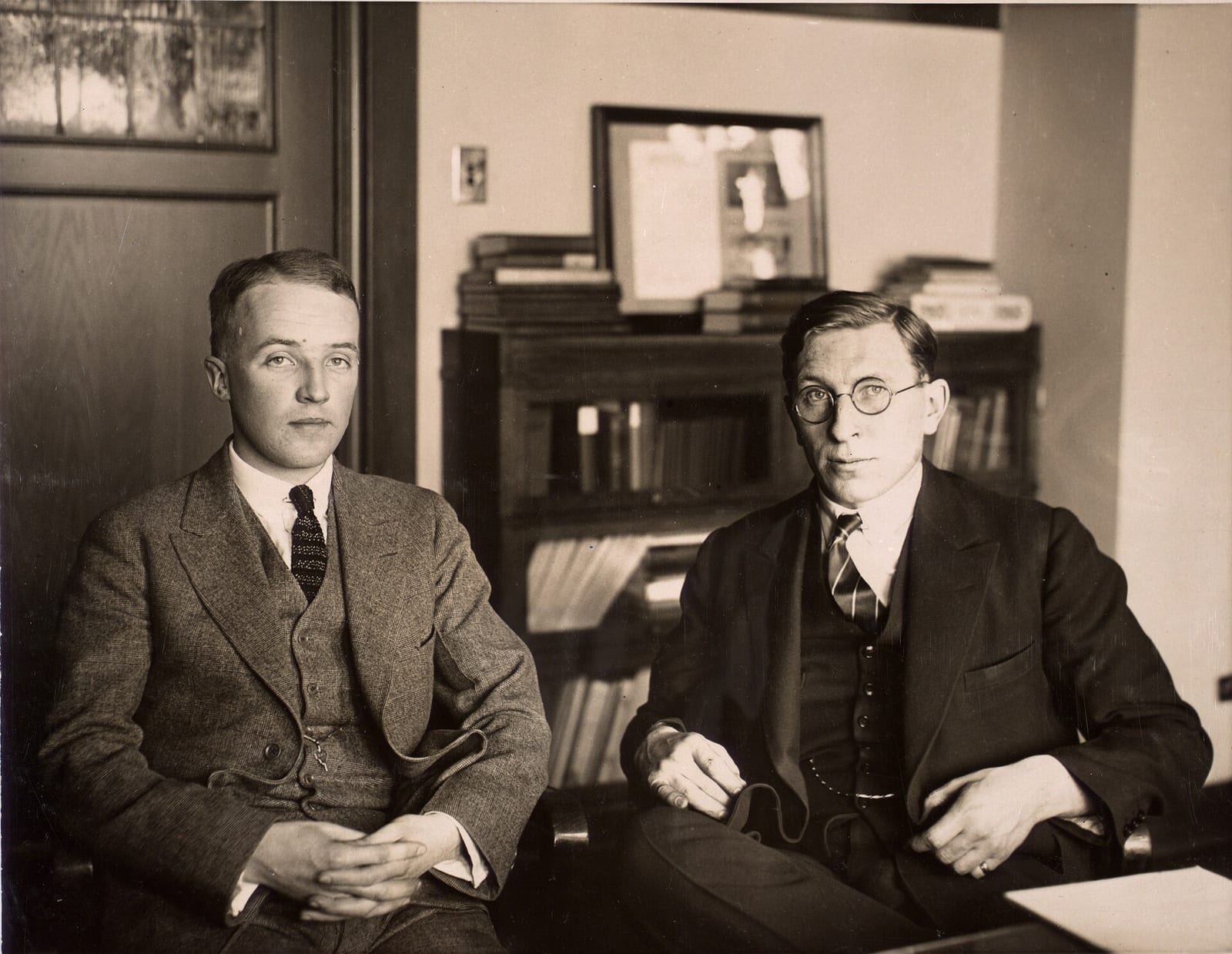
In the early hours of October 31, 1920, Canadian surgeon Frederick Banting hypothesized that digestive secretions produced by the pancreas were degrading an internal secretion essential for managing diabetes. Reasoning that tying off pancreatic ducts would trigger the atrophy of surrounding tissue while preserving the islets of Langerhans, he took the idea to the University of Toronto in November 1920 to seek facilities. John Macleod, a professor of physiology, met Banting with skepticism because the surgeon lacked a research background. Nonetheless, Macleod offered laboratory space, experimental dogs, and a student assistant for the summer of 1921. Following a coin toss between two undergraduates, Charles Best took the initial assignment and remained alongside Banting throughout the summer.
Banting and Best tied pancreatic ducts in dogs and waited weeks for the tissue to degenerate before attempting extraction. On July 30, 1921, they injected their initial preparation, labeled isletin, into a diabetic dog and observed a sharp drop in its blood sugar. When Macleod reviewed the findings in the autumn, he criticized flaws in the experimental design and urged repetitions with improved equipment. As work continued that autumn, they found that equally effective extract could be made from fresh, chilled beef or pork pancreas from slaughterhouses, making duct ligation unnecessary. At Banting's request, Macleod added biochemist James Collip to the team in December 1921 to purify the extract for human use.

Keep reading in Yester
Coming soon to the App Store
Keep following the story
Sources
- Banting, Best, Collip and Macleod (Science History Institute)
- Celebrating Western's Research History (Western University)
- The Discovery of Insulin, Michael Bliss (The Canadian Encyclopedia)
- The Nobel Prize in Physiology or Medicine 1923: Summary (Nobel Prize)
- James Bertram Collip (The Canadian Encyclopedia)
- John G. FitzGerald (The Canadian Encyclopedia)
- Insulin
Image: Unknown author