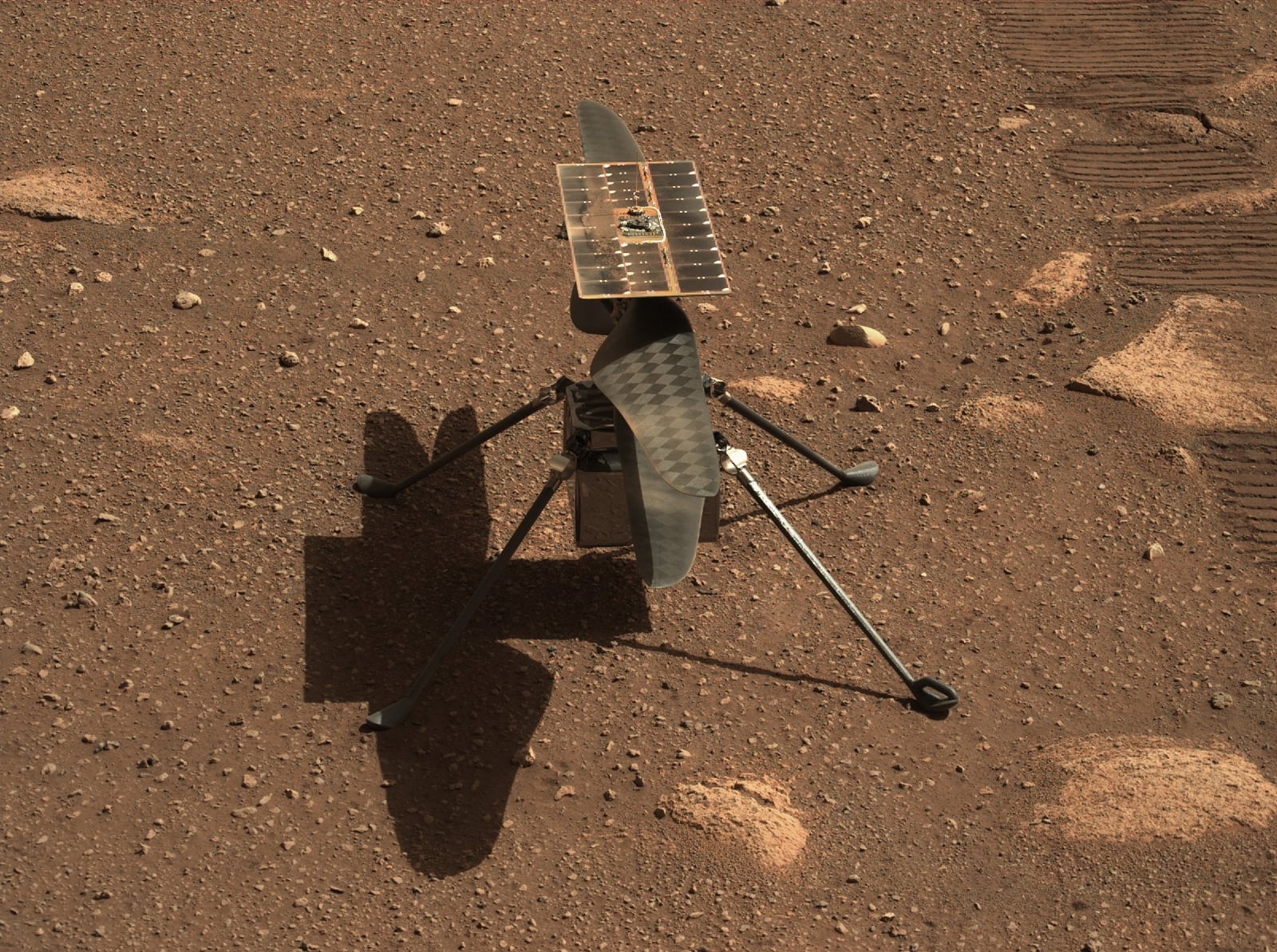
Ingenuity Makes the First Powered Flight on Another Planet
A small helicopter rose above Mars in thin air.
On 19 April 2021, a small autonomous rotorcraft named Ingenuity spun its contra-rotating blades and lifted three meters above the floor of Jezero Crater. Lingering in the Martian air for roughly forty seconds before settling back onto the regolith, the machine completed the first powered, controlled flight by an aircraft on another world. Designed primarily as an engineering proof of concept by NASA's Jet Propulsion Laboratory in partnership with AeroVironment, the brief hover marked a critical milestone in extraterrestrial exploration.
Achieving aerodynamic lift on Mars required overcoming severe environmental barriers. Although the planet possesses roughly one-third of Earth's gravity, its atmosphere is composed of about ninety-five percent carbon dioxide and exhibits a density only one percent of that found at terrestrial sea level. Because the air at the Martian surface is as thin as Earth's atmosphere about 30,000 meters (100,000 feet) up, generating adequate lift demanded lightweight construction and custom, enlarged rotor blades. To stay aloft, Ingenuity spun its rotors at more than 2,500 revolutions per minute on its first flight, and NASA described its design speed of almost 3,000 rpm as about ten times the rate of a helicopter on Earth.

Keep reading in Yester
Coming soon to the App Store
Keep following the story
Sources
- Ingenuity Mars Helicopter (NASA Science)
- Mars Helicopter to Fly on NASA's Next Red Planet Rover Mission (NASA)
- NASA Performs First Aircraft Accident Investigation on Another World (NASA)
- NASA's Ingenuity Mars Helicopter Team Says Goodbye ... for Now (NASA JPL)
- Ingenuity Mars Helicopter: First Flight on Mars (Sky & Telescope)
- Ingenuity (helicopter)
Image: NASA/JPL-Caltech/ASU/MSSS