Curiosity Lands on Mars with a Sky Crane
A car-sized rover was lowered onto Mars to look for signs of past habitability.
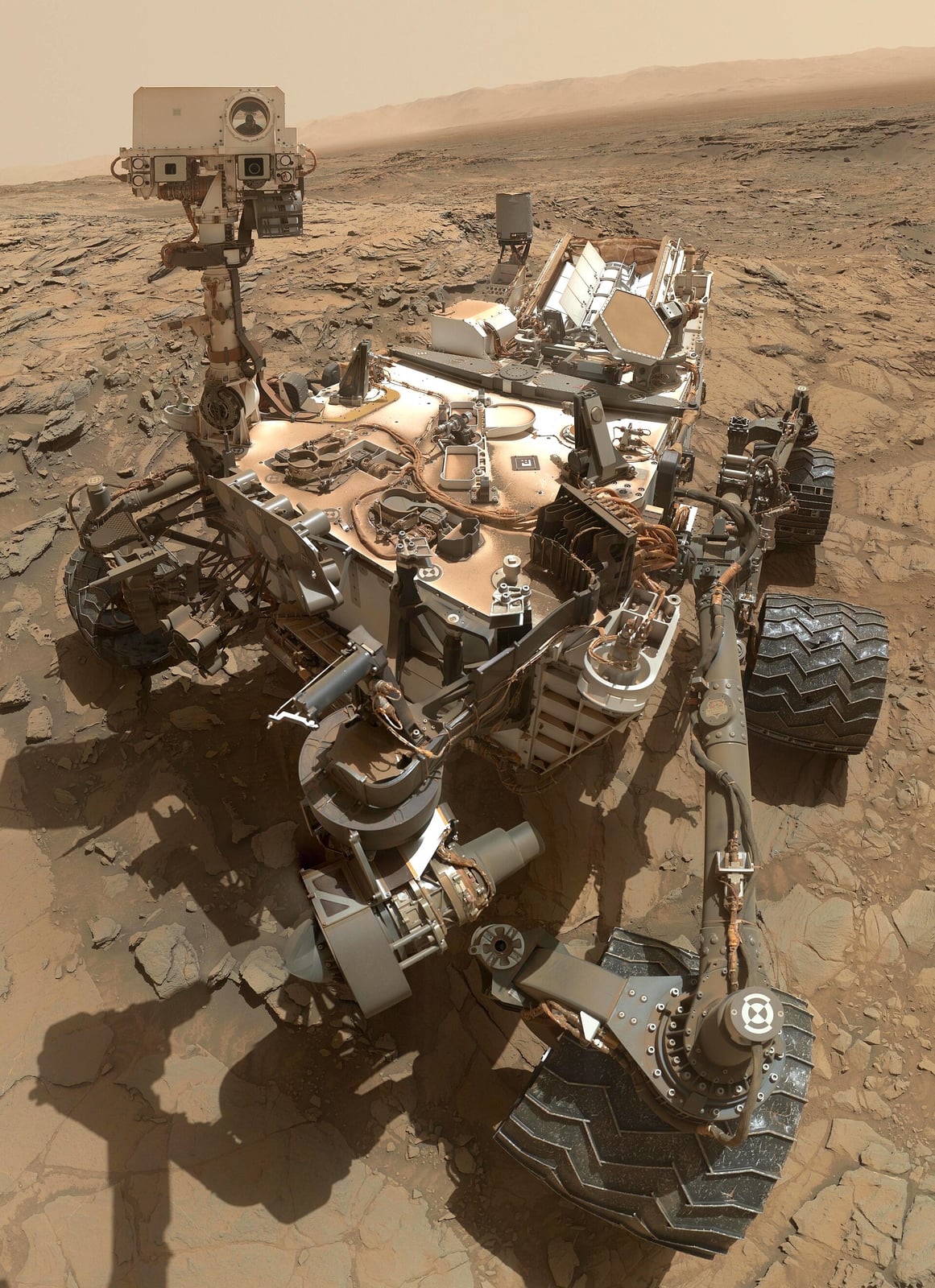
On August 6, 2012, NASA landed its Mars Science Laboratory rover inside Gale crater on the red planet. Named Curiosity through an essay contest won by twelve-year-old Clara Ma, the machine touched down at a spot later named Bradbury Landing in honor of the science fiction author Ray Bradbury. The rover, with a mass of 899 kilograms, was delivered by a rocket-powered descent stage known as a sky crane, which hovered on its rocket engines and lowered the rover onto its wheels on a bridle about 7.5 meters (25 feet) long before the bridle was cut and the descent stage flew off to stay clear of the landing site.
Unlike its smaller predecessors, Curiosity was set down directly on its six wheels, which ride on a rocker-bogie suspension designed for rough, rocky terrain. Engineers cut patterned holes into the wheels that left tracks readable by on-board cameras to calculate distance, spelling the letters JPL in Morse code. Curiosity represented a substantial leap in scale over earlier rovers like Opportunity, measuring about 3 meters (10 feet) long and carrying 10 science instruments.

Keep reading in Yester
Coming soon to the App Store
Keep following the story

Sources
- Mars Science Laboratory: Curiosity Rover (NASA Science)
- Curiosity's Sky Crane Maneuver, Artist's Concept (NASA Science)
- NASA Mars Rover Begins Driving at Bradbury Landing (NASA Jet Propulsion Laboratory)
- NASA Finds Ancient Organic Material, Mysterious Methane on Mars (NASA)
- Mars 2020 Perseverance Rover Components (NASA Science)
- Powering Curiosity: Multi-Mission Radioisotope Thermoelectric Generators (U.S. Department of Energy)
- NASA's Curiosity Rover on Mars Sidelined By 'Short Circuit' Glitch (Space.com)
- Curiosity (rover)
Image: NASA