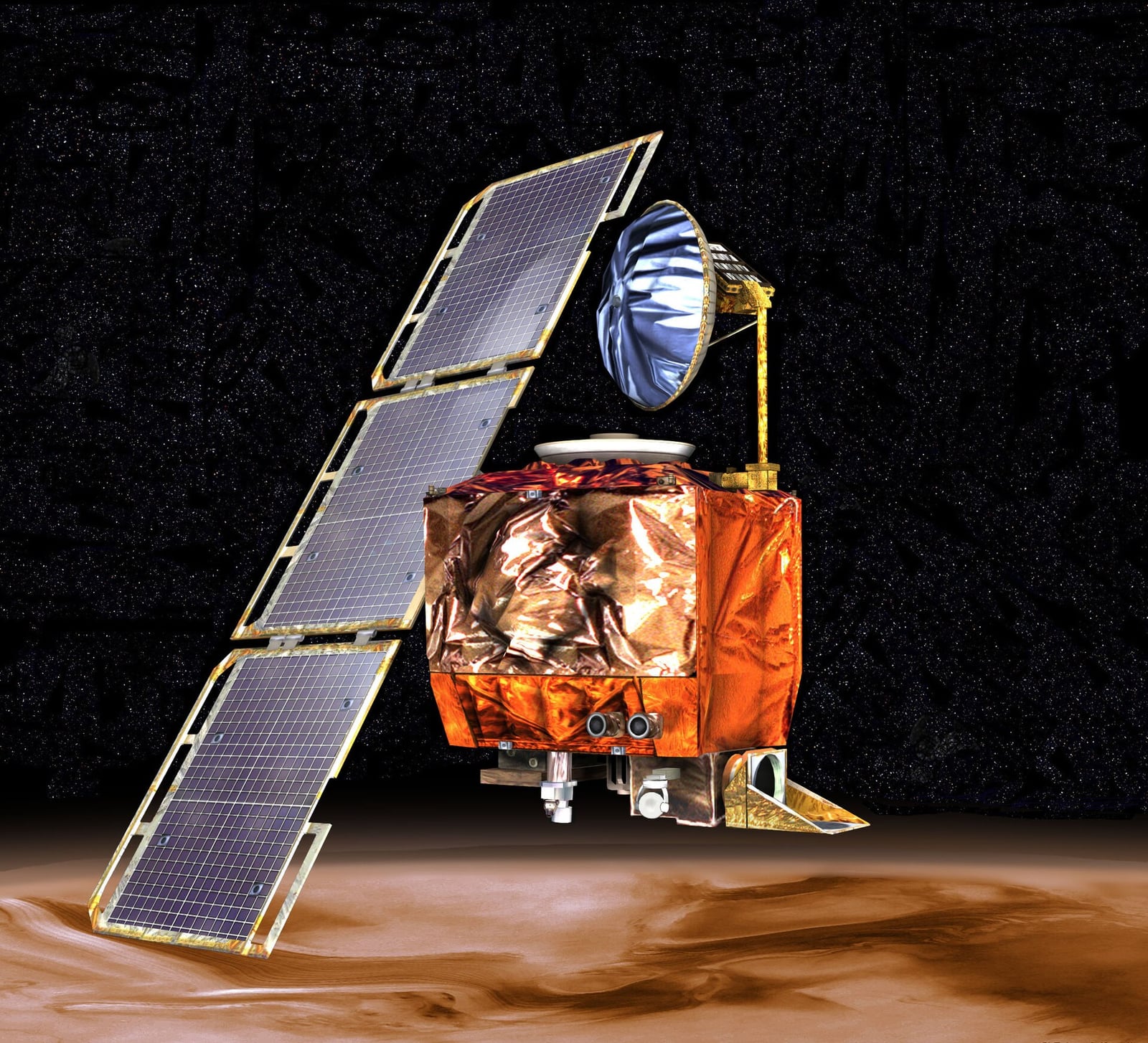
A Units Mix-up Dooms the Mars Climate Orbiter
A spacecraft was lost because one team used imperial units and another metric.
On December 11, 1998, a Delta II rocket lifted off from Cape Canaveral carrying the robotic Mars Climate Orbiter. The probe was designed to study the atmosphere, climate patterns, and surface changes of the red planet while serving as a communications relay for the upcoming Mars Polar Lander. Weighing about 630 kilograms at launch, the probe was part of a broader effort by NASA during the 1990s to develop smaller, less expensive interplanetary missions following the loss of Mars Observer and amid rising expenditures for the International Space Station.
The journey through deep space toward Mars took about nine and a half months and covered more than 660 million kilometers. Science instruments aboard the spacecraft included the Pressure Modulated Infrared Radiometer and the Mars Color Imager. These payloads were intended to map atmospheric temperatures, measure dust and water vapor distributions, and photograph the landscape. Energy was supplied by a three-panel solar array that delivered an average of 500 watts, while propulsion relied on monopropellant hydrazine thrusters and a main liquid-fuel engine designed for orbit insertion.

Keep reading in Yester
Coming soon to the App Store
Keep following the story
Sources
- Mars Climate Orbiter (NASA Space Science Data Coordinated Archive)
- Mars Climate Orbiter Team Finds Likely Cause of Loss (NASA Jet Propulsion Laboratory)
- Mars Climate Orbiter failure board releases report (NASA press release, via SpaceNews archive)
- How a unit mismatch doomed Mars Climate Orbiter (Space Daily)
- Mars Climate Orbiter gets lost (FlightGlobal)
- Overload caused Mars failures (FlightGlobal)
- CNN transcript, 28 March 2000: Mars Program Independent Assessment Team findings (CNN)
- Mars Climate Orbiter
Image: NASA/JPL/Corby Waste