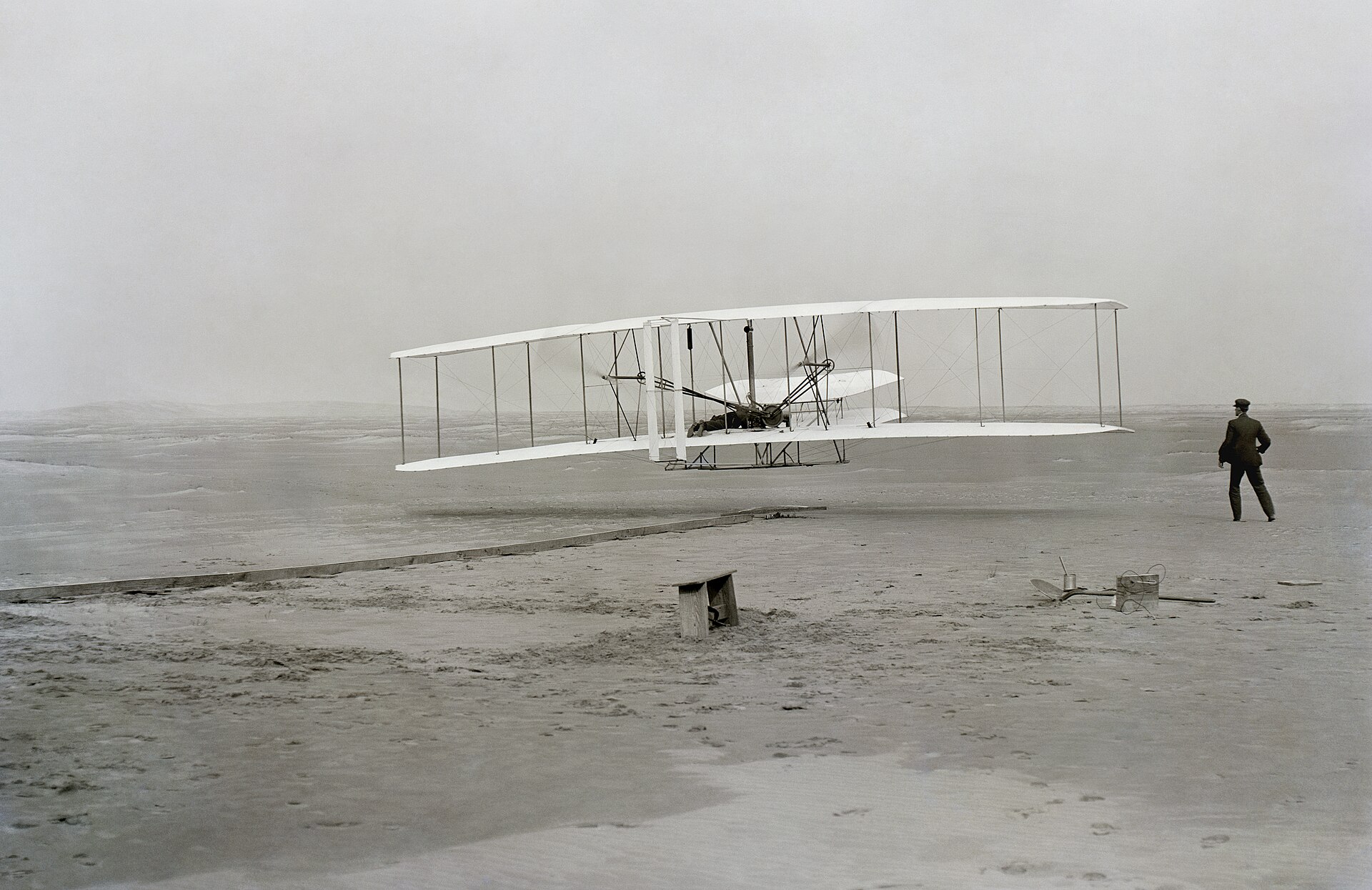
Twelve Seconds That Changed Flight
At Kill Devil Hills, Wilbur and Orville Wright successfully operated a powered aircraft capable of being guided by its pilot. Their brief airborne runs established that sustained mechanical flight was an achievable, repeatable reality.
Before building a powered machine, Wilbur and Orville Wright approached aviation through repeated experiments with gliders. They recognized that an aircraft required more than lift, focusing their efforts on providing a pilot with reliable methods to manage balance and direction. Rather than attempting a daring jump, they treated the challenge of flight as a technical problem to test.
By 1903, their work produced the Flyer, an aircraft built around its pilot, who lay prone across the lower wing. The craft integrated a light engine, propellers, wings, and a dedicated control system. While its exposed structure bore little resemblance to later airplanes, the design was built specifically to achieve sustained, controlled powered movement.

Keep reading in Yester
Coming soon to the App Store
Keep following the story
Sources
Image: John T. Daniels