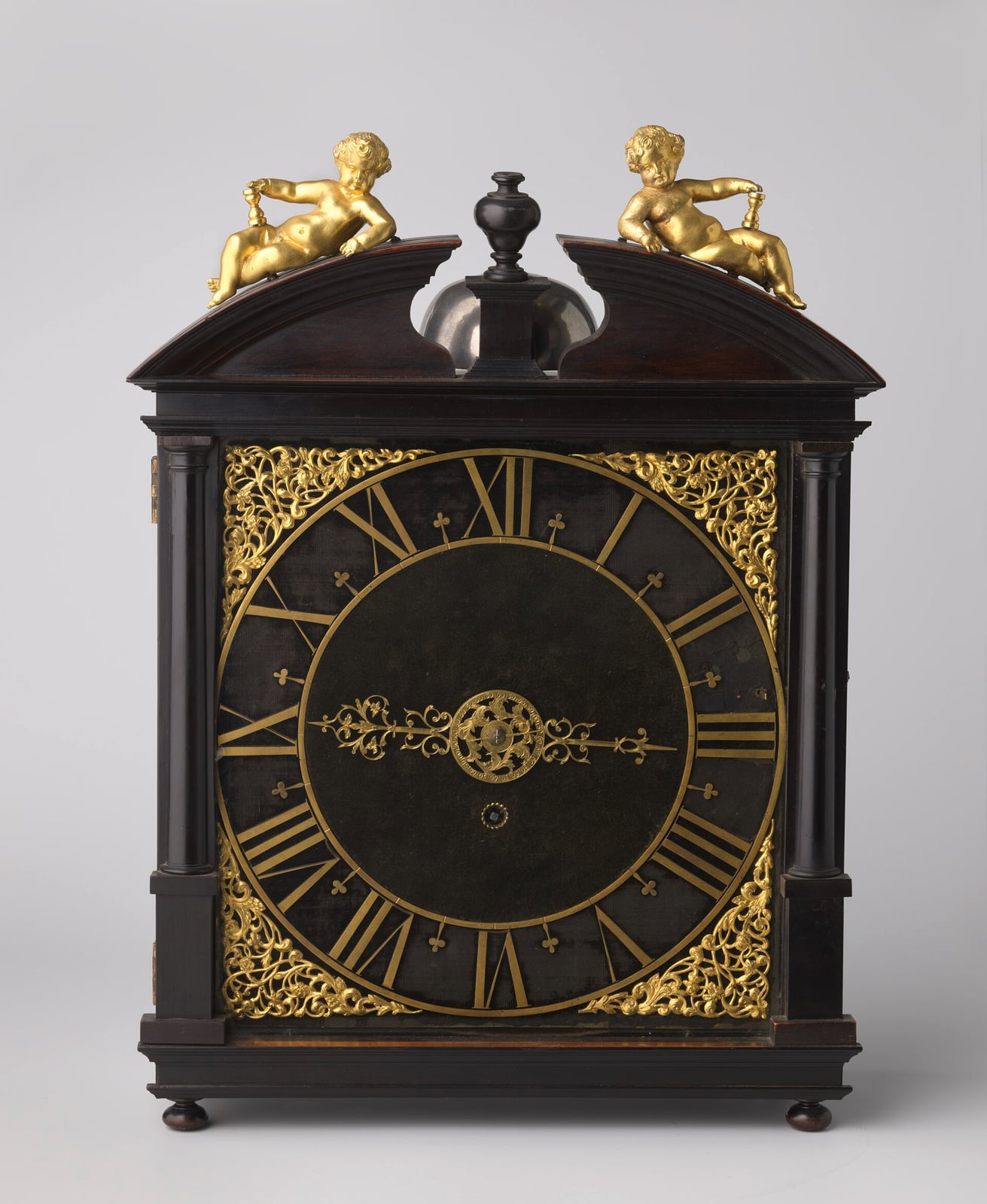
Huygens Builds a Pendulum Clock
A new regulator greatly improved the measurement of time.
On 25 December 1656, Dutch scientist and inventor Christiaan Huygens designed the first functional pendulum clock. Prior to this development, mechanical timekeeping relied largely on verge and foliot mechanisms, which drifted by approximately fifteen minutes each day. Such variance made the inclusion of minute and second indicators impractical, despite earlier commissions requesting them. Huygens contracted the physical construction of his initial timepiece to the Hague clockmaker Salomon Coster and obtained a patent for the invention the following year. He subsequently published a full description of the mechanism in his 1658 treatise, Horologium.
Huygens drew inspiration from Galileo Galilei, who had observed around 1602 that pendulums swing isochronically, maintaining a consistent period regardless of the amplitude of their motion. While Galileo conceptualized a swinging mechanism for his son Vincenzo in 1637, which Vincenzo only partially constructed in 1649, Huygens was the first to integrate the pendulum successfully into an operational clock. By functioning as a harmonic oscillator whose period depends primarily on its effective length, the pendulum reduced daily timing errors from about a quarter of an hour to just a few minutes. The dramatic gain in precision led to swift adoption, with clockmakers across Europe retrofitting existing verge movements with pendulums.

Keep reading in Yester
Coming soon to the App Store
Keep following the story

Sources
- Christian Huygens, Scientist of the Day (Linda Hall Library)
- The invention of the pendulum clock (The Seiko Museum Ginza)
- The Shortt-Synchronome Free Pendulum Clock (The Seiko Museum Ginza)
- Longcase clock by Joseph Knibb, c. 1675, museum number 1958,1006.2100 (British Museum)
- Time stands still (National Trust for Scotland)
- Pendulum clock
Image: Rijksmuseum