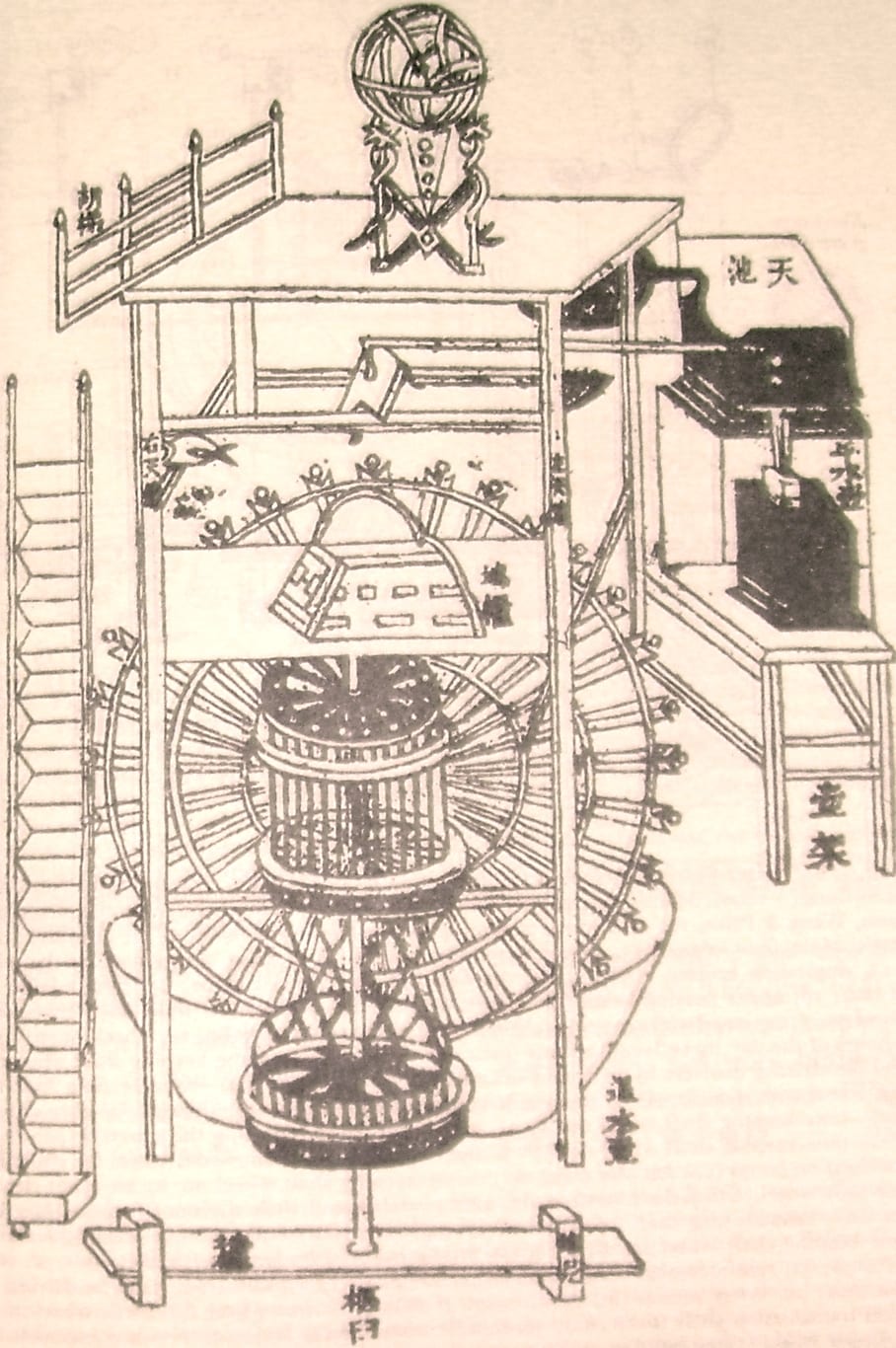
Su Song Builds a Clock Tower for the Heavens
A water-powered astronomical tower brought mechanisms, observation and the measurement of time together.
In 1086, Emperor Zhezong of the Song dynasty commissioned the scholar-official Su Song to reconstruct an armillary clock for the imperial capital of Kaifeng. Su, an accomplished administrator and polymath, took charge of an ambitious engineering effort that brought together celestial observation, timekeeping, and mechanical power. The resulting structure, a water-powered astronomical clock tower rising forty feet high, was tested through a wooden prototype in 1088, equipped with bronze components cast by 1090, and fully completed by 1094. Su set down a thorough record of the apparatus in his 1092 treatise, Xinyi Xiangfayao.
The tower operated by harnessing a steady stream of water to turn a large driving wheel eleven feet in diameter, fitted with thirty-six scoops. To achieve consistent motion from a fluid source, the mechanism employed an escapement system developed earlier in the Tang dynasty by Yi Xing and Liang Lingzan, which held and released the wheel through a balance of counterweights as each scoop filled. Su acknowledged older traditions of water-driven celestial apparatus, explicitly citing the hydraulic armillary sphere of Zhang Heng from the second century, while introducing novel refinements to coordinate the movements of the sky with mechanical gearwork.

Keep reading in Yester
Coming soon to the App Store
Keep following the story
Sources
Image: Su Song