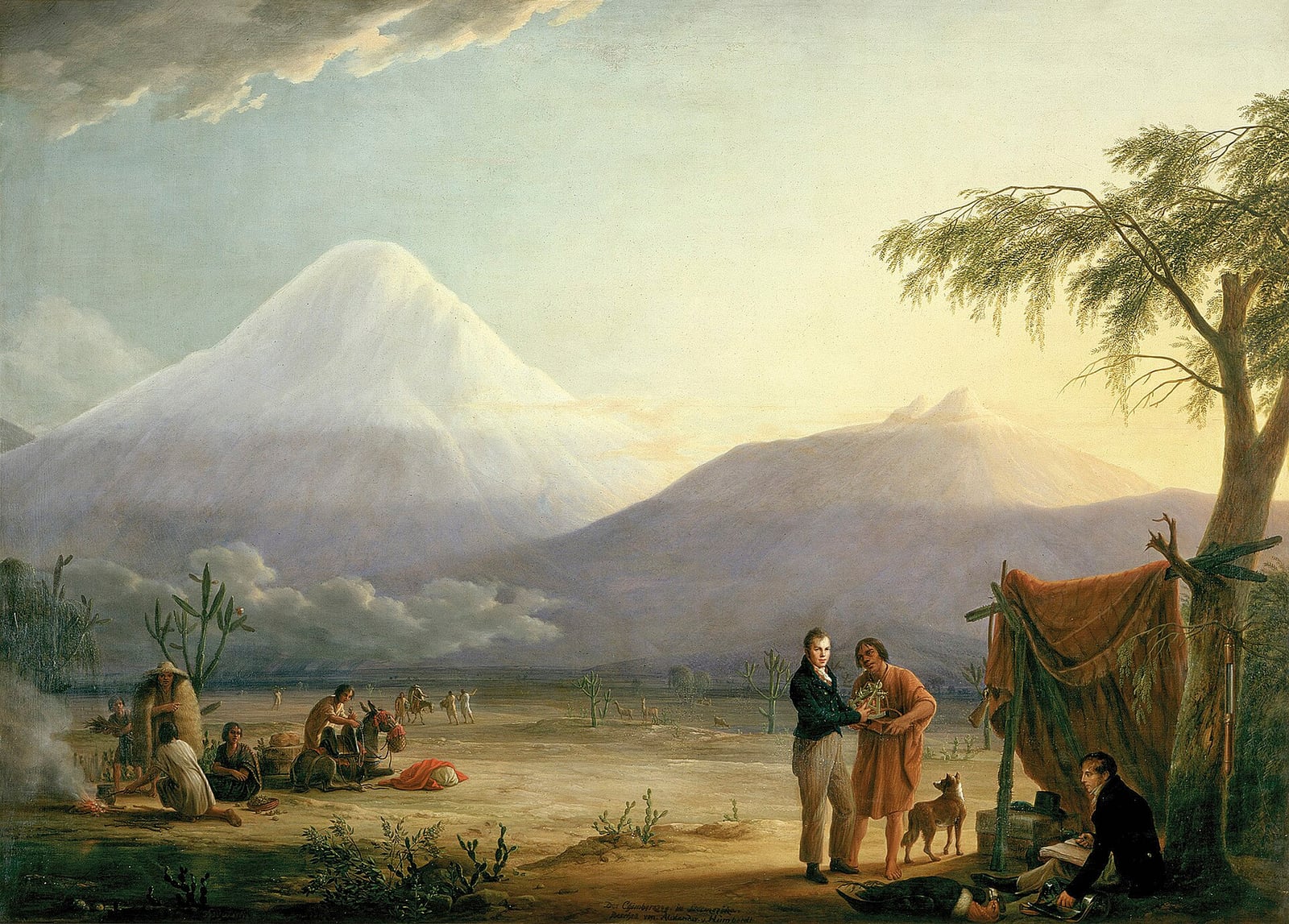
Humboldt Climbs Chimborazo and Maps Life by Altitude
A mountain ascent fed a new way of connecting climate, plants and place.
In 1802, the Prussian naturalist Alexander von Humboldt undertook an ascent of Chimborazo in modern Ecuador, climbing alongside the French botanist Aimé Bonpland. Humboldt later presented the climb as having reached the highest altitude yet attained by anyone, although the party did not attain the summit of the Andean peak. Rather than treating the mountain merely as an isolated obstacle, Humboldt observed its dramatic vertical rise as an integrated laboratory for studying the physical world. The climb concentrated years of fieldwork across Spanish America into a direct encounter with the systematic shifts that govern vegetation, air pressure, and temperature as one ascends through different elevations.
Humboldt and Bonpland had set out in 1799 on a five-year expedition through the forests and mountains of tropical America, making physical measurements, natural history observations and plant collections. Before reaching the northern Andes, the two travelers explored the Orinoco River in South America. During those stages, Humboldt gathered botanical samples, documented waterways, and noted the soil, rainfall, humidity and altitude where plants grew, laying the groundwork for interpreting nature as a deeply interconnected whole.

Keep reading in Yester
Coming soon to the App Store
Keep following the story

Sources
- Strong upslope shifts in Chimborazo's vegetation over two centuries since Humboldt (PNAS, 2015, via PubMed Central)
- Humboldt's Tableau Physique revisited (PNAS, 2019, via PubMed Central)
- Scientist of the Day: Alexander von Humboldt (Linda Hall Library)
- Scientist of the Day: Aime Bonpland (Linda Hall Library)
- Alexander von Humboldt (Darwin Correspondence Project, University of Cambridge)
- Alexander von Humboldt
Image: Friedrich Georg Weitsch