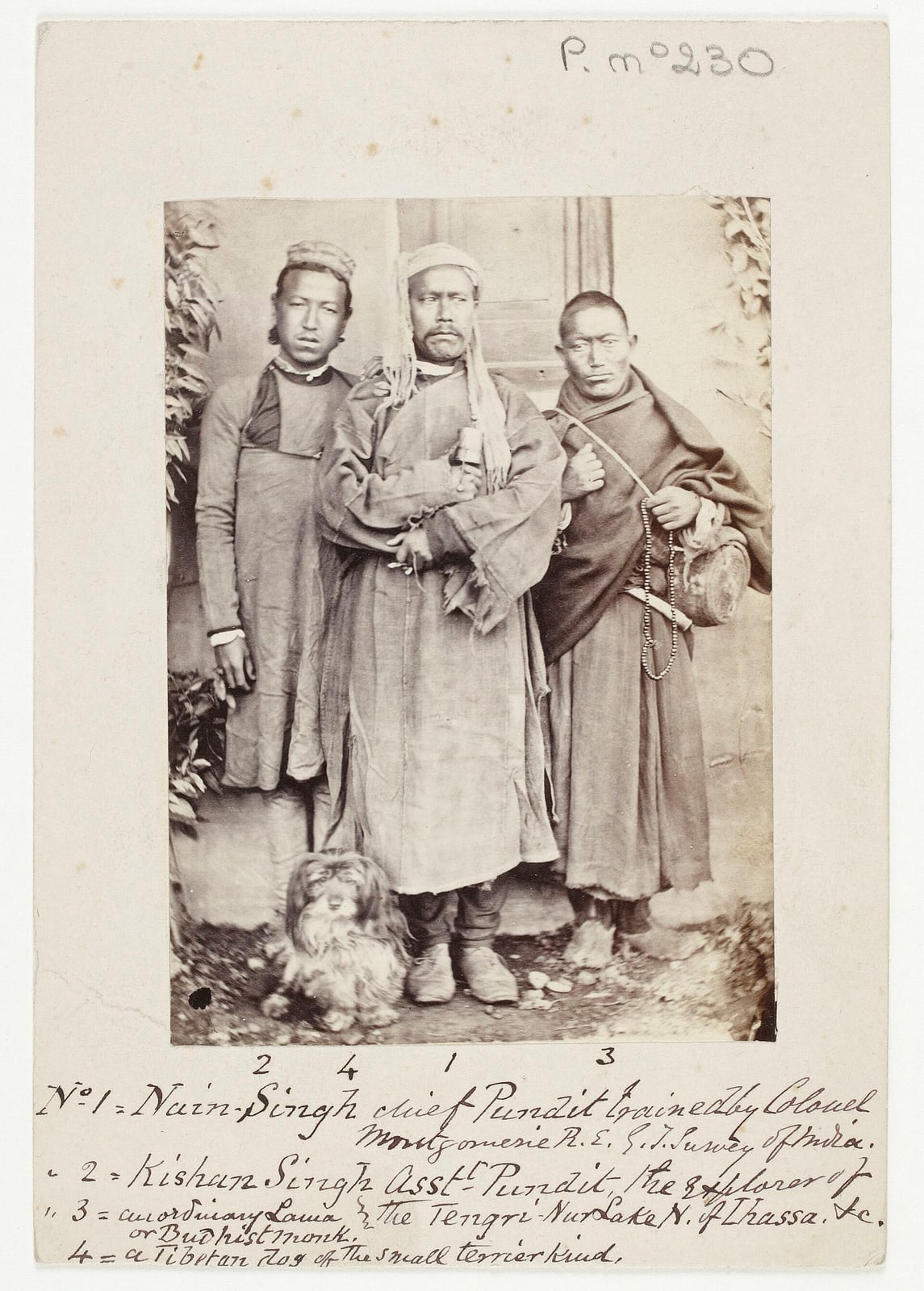
Nain Singh Secretly Surveys the Road to Lhasa
A trained surveyor counted his steps with a rosary to map Tibet.
During the nineteenth century, British authorities in India sought systematic geographic data across Central Asia and Tibet, yet political barriers prevented European surveyors from crossing the northern frontiers. Following the Sino-Nepalese conflict in the late eighteenth century, Qing authorities restricted outside access to Tibet. Repeated attempts by European travelers to travel up the Yangtze or penetrate mountain passes ended in expulsion by border guards. To bypass these restrictions, Captain Thomas Montgomerie of the Great Trigonometrical Survey proposed recruiting indigenous men from Himalayan border communities who could pass unnoticed through the restricted territories. Among the recruits selected for this sensitive task was Nain Singh Rawat, a schoolteacher from the Johar Valley.
Rawat was born in 1830 in the high-altitude village of Milam, located in the Kumaon region near the Tibetan border. As a youth assisting his father in seasonal trans-Himalayan commerce, he gained fluency in the Tibetan language and learned local social customs. In the mid-1850s, he and his relatives gained practical experience with European surveying instruments while accompanying the German researchers Hermann, Adolf, and Robert Schlagintweit through Ladakh. Although Adolf Schlagintweit hoped to dispatch the cousins further toward Lhasa, that project lapsed. Years later, on the basis of a recommendation from Edmund Smyth, Montgomerie selected Nain Singh and his cousin Mani Singh for specialized clandestine operations.

Keep reading in Yester
Coming soon to the App Store
Keep following the story

Sources
- Pundit Nain Singh Rawat: Explorer Extraordinaire (The Himalayan Journal 72, Himalayan Club)
- The Survey of India and the Pundits (The Himalayan Journal 55, Himalayan Club)
- Gold Medal Recipients 1832-2026 (Royal Geographical Society)
- Sven Hedin, Southern Tibet vol. 3, ch. XV: Nain Sing's Journey 1865-66 (Digital Silk Road, Toyo Bunko / NII)
- Nain Singh