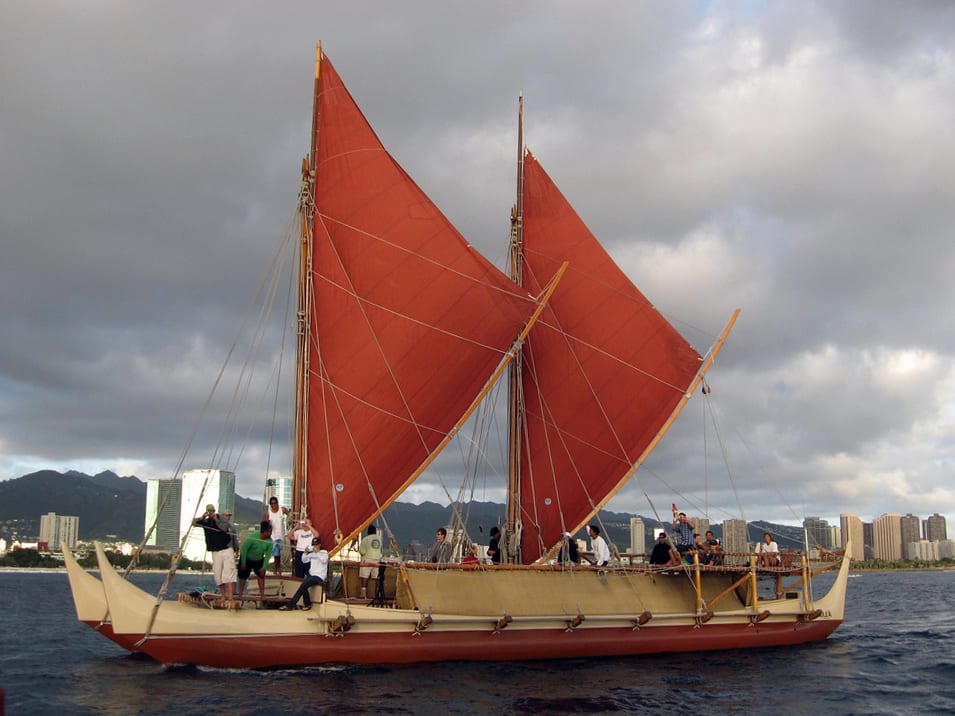
Hōkūleʻa Reconnects Voyaging with Pacific Knowledge
A sailing canoe and traditional navigation helped challenge assumptions about how Polynesia was settled.
On 8 March 1975, the Polynesian Voyaging Society launched Hōkūleʻa, a performance-accurate double-hulled voyaging canoe, or waʻa kaulua. Measuring over sixty-one feet long with twin wood masts and a steering paddle, the vessel was named after the Hawaiian term for Arcturus, a zenith star that passes directly over Hawaiʻi. Rather than relying exclusively on traditional timber, its construction integrated modern materials such as plywood, fiberglass, and resin. The primary objective behind its creation was to evaluate anthropological theories regarding the settlement of Polynesia, specifically testing whether native Oceanic ancestors could have made intentional, non-instrument voyages from Asia across the vast ocean rather than merely drifting passively on currents or arriving from the Americas.
By the mid-1970s, the Hawaiian line of teaching for long-distance, non-instrument voyaging had been severely disrupted. To bridge this divide, the Polynesian Voyaging Society looked to the Caroline Islands in Micronesia, where a handful of master navigators preserved the art. Master Navigator Mau Piailug, of the Weriyeng school from the island of Satawal, agreed to share his closely guarded knowledge to protect it from extinction. Under Mau's guidance as navigator and Captain Elia David Kuʻualoha Kapahulehua, Hōkūleʻa set sail from Honolua Bay, Maui, on 1 May 1976, arriving in Papeʻete, Tahiti, on 4 June 1976. Navigated entirely without modern instruments, the inaugural journey demonstrated that deliberate open-sea transit across ancient routes was entirely achievable.

Keep reading in Yester
Coming soon to the App Store
Keep following the story
Sources
Image: HongKongHuey