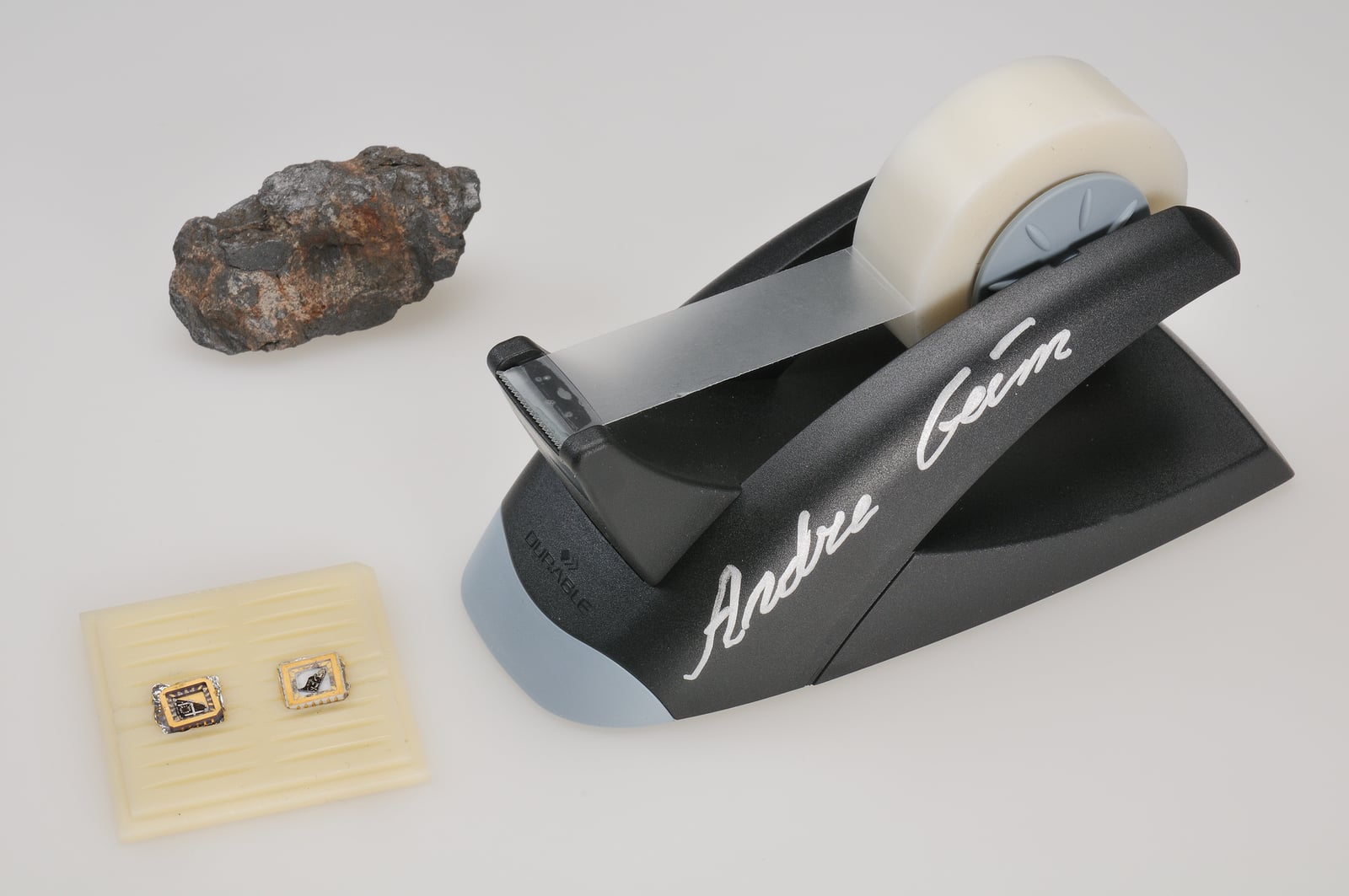
Scientists Isolate Graphene with Sticky Tape
A sheet of carbon one atom thick won a Nobel Prize six years later.
In 2004 at the University of Manchester, physicists Andre Geim and Konstantin Novoselov successfully isolated and characterized monolayer graphene using an unexpectedly modest instrument: standard adhesive tape. The existence of a single, two-dimensional sheet of carbon atoms arranged in a hexagonal honeycomb lattice had engaged theorists and experimentalists for decades. P. R. Wallace had explored the theoretical electronic behavior of such a single sheet in 1947 in a 1947 study of the band theory of graphite. Yet securing a free-standing, single-atom layer that could be systematically measured remained elusive until the Manchester experiments.
The breakthrough relied on micromechanical cleavage, commonly described as the Scotch tape technique. By repeatedly peeling flakes of graphite with common adhesive tape, Geim and Novoselov thinned the mineral down to its ultimate constitutional unit. They subsequently transferred these cleaved flakes onto a silicon wafer topped with a thin layer of silicon dioxide. This substrate played a crucial role, as the silica provided electrical isolation and interacted only weakly with the carbon layer, yielding nearly charge-neutral specimens. Crucially, the underlying silicon plate could act as an electrical back gate to adjust charge density, while optical microscopy against the substrate gave the faint visible contrast needed to detect the atomic sheets.

Keep reading in Yester
Coming soon to the App Store
Keep following the story
Sources
- The Nobel Prize in Physics 2010: Press release (NobelPrize.org)
- The Nobel Prize in Physics 2010: Popular information (NobelPrize.org)
- October 22, 2004: Discovery of Graphene (APS News, American Physical Society)
- Two-dimensional gas of massless Dirac fermions in graphene (Nature)
- The Band Theory of Graphite (Physical Review)
- Chancellor officially opens National Graphene Institute (University of Manchester)
- Graphene
Image: Gabriel Hildebrand