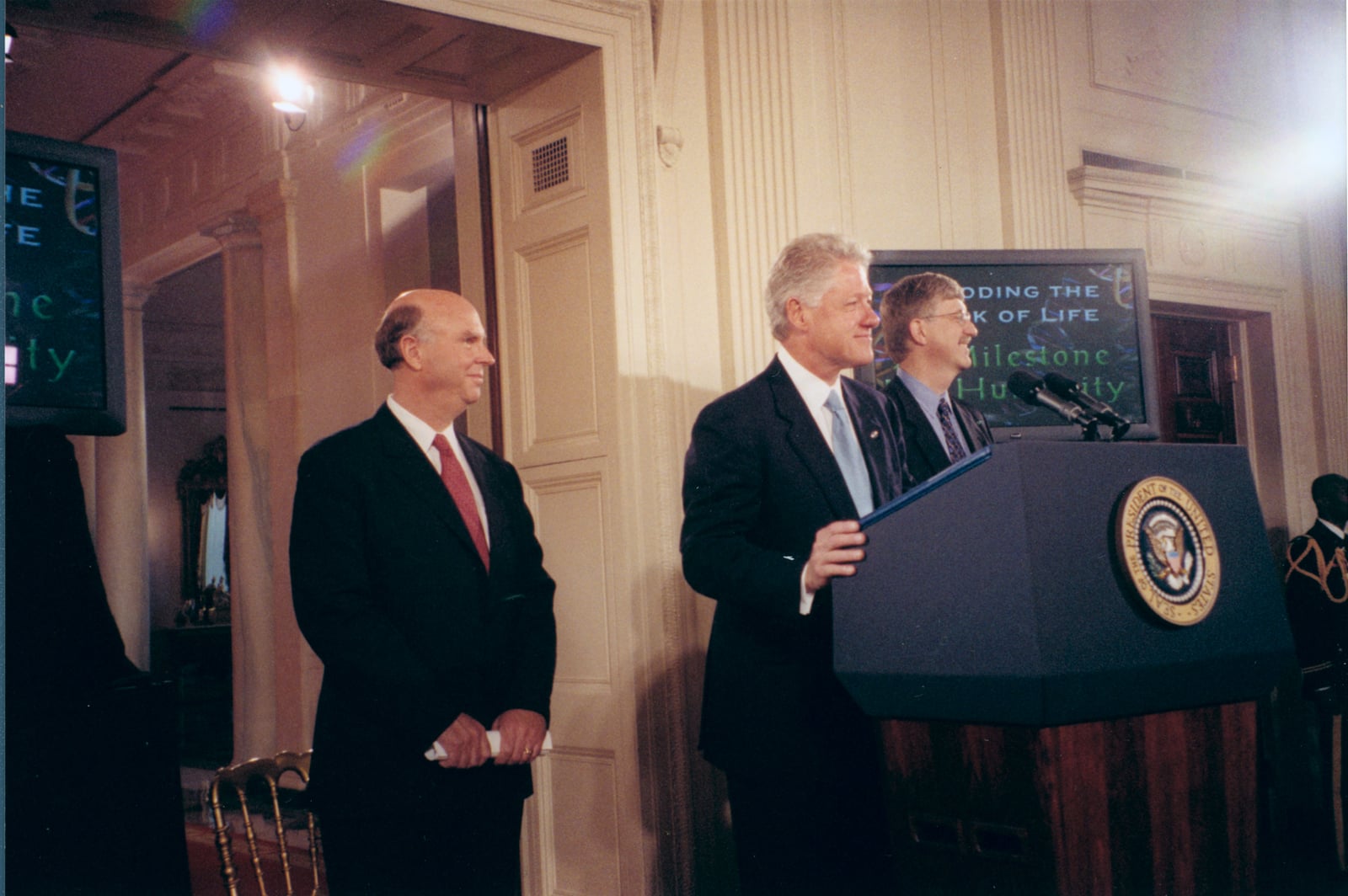
The Human Genome Project Finishes Its Map
An international effort read the sequence of human DNA two years ahead of schedule.
On 14 April 2003, researchers declared the completion of the Human Genome Project, bringing an end to a coordinated thirteen-year effort to identify and sequence the chemical base pairs of human DNA. Formally launched in 1990 by the United States Department of Energy and the National Institutes of Health, the initiative was designed as a fifteen-year international program to chart the entire euchromatic human genome. Collaborative work across twenty institutions situated in the United States, the United Kingdom, Japan, France, Germany, and China enabled the consortium to finish its map two years ahead of the original timetable.
The institutional origins of the venture took shape during the mid-1980s. In May 1985, Robert Sinsheimer, chancellor of the University of California, Santa Cruz, convened a workshop on sequencing the human genome, and in March 1986 the Department of Energy's Office of Health and Environmental Research held a meeting in Santa Fe, New Mexico, to assess the idea's feasibility. In April 1990, the National Institutes of Health and the Department of Energy published a plan for the first five years of what was expected to be a 15-year project. James Watson became the first director of the NIH genome center in 1989, and Francis Collins was appointed to lead it in 1993.

Keep reading in Yester
Coming soon to the App Store
Keep following the story

Sources
- Human Genome Project Fact Sheet (National Human Genome Research Institute)
- Human Genome Project Timeline (National Human Genome Research Institute)
- Researchers assemble the first complete sequence of a human Y chromosome (National Human Genome Research Institute)
- On the sequencing of the human genome (Proceedings of the National Academy of Sciences, via PMC)
- Joint Statement by President Clinton and Prime Minister Tony Blair, 14 March 2000 (The White House, National Archives)
- Multiple evidence strands suggest that there may be as few as 19 000 human protein-coding genes (Human Molecular Genetics, via PMC)
- Human Genome Project
Image: National Human Genome Research Institute (NHGRI)