CRISPR Turns a Bacterial Defense into a Gene-Editing Tool
A molecular system from bacteria offered a simpler way to edit DNA.
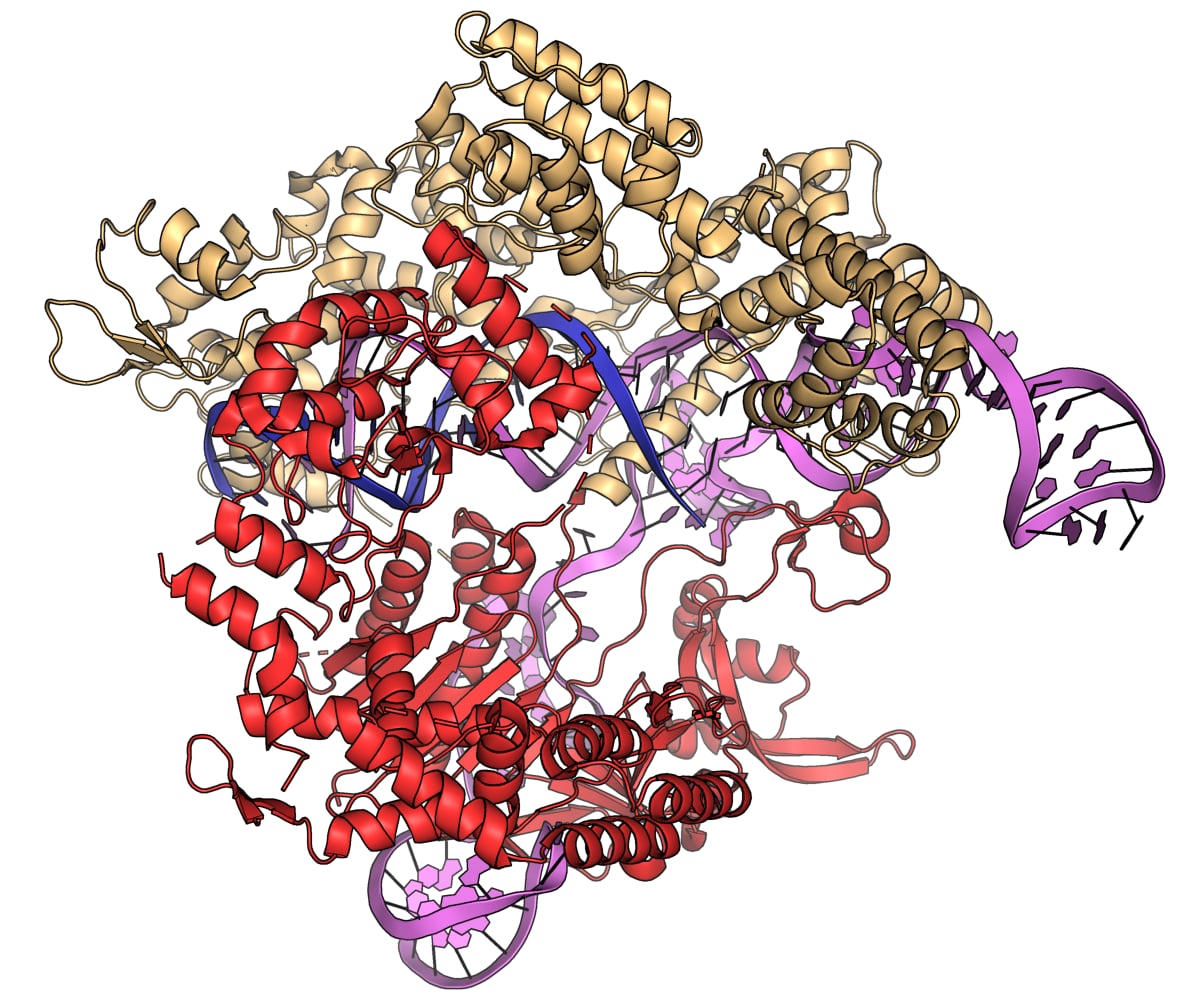
In 2012, researchers led by Jennifer Doudna at the University of California, Berkeley, and Emmanuelle Charpentier at Umeå University published a method that repurposed a natural bacterial immune system into a programmable gene-editing technology. Earlier investigations into microbial defenses had traced how clustered regularly interspaced short palindromic repeats worked alongside Cas enzymes. Alexander Bolotin's team described the protein now known as Cas9 in 2005, and in 2007 Rodolphe Barrangou and Philippe Horvath demonstrated experimentally that bacteria capture fragments of bacteriophage DNA to fend off future viral attacks. The 2012 advance showed that pairing the Cas9 nuclease from Streptococcus pyogenes with customizable synthetic guide RNA enabled researchers to direct molecular cuts to specific sequences of DNA.
Earlier genetic engineering methods in eukaryotic cells had existed since the 1980s, but they remained difficult to implement on a routine basis. Technologies developed in the 2000s, such as zinc finger nucleases and transcription activator-like effector nucleases, required researchers to design and manufacture entirely new proteins for each target sequence. CRISPR-Cas9 fundamentally changed laboratory workflows because targeting required only the synthesis of a short RNA guide that bonded with complementary DNA base pairs adjacent to a protospacer motif. This simplified mechanism offered a comparatively inexpensive way to target multiple genetic sites at once and achieve irreversible gene knockouts.

Keep reading in Yester
Coming soon to the App Store
Keep following the story
Sources
- Appeals court reopens the question of who owns patents for groundbreaking CRISPR discovery (STAT, May 12, 2025)
- Federal Circuit Vacates and Remands in Long-Pending Dispute over CRISPR IP (Morrison Foerster)
- The PTAB Reaffirms Priority Decision for CRISPR IP (Morrison Foerster, 7 Apr 2026)
- PTAB sides with Broad Institute over University of California (Berkeley News)
- PTAB Upholds Priority Win for Broad Institute in CRISPR Patent Case (IPWatchdog, Mar 27, 2026)
- The Nobel Prize in Chemistry 2020, press release (Nobel Foundation)
- CRISPR-Cas9: A History of Its Discovery and Ethical Considerations of Its Use in Genome Editing (Biochemistry (Moscow), via PubMed Central)
- International Summit on Human Gene Editing (National Academies of Sciences, Engineering, and Medicine)
Image: Deposition authors: Nishimasu, H., Ishitani, R., Nureki, O.; Visualization author: Synpath