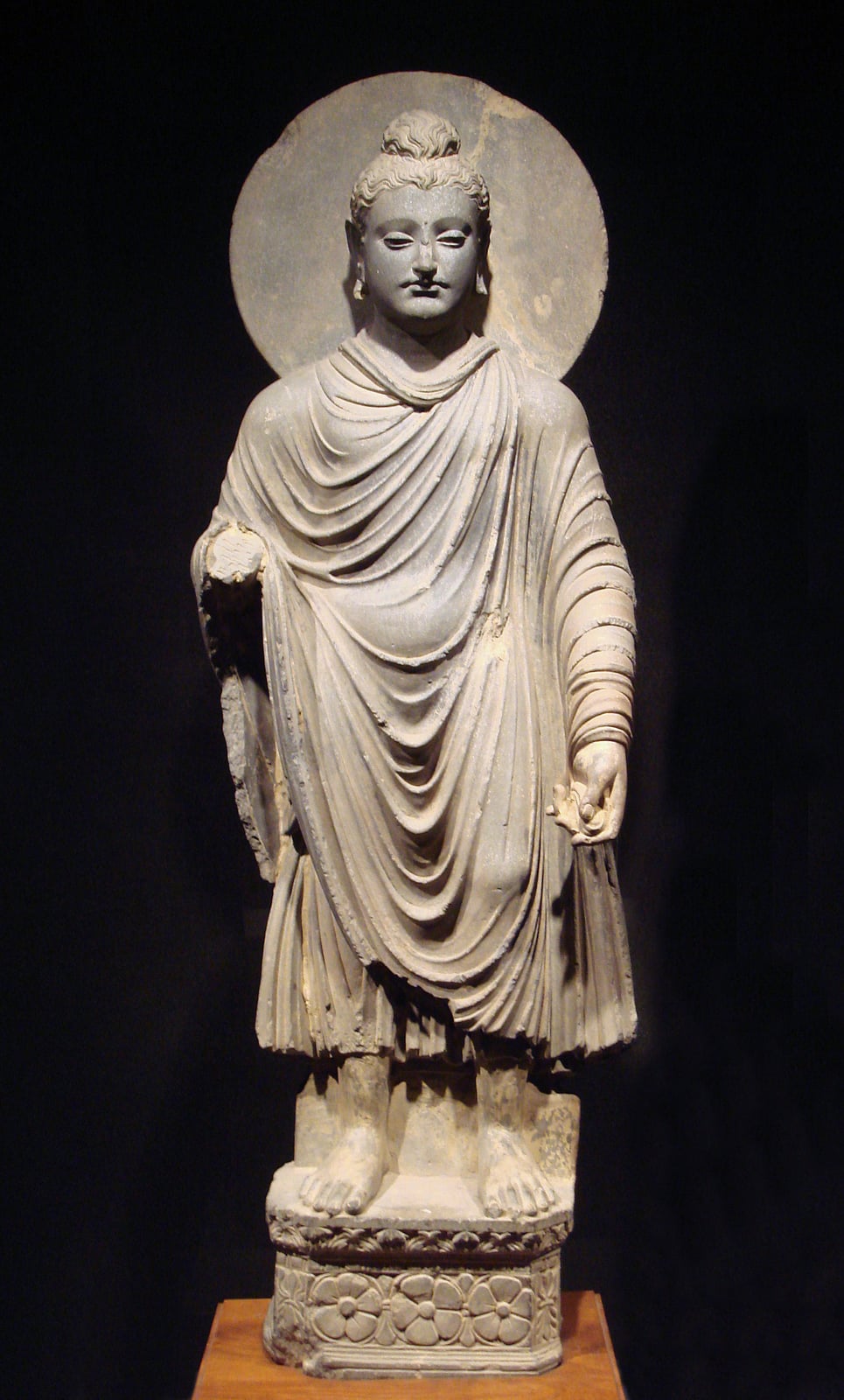
Gandhara’s Sculptors Give the Buddha a Human Form
Artists in the northwest of the subcontinent blended Greek and Indian styles.
During the third century BC, the Mauryan emperor Ashoka extended his patronage across South Asia, actively encouraging the spread of Buddhism into the northwestern reaches of the subcontinent. In these frontier territories, earlier military incursions under Alexander the Great had previously established Hellenistic satrapies. When the Mauryan dynasty later gave way, regional Hellenistic realms such as the Greco-Bactrian and Indo-Greek kingdoms continued to foster both Greek civic culture and Buddhist traditions. Early Buddhist art in central India had generally avoided depicting Gautama Buddha in human form, choosing instead to indicate his presence through symbolic markers such as footprints, an empty seat, or the sacred Bodhi tree.
This established convention of aniconism underwent a dramatic shift in the region of Gandhara, situated along the northwestern frontier. Beginning around the first century AD and flourishing under the Kushan Empire, regional artisans produced some of the earliest known statues of the Buddha in human form, although scholars still debate whether the practice began in Gandhara, in Mathura, or in both. Rather than relying on previous Indian conventions, Gandharan sculptors adapted Classical Mediterranean techniques to express spiritual authority. They rendered the Buddha with naturalistic facial planes, wavy hair gathered in a topknot reminiscent of Hellenistic statuary, and heavy monastic robes apparently inspired by the Greek himation, often covering one or both shoulders.

Keep reading in Yester
Coming soon to the App Store
Keep following the story
Sources
Image: World Imaging