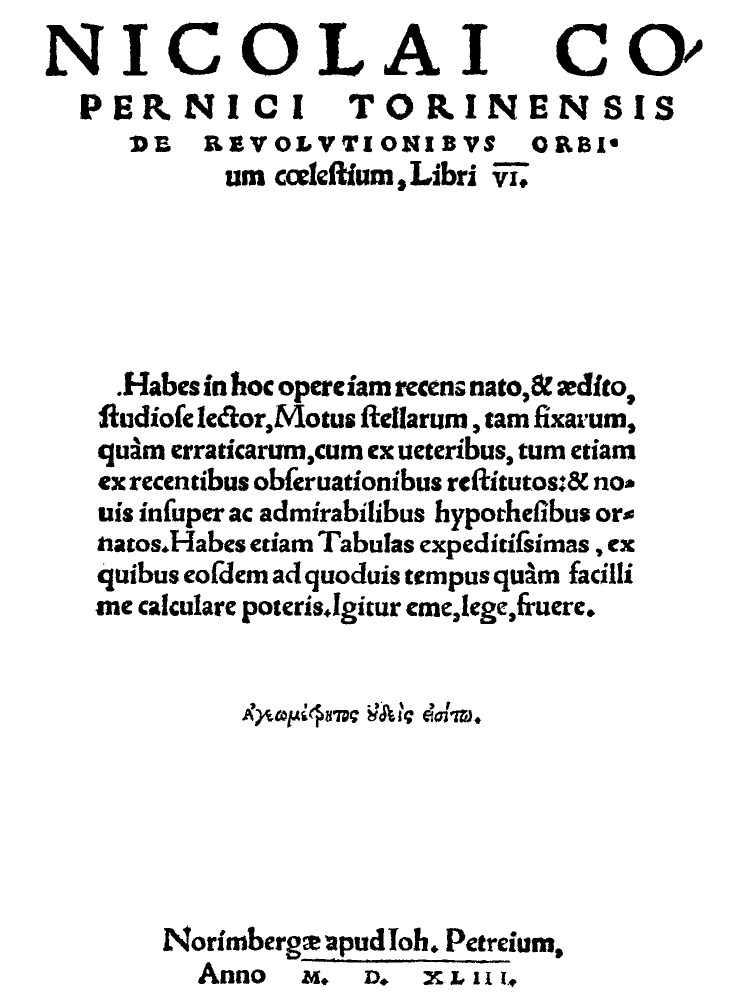
Copernicus Places Earth in Motion
A published model reorganized the heavens around a moving Earth.
In 1543, printer Johannes Petreius issued a dense Latin treatise in Nuremberg titled De revolutionibus orbium coelestium. Its author, the Polish canon Nicolaus Copernicus, died shortly around the time of publication, having developed his ideas over decades. He had outlined his core concept as early as the 1510s in an anonymous manuscript known as the Commentariolus. Seeking to compute celestial paths with fewer distinct movements than Ptolemy's ancient geocentric model required, Copernicus proposed that the stationary Sun rested at the centre of the universe while the Earth rotated daily on its axis and revolved annually through space.
Copernicus hesitated for years to release his full manuscript. In 1539, a young mathematician from Wittenberg named Georg Joachim Rheticus travelled to Frombork to study the new astronomy. Encouraged by Rheticus, who published a preliminary summary called the Narratio Prima in 1540, Copernicus finally released a section on trigonometry in 1542 and entrusted the complete text to Bishop Tiedemann Giese. Giese passed the work to Rheticus, who delivered it to Petreius for printing in Nuremberg before departing to take a professorship in Leipzig.

Keep reading in Yester
Coming soon to the App Store
Keep following the story
Sources
Image: derivative work of Johannes Petreius 1543 edition of File:Nicolai_Copernici_torinensis_De_revolutionibus_orbium_coelestium.djvu