A Fusion Experiment Releases More Energy Than Its Lasers Delivered
Researchers reached fusion ignition in a laboratory for the first time.
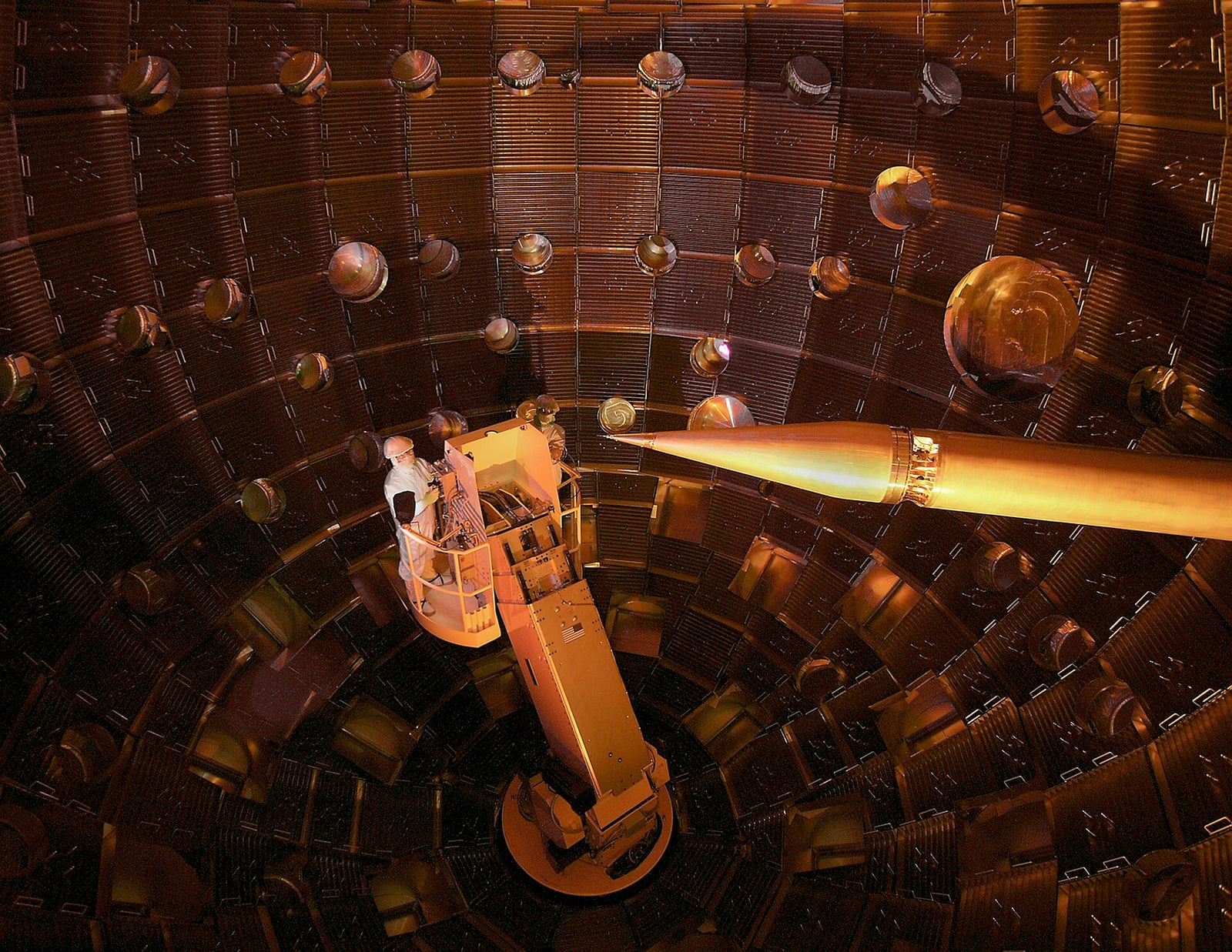
On December 5, 2022, an experiment at the National Ignition Facility in Livermore, California, achieved scientific breakeven in controlled nuclear fusion for the first time. Operating at Lawrence Livermore National Laboratory, the facility focused 192 laser beams onto a miniature target, delivering 2.05 megajoules of ultraviolet light and generating 3.15 megajoules of fusion energy. The achievement marked a laboratory milestone sought for decades, yielding roughly 154 percent of the energy delivered directly to the target assembly.
The facility utilizes inertial confinement fusion, an approach that grew out of work at Livermore in the 1960s, when a group of scientists led by physicist John Nuckolls proposed that lasers could be used to induce fusion in a laboratory. In the design adopted at Livermore, researchers primarily rely on an indirect-drive method. Rather than striking the fuel pellet directly, the laser beams enter a small hollow metal cylinder known as a hohlraum. The cylinder absorbs the laser energy and re-emits X-rays, which heat and ablate the outer shell of a capsule containing frozen deuterium and tritium fuel.

Keep reading in Yester
Coming soon to the App Store
Keep following the story
Sources
- DOE National Laboratory Makes History by Achieving Fusion Ignition (U.S. Department of Energy)
- Achieving Fusion Ignition (Lawrence Livermore National Laboratory)
- National Ignition Facility History, NIF User Guide (Lawrence Livermore National Laboratory)
- Building NIF (Lawrence Livermore National Laboratory)
- Power Conditioning System (Lawrence Livermore National Laboratory)
- National Ignition Facility
Image: Lawrence Livermore National Laboratory, Lawrence Livermore National Security, LLC, and the Department of Energy