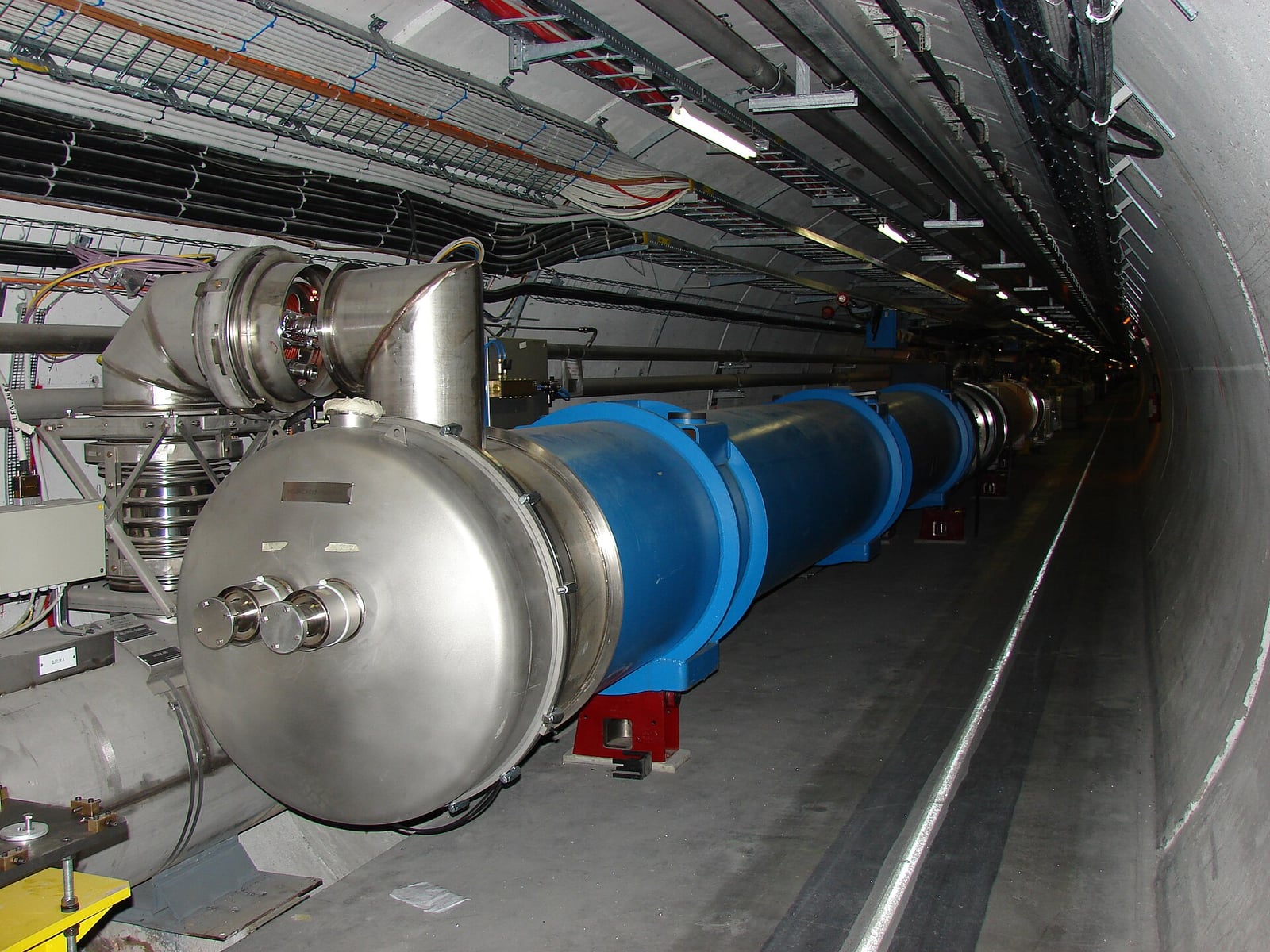
The Large Hadron Collider Starts Up
The world’s largest particle accelerator circulated its first beams.
On the morning of 10 September 2008, physicists and engineers at the European Organization for Nuclear Research, known as CERN, circulated the first beam of protons through the Large Hadron Collider. Housed in a circular tunnel 26.7 kilometres in circumference lying about 100 metres beneath the Franco-Swiss border near Geneva, the machine had been under construction since 1996. It involved more than 10,000 scientists and hundreds of institutions across over 100 countries. That morning, operators guided proton streams clockwise in stages around the ring, completing the inaugural transit in under an hour before steering a counter-clockwise beam later that afternoon.
The engineering behind the accelerator required pushing cryogenic and electromagnetic technologies to extreme thresholds. The facility reused the tunnel excavated between 1985 and 1988 for the earlier Large Electron-Positron Collider. Within this ring, two parallel beam pipes were installed, guided by some 1,232 dipole magnets and 392 quadrupole magnets. To keep the copper-clad niobium-titanium coils superconducting, a cryogenic system using some 120 tonnes of helium, in its superfluid state, chilled the magnets to 1.9 Kelvin, slightly above absolute zero. At full intended strength, proton bunches would circulate at near the speed of light, crossing paths at four designated intersection points equipped with large detector caverns.

Keep reading in Yester
Coming soon to the App Store
Keep following the story
Sources
- Facts and figures about the LHC (CERN)
- Cryogenics: Low temperatures, high performance (CERN)
- The Large Electron-Positron Collider (CERN)
- The LHC sees its first circulating beam (CERN Courier)
- LHC report confirms electrical fault (Physics World)
- The bumpy ride to the bump (CERN Courier)
- Large Hadron Collider inaugurated (CORDIS, European Commission)
- Large Hadron Collider
Image: Christophe Delaere