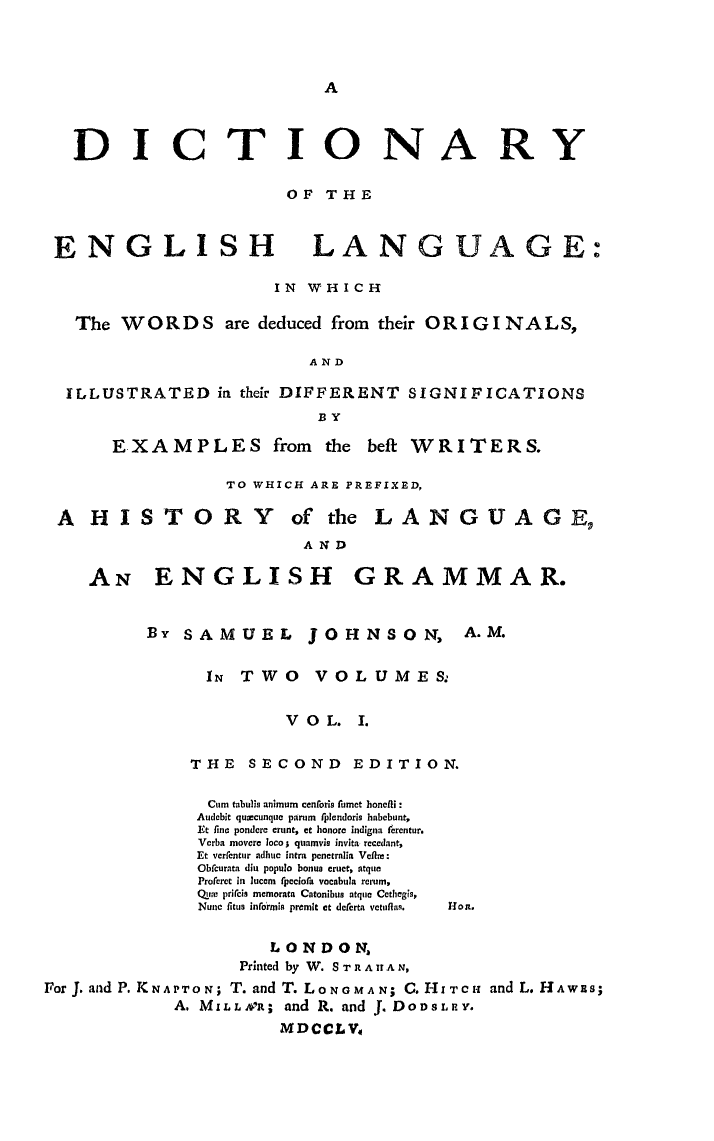
Samuel Johnson Publishes His Dictionary
A single scholar defined over 40,000 English words with quotations.
In June 1746, a group of London booksellers and printers, including Robert Dodsley and Thomas Longman, contracted the author Samuel Johnson to create an authoritative dictionary of the English language. Mid-eighteenth-century Britain had experienced a surge in public literacy and advances in print technology, which led to a growing circulation of newspapers, pamphlets, and books. The expanding reading public created a widespread demand for standardized spelling, grammar, and definitions. Existing English lexicons had primarily functioned as unorganized lists of rare or obscure terms. To remedy this lack of structure, the booksellers pooled their resources and offered Johnson 1,500 guineas to complete the project.
Although Johnson initially claimed he could finish the dictionary in three years, the undertaking required nearly a decade. Working for much of that time from his rented home at 17 Gough Square in London, he compiled the vast text almost single-handedly, relying on assistants only to transcribe the illustrative passages he marked while reading. Johnson set out his methodology in his 1747 Plan of a Dictionary of the English Language, which received patronage from Philip Stanhope, the 4th Earl of Chesterfield. When Chesterfield later praised the forthcoming work in two essays, Johnson felt the aristocrat had provided no meaningful assistance during his years of struggle, writing a sharp letter refusing patronage offered only when the labor was nearly complete.

Keep reading in Yester
Coming soon to the App Store
Keep following the story
Sources
- Johnson's Dictionary (Dr Johnson's House)
- Samuel Johnson's A Dictionary of the English Language (Library of Parliament, Canada)
- Miniature Dictionaries (Samuel Johnson Birthplace Museum)
- Johnson's dictionary (1755) (Examining the OED, Hertford College, University of Oxford)
- First Modern English Dictionary (EBSCO Research Starters)
- A Dictionary of the English Language
Image: Samuel Johnson