Akbar Opens a House of Religious Debate
Discussions at the Mughal court brought competing traditions into conversation.
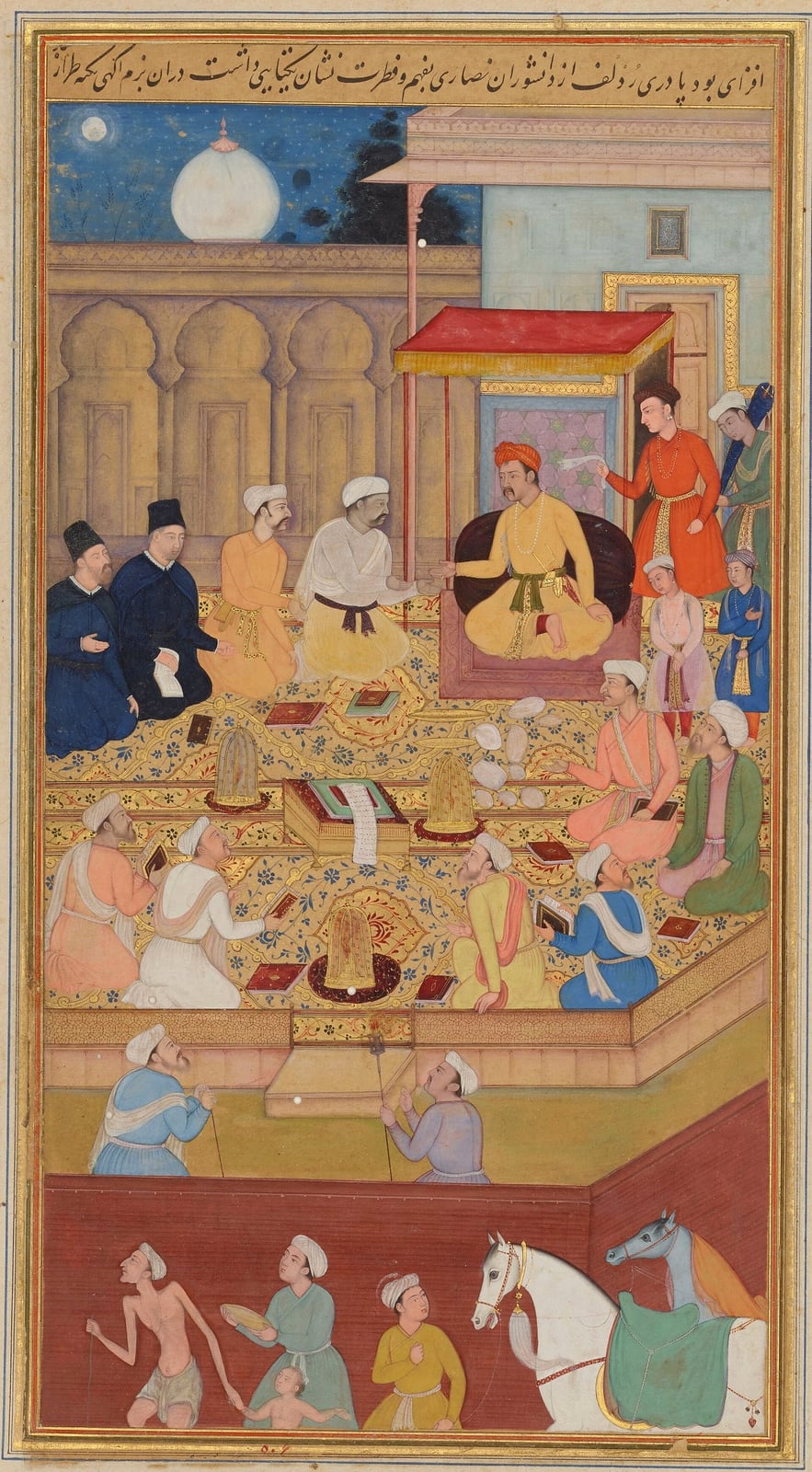
In 1575, the Mughal emperor Akbar ordered the construction of a dedicated meeting hall known as the Ibadat Khana at his capital of Fatehpur Sikri. Having ruled since 1556 over an empire characterized by profound cultural and sectarian pluralism, Akbar sought a structured forum where theological assertions could be openly debated. His decision was partly inspired by reports of Sulaiman Karrani, a ruler of Bengal who regularly spent nights deliberating with numerous spiritual thinkers. Akbar was also preparing for the impending visit of Mirza Sulaiman of Badakshan, a Sufi noted for his strong interest in intellectual disputes.
The building became the venue for weekly Thursday evening discussions that sometimes continued through the night. The assembly began as a gathering of Sunni Muslim scholars, but after the debates resumed in 1578, Akbar widened it, bringing together Muslim theologians and mystics with scholars of Hinduism, Zoroastrianism, Christianity, Jainism, and Buddhism, as well as atheist thinkers. The debates exposed the court to conflicting dogmas, sectarian rivalries, and competing philosophical interpretations. Rather than confirming the supremacy of a single orthodoxy, the exchanges pushed the emperor toward the view that various religious traditions shared an underlying spiritual destination.

Keep reading in Yester
Coming soon to the App Store