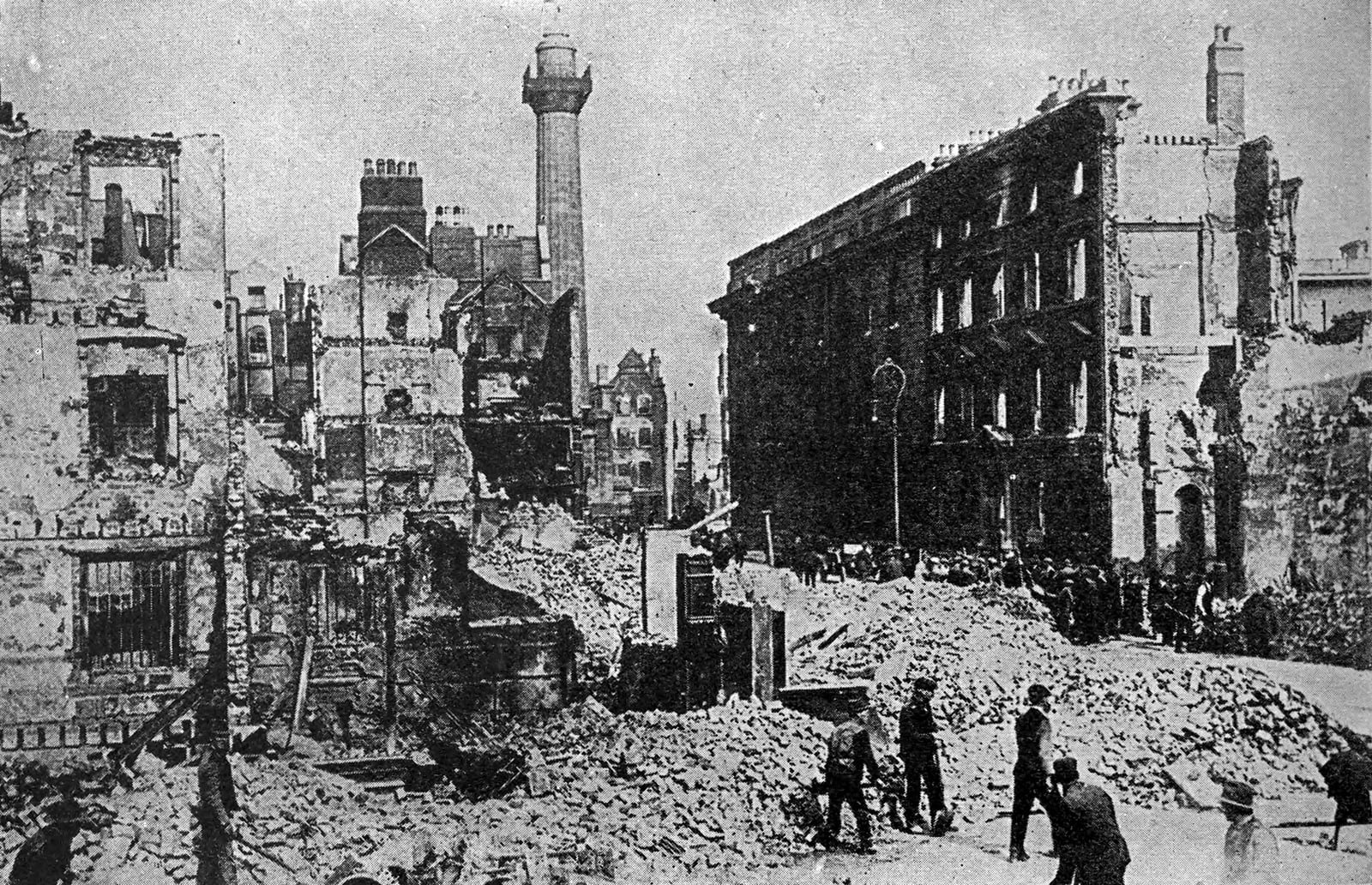
The Easter Rising Proclaims an Irish Republic
A week of fighting failed militarily but transformed Irish politics.
On Easter Monday, 24 April 1916, more than a thousand armed members of the Irish Volunteers, the Irish Citizen Army, and the all-female organisation Cumann na mBan converged across central Dublin. Operating under the clandestine direction of a seven-man Military Council from the Irish Republican Brotherhood, the insurgent groups intended to overturn British rule and establish an independent republic while the United Kingdom remained preoccupied with the First World War. Shortly before noon, a detachment led by Patrick Pearse and James Connolly seized the General Post Office on O'Connell Street and made it their headquarters, and Pearse then read a proclamation of the Irish Republic outside the building.
Simultaneously, other rebel battalions secured prominent positions across the city centre, including the Four Courts, St Stephen's Green, Jacob's biscuit factory, and the South Dublin Union. Small units attempted to disrupt communications and transport by seizing railway stations, blocking bridges, and severing telegraph wires. An attempt to capture Dublin Castle faltered at the gate after an unarmed police sentry was shot, prompting the insurgents to retreat into Dublin City Hall. A separate detachment attacked the Magazine Fort in the Phoenix Park, but the attempt to destroy its munitions failed.

Keep reading in Yester
Coming soon to the App Store
Keep following the story

Sources
- Easter Rising (Encyclopaedia Britannica)
- Chronology of the Easter Rising (RTÉ Century Ireland)
- The Civilian Dead: Counting the human cost of the 1916 Rising (RTÉ Century Ireland)
- The terrible toll of the Rising (Dublin People)
- The 1916 Rising: Personalities and Perspectives, The Rising (National Library of Ireland)
- Irish General Election 1918 results (ARK, Northern Ireland Elections)
- Easter Rising
Image: Miller, James Martin & H.S. Canfield.