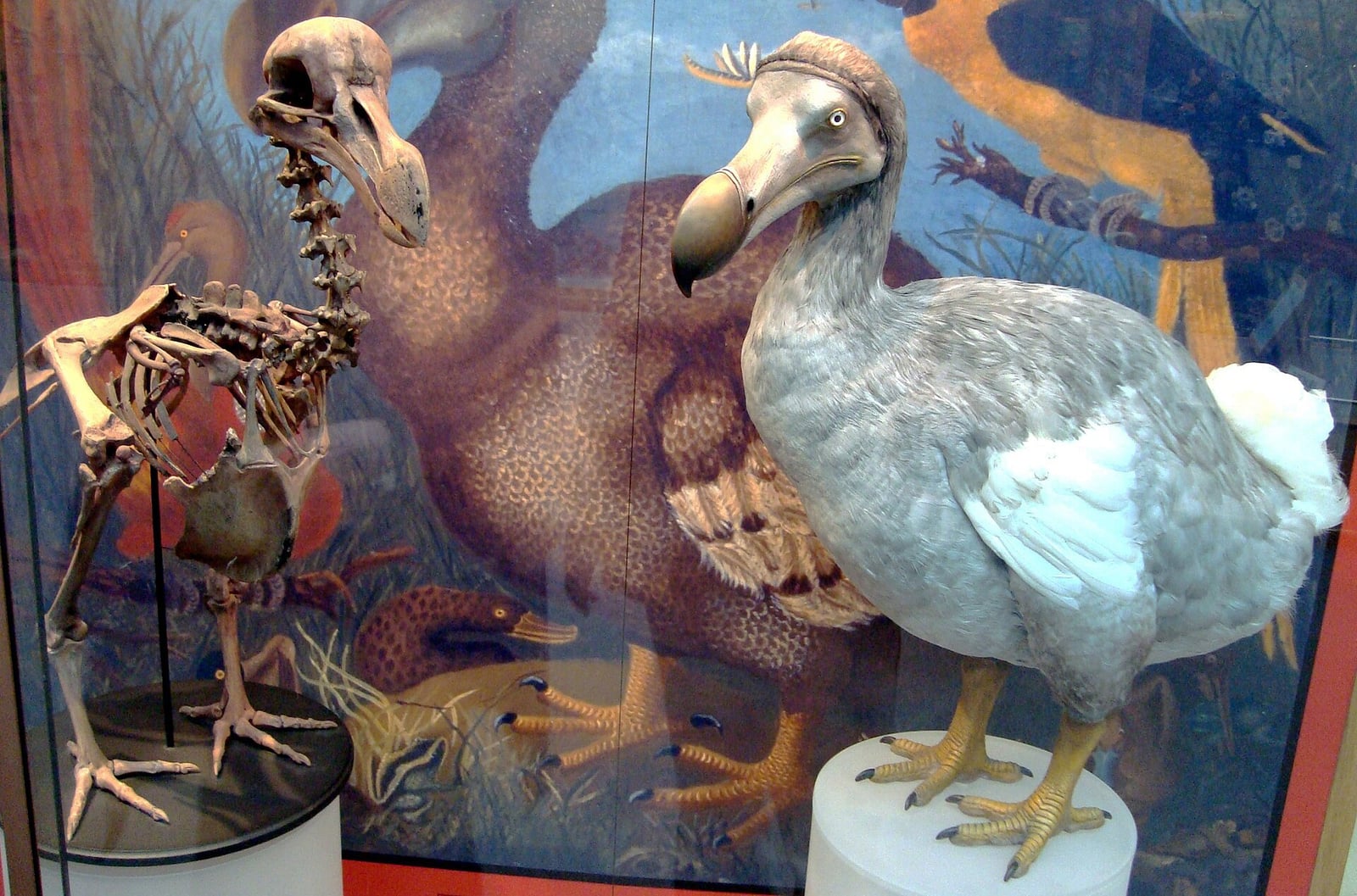
The Dodo Is Last Seen on Mauritius
A flightless bird became the best-known example of human-caused extinction.
In 1598, sailors aboard a Dutch voyage under Wybrand van Warwijck documented an unfamiliar flightless bird on the Indian Ocean island of Mauritius. Encountering creatures as large as swans or larger that could easily be approached, the mariners called them Walghvoghel, meaning insipid or sickening bird, because protracted boiling failed to tenderize their flesh. Over the ensuing decades, passing crews repeatedly sought fresh provisions across the island, harvesting the birds while introducing invasive mammals and altering native forests. The last widely accepted sighting of a live bird occurred in 1662. Within less than a century of its first recording by European visitors, the species had disappeared entirely, marking one of the earliest recognized instances of human activity driving a creature to total extinction.
For generations following its vanishing, the bird was regarded with scepticism, with some commentators even dismissing it as a fable. Only a few partial specimens brought to Europe in the seventeenth century survive today, including a mummified head and foot preserved at Oxford and a single skull in Copenhagen. Early naturalists struggled to classify these remnants, variously proposing that the bird was an ostrich, a rail, an albatross, or a vulture. In 1842, Danish zoologist Johannes Theodor Reinhardt argued that a skull he studied belonged to a giant ground-dwelling pigeon. This determination was corroborated in an 1848 monograph by Hugh Edwin Strickland and Alexander Gordon Melville, who dissected the Oxford head and foot, identifying clear anatomical affinities with the family Columbidae, including nostril structure and leg proportions.

Keep reading in Yester
Coming soon to the App Store
Keep following the story
Sources
Image: BazzaDaRambler