Deep Impact Strikes a Comet
A NASA probe hit comet Tempel 1 to reveal what lay beneath its surface.
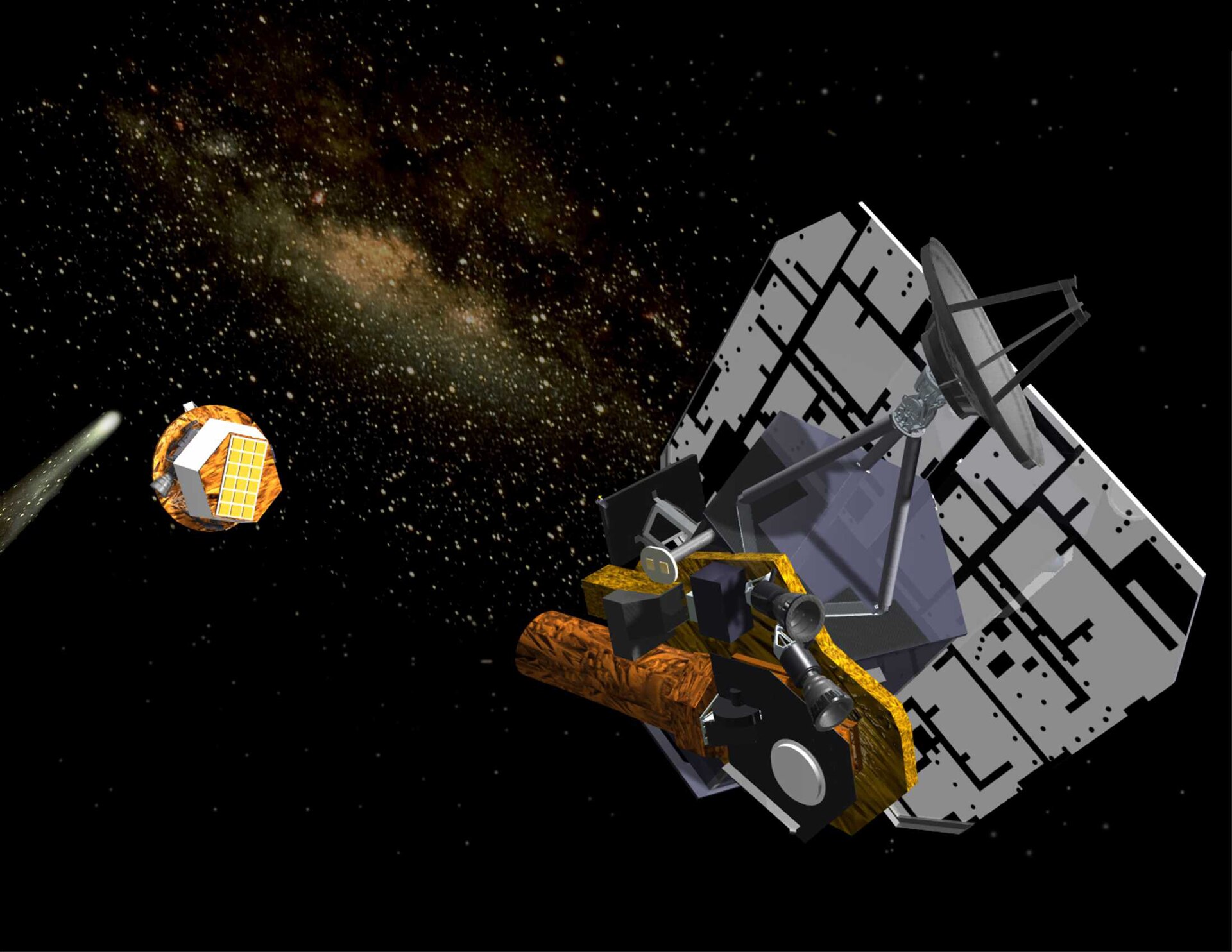
On July 4, 2005, a small robotic projectile detached from an American spacecraft and steered directly into the path of comet Tempel 1. Designed by NASA as part of its low-cost Discovery Program, the Deep Impact mission sought to answer fundamental questions about the formation and internal makeup of comets. Previous explorations of cometary bodies had relied exclusively on distant flyby maneuvers, examining only the weathered crust. Deep Impact aimed instead to excavate pristine primordial debris from beneath the surface by staging a high-velocity collision.
The spacecraft, launched aboard a Delta II rocket from Cape Canaveral on January 12, 2005, comprised two distinct components. A larger flyby probe carried imaging sensors, an infrared spectrometer, and communications equipment, while a 372-kilogram projectile, designated the Impactor, carried autonomous navigation software and a solid copper cratering mass. Engineers selected copper for roughly half of the Impactor's overall mass because the element was not expected to exist naturally in the comet, ensuring that material from the projectile would not confuse spectroscopic readings of the excavated plume.

Keep reading in Yester
Coming soon to the App Store
Keep following the story
Sources
- Deep Impact (EPOXI) (NASA Science)
- NASA's Deep Impact Produced Deep Results (NASA Jet Propulsion Laboratory)
- Deep Impact Impactor (University of Maryland, Deep Impact mission team)
- NASA Deep Impact news release, 8 July 2005 (NASA NSSDC archive)
- Tempel 1's Secret Ingredients Revealed (Spitzer Space Telescope, Caltech/NASA)
- NASA's Deep Impact comet mission ends (Spaceflight Now)
- Deep Impact (spacecraft)
Image: NASA/JPL