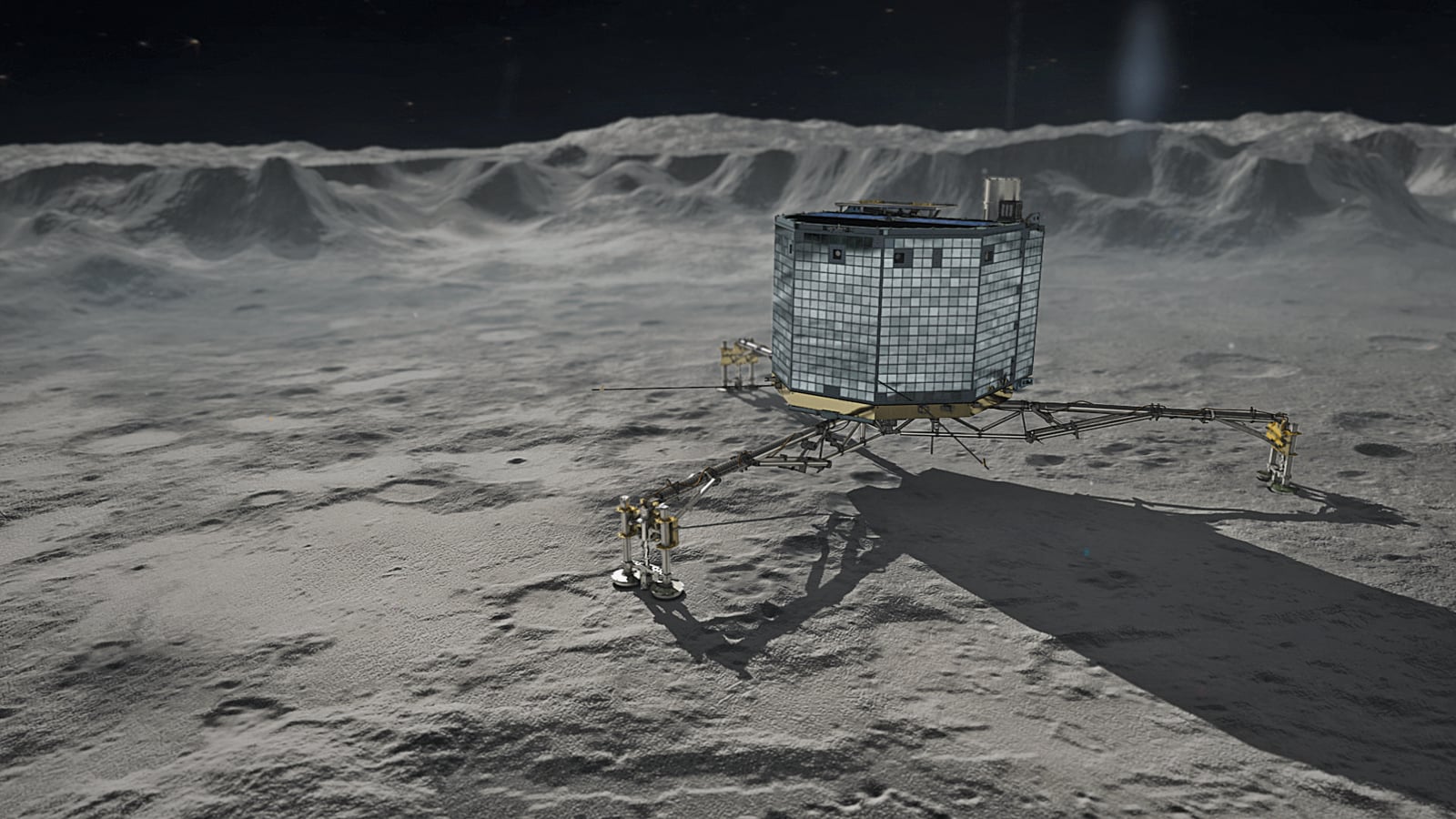
Philae Becomes the First Probe to Land on a Comet
After a ten-year chase, Europe’s Rosetta dropped a lander that bounced twice on comet 67P.
On 12 November 2014, flight controllers at the European Space Operations Centre in Darmstadt, Germany, received confirmation that the Philae lander had touched down on the surface of comet 67P/Churyumov-Gerasimenko. Dispatched from its parent spacecraft, the European Space Agency probe Rosetta, the three-legged robot became the first robotic explorer to execute a soft landing on a comet nucleus. The touchdown represented the culmination of a ten-year interplanetary passage across the inner Solar System, marking a major milestone in deep-space robotic exploration.
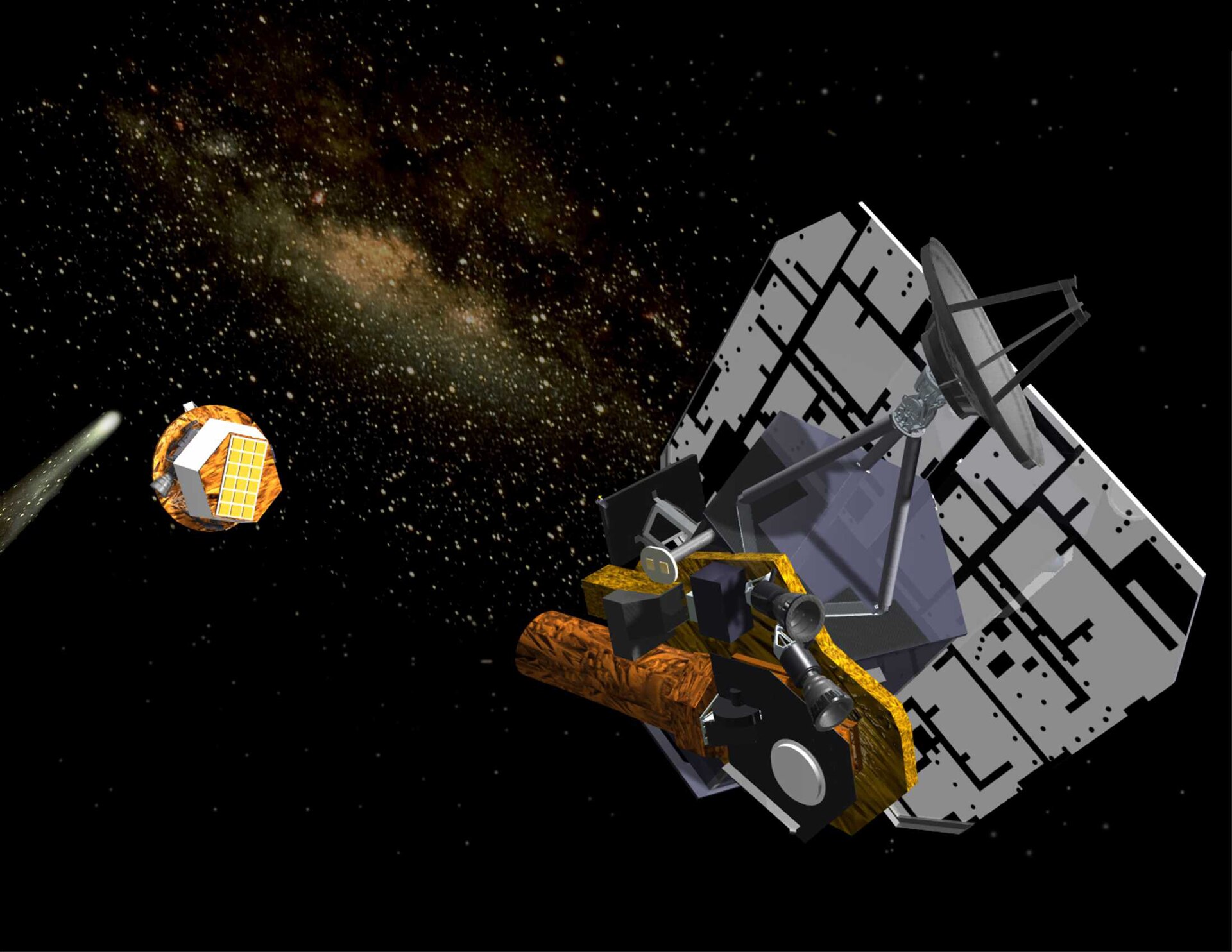
The journey had commenced on 2 March 2004 with a launch from Kourou, French Guiana, aboard an Ariane 5 rocket. Originally slated for launch toward comet 46P/Wirtanen in January 2003, the mission was redirected after the failure of a new Ariane 5 variant in December 2002 grounded the launch vehicle, requiring engineers to retarget 67P and redesign the lander's gear to accommodate the larger celestial body. Reaching the comet demanded an intricate series of gravity-assist maneuvers, including three flybys of Earth and one close pass of Mars in 2007. Along the route, Rosetta also completed close-range observations of asteroids 2867 Steins and 21 Lutetia, and even monitored the celestial impact created during NASA's Deep Impact encounter with comet Tempel 1 in 2005.

Keep reading in Yester
Coming soon to the App Store
Keep following the story
Sources
- Rosetta frequently asked questions (European Space Agency)
- Science on the surface of a comet (European Space Agency)
- Rosetta's lander Philae wakes up from hibernation (European Space Agency)
- Philae found (European Space Agency)
- Mission complete: Rosetta's journey ends in daring descent to comet (European Space Agency)
- Philae calling (German Aerospace Center, DLR)
- ESA: Philae Landed THREE Times, not Two, But is OK (SpacePolicyOnline)
- Rosetta (spacecraft)
Image: DLR German Aerospace Center