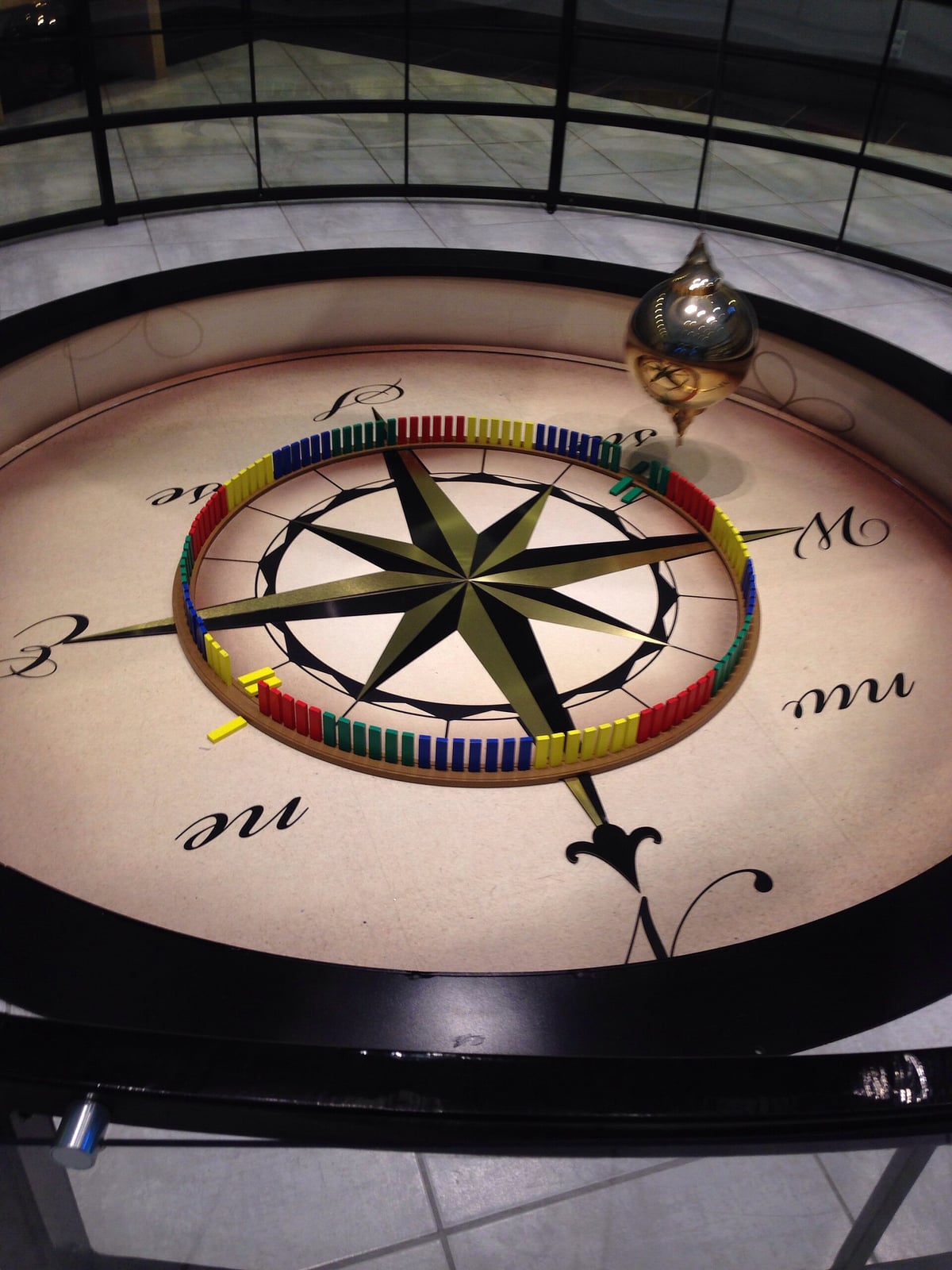
Foucault’s Pendulum Shows Earth Turning
A swinging weight in the Panthéon made the planet’s rotation visible.
In February 1851, French physicist Léon Foucault staged the first public demonstration of his pendulum along the Meridian of the Paris Observatory. The concept had emerged from a mechanical workshop observation, where Foucault noticed that a flexible metal rod set on the axis of a turning lathe maintained its vibration in a constant plane despite the motion of its mounting frame. Applying this insight to a freely swinging mass, he devised an apparatus intended to offer direct proof of the rotation of the Earth beneath it.
Weeks after the initial trial, Foucault assembled a far larger installation beneath the grand dome of the Panthéon in Paris. He hung a twenty-eight-kilogram brass-coated lead weight from a sixty-seven-meter wire, creating a system with an oscillation period of roughly sixteen and a half seconds. Because of the building's latitude of nearly forty-nine degrees north, the plane traced by the swing rotated clockwise at roughly 11.3 degrees per hour, completing an apparent circuit in just under thirty-two hours. With each period of oscillation the path shifted by about 2.3 millimeters, a movement made visible by a stylus that left marks in piles of sand.

Keep reading in Yester
Coming soon to the App Store
Keep following the story
Sources
Image: Stephen Rahn