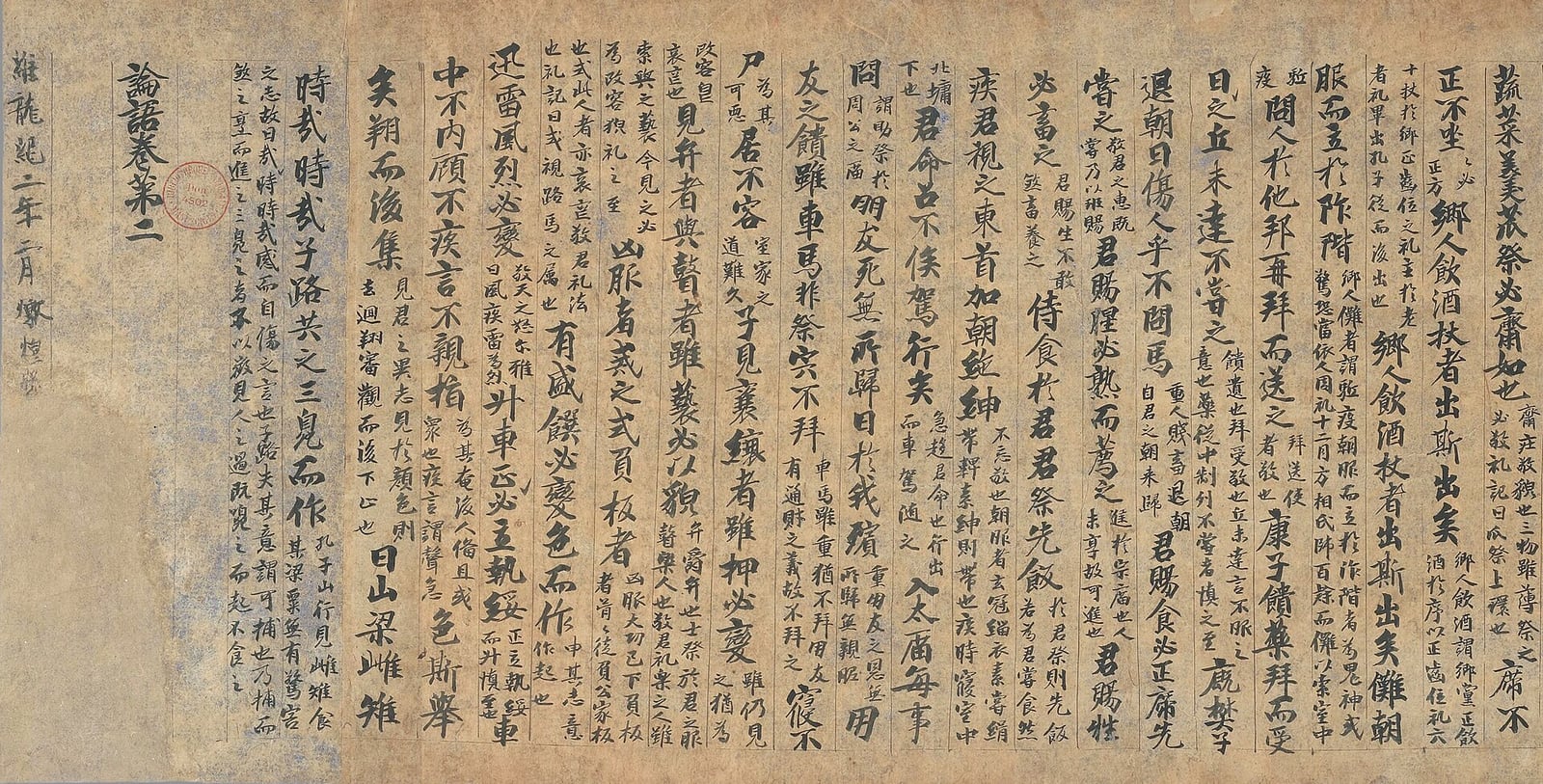
Confucius’s Students Preserve His Teachings in the Analects
Sayings collected by disciples shaped ideas of virtue and government in East Asia.
Following the death of Confucius in 479 BCE, his followers preserved their records of conversations with the teacher. According to the traditional account presented by the Han dynasty historian Ban Gu, these separate notes were subsequently gathered and edited by direct disciples and later pupils. The resulting anthology, known as the Lunyu or Analects, was compiled to ensure that the core tenets of Confucius's philosophy would not be lost amid the political instability of ancient China.
Modern scholars have extensively scrutinized this traditional narrative of rapid compilation. Linguistic analyses by Qing dynasty philologist Cui Shu and subsequent researchers have indicated that the received text contains multiple compositional layers, with some books likely originating much later than others. Many historians conclude that the collection grew gradually over roughly two centuries during the Warring States period. Discoveries of bamboo manuscripts dating to around 300 BCE, such as those recovered in Wangjiazui and acquired by Anhui University, confirm that collections of Confucius's sayings were already circulating well before the Han dynasty.

Keep reading in Yester
Coming soon to the App Store
Keep following the story
Sources
- Confucius (Stanford Encyclopedia of Philosophy)
- Confucius (Internet Encyclopedia of Philosophy)
- New Manuscript Evidence on the Formation of the Analects: The Warring States Anhui University *Zhongni said and the Wangjiazui *Kongzi said (Early China, Cambridge University Press)
- Zhu Xi (EBSCO Research Starters)
- Analects
Image: anonymous