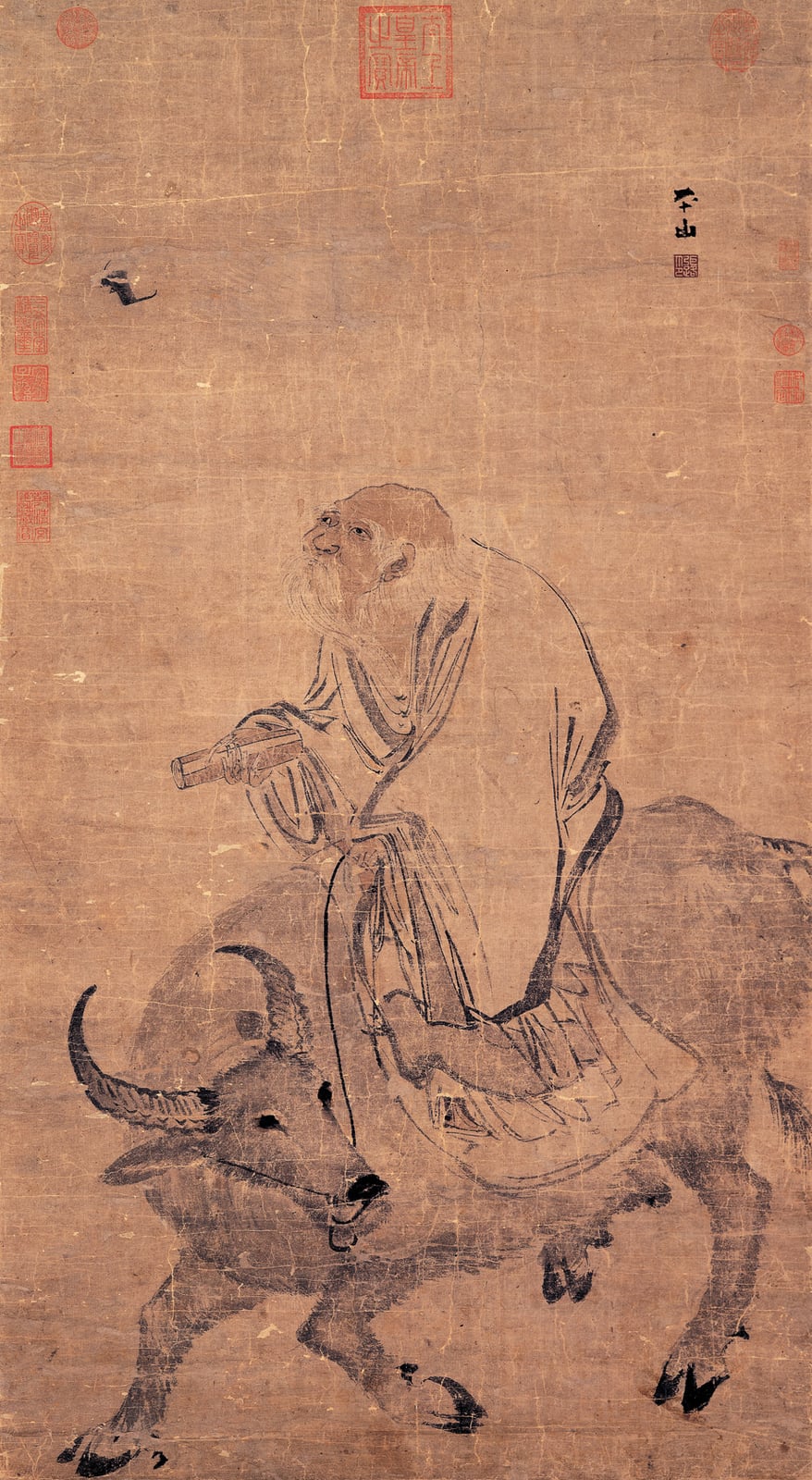
The Tao Te Ching Teaches the Power of Yielding
A short book attributed to Laozi became the founding text of Daoism.
In 1993, archaeologists working near Guodian in Hubei province unearthed bamboo slips from a tomb dated to around 300 BCE. Among roughly eight hundred recovered slips were around two thousand Chinese characters corresponding to passages of the Tao Te Ching, making them the oldest known manuscript fragments of the work. Rather than presenting a unified, completed book, the Guodian bundles contained shorter selections of aphorisms. Modern Sinologists generally view the classic not as the singular creation of an individual, but as a composite compilation drawn from oral traditions and textual collections that took shape across the Warring States period before stabilizing in the third century BCE.
Traditional Chinese historiography attributed the entire text to the sage Laozi, whose name translates literally as Old Master. Sima Qian, writing in the Han dynasty Records of the Grand Historian, recorded three distinct figures associated with the persona: a keeper of archives at the Zhou royal court who composed a two-part work before journeying west, a contemporary of Confucius named Lao Laizi who produced a book in fifteen parts, and a later Zhou court historian named Dan. Later legends multiplied these biographical traditions, attributing extraordinary lifespans and multiple incarnations to the teacher. Modern scholars maintain considerable skepticism regarding Laozi as a historical individual, with some arguing that stories of his life developed only after early collections had already begun circulating.

Keep reading in Yester
Coming soon to the App Store
Keep following the story
Sources
Image: Zhang Lu