Çatalhöyük Packs Thousands into a Town Without Streets
Residents of an early Anatolian town walked across rooftops and entered their homes by ladder.
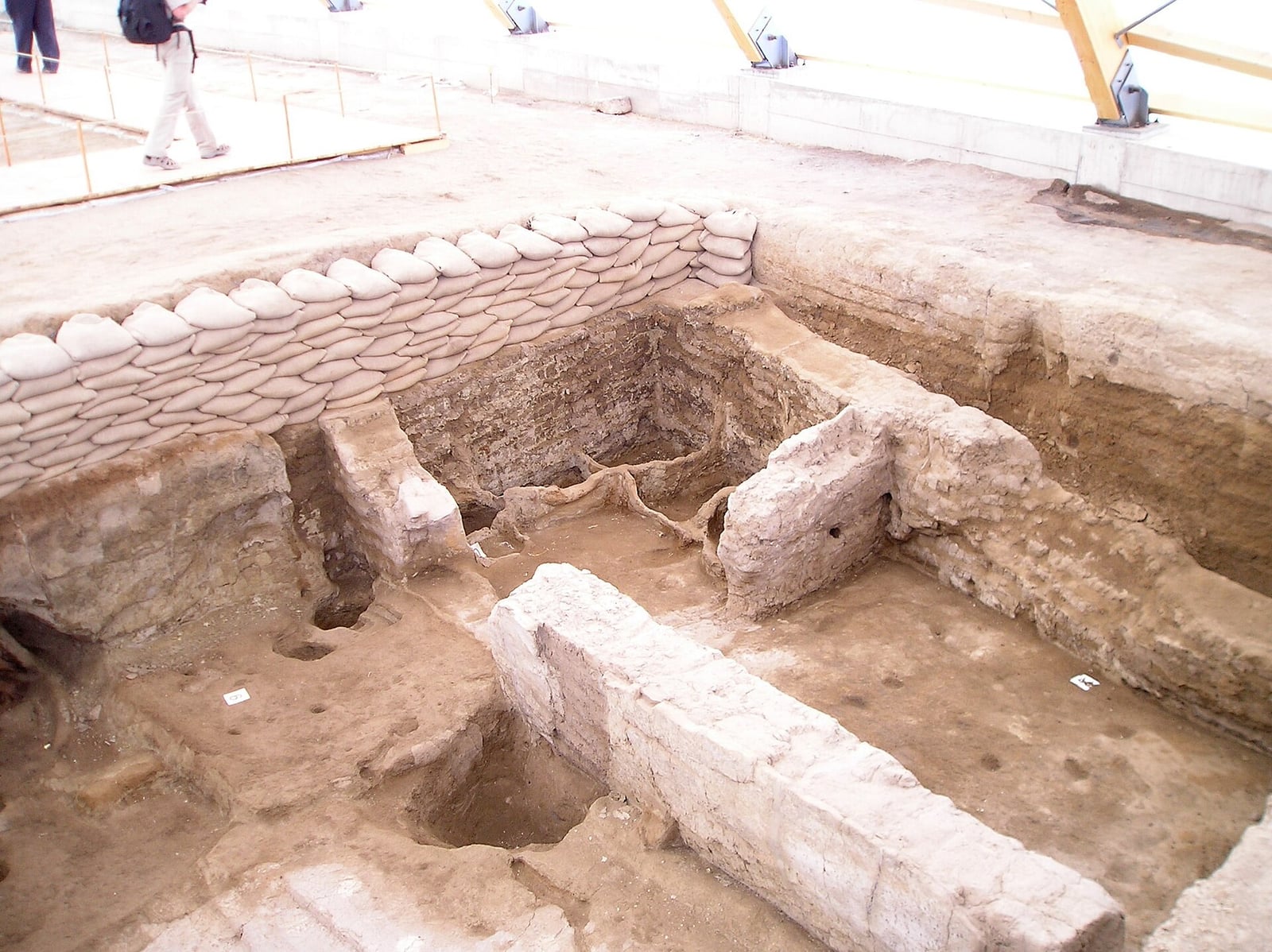
Rising above the Konya Plain in southern Anatolia, the prehistoric tell of Çatalhöyük preserves one of the most remarkable experiments in early urban living. Settled around 7400 BC and flourishing around 7000 BC, the site encompasses two mounds that accumulated over centuries of continuous human habitation. The sprawling Eastern Mound contains eighteen successive layers of Neolithic mudbrick buildings, while the smaller Western Mound was later occupied during the Early Chalcolithic period. Unlike conventional towns, Çatalhöyük developed without streets, pathways, or administrative palaces, functioning instead as a densely clustered aggregate of domestic dwellings.
The inhabitants lived in mudbrick homes arranged directly against one another like cells in a honeycomb. Because there were no ground-level roadways, public movement occurred entirely across flat roofs, transforming the rooftops into communal thoroughfares and gathering spaces. Residents descended into their homes using wooden ladders or steep stairs placed below openings in the ceiling, which doubled as the only exits for smoke rising from domestic ovens and hearths. Typical residences featured smooth, plastered interiors divided into two main activity rooms with raised platforms, alongside smaller ancillary chambers used for household storage.

Keep reading in Yester
Coming soon to the App Store
Keep following the story
Sources
- Neolithic Site of Çatalhöyük (UNESCO World Heritage Centre)
- New insights on commemoration of the dead through mortuary and architectural use of pigments at Neolithic Çatalhöyük, Turkey (Scientific Reports, via PubMed Central)
- One of the world's earliest farming villages housed surprisingly few people (Science News)
- What archaeologists got wrong about female statues, goddesses, and fertility (Popular Science)
- Çatalhöyük
Image: Verity Cridland