A Chola King Builds the Great Temple at Thanjavur
Architecture and inscriptions record royal ambition and organized patronage.
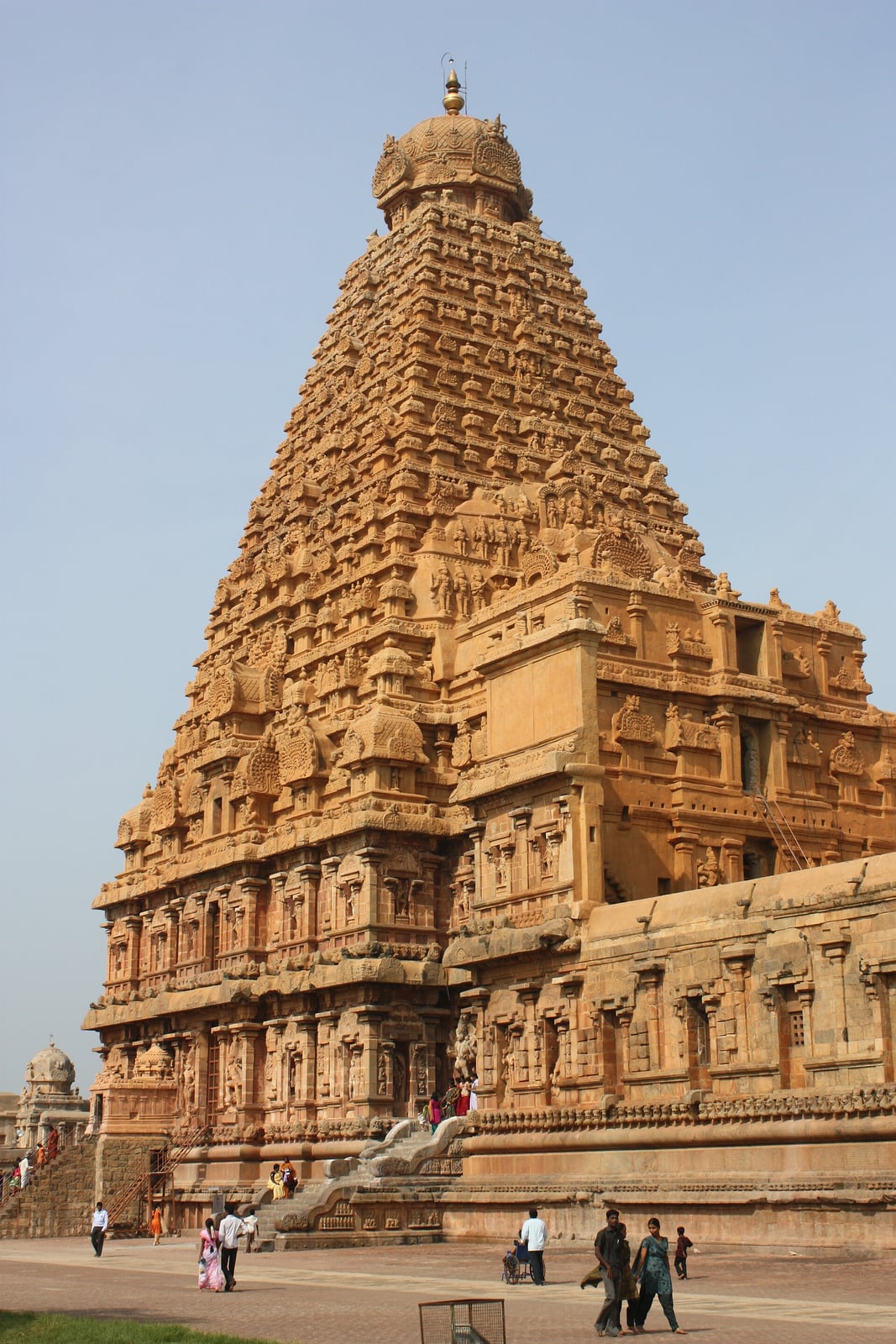
Between 1003 and 1010 CE, the Chola monarch Rajaraja I directed the construction of a monumental Shaivite temple in Thanjavur, the capital of his expanding empire on the south bank of the Cauvery River. Known originally as Rajarajesvaram, meaning the temple of the god of Rajaraja, the sanctuary was designed to express the religious devotion and political authority of the dynasty. Erected on a raised platform following precise axial and symmetrical geometry, the rectangular complex brought Tamil temple architecture to an unprecedented physical scale, far outstripping the dimensions of earlier Pallava and early Chola sanctuaries.
At the heart of the enclosure stands the primary sanctum, housing a massive Shiva linga. Above this inner chamber ascends the granite sri vimana, a straight-sided pyramid about 60 meters high composed of thirteen tapering tiers. The massive tower is crowned by an eighty-ton block of granite, capped in turn by an octagonal domed sikhara and a finial. Stretching along the main east-west axis before the sanctum, a series of linked pillared pavilions, including the mukhamandapam and mahamandapam, accommodated communal rituals and led outward toward an immense monolithic statue of the bull Nandi.

Keep reading in Yester
Coming soon to the App Store
Keep following the story
Sources
- Great Living Chola Temples (UNESCO World Heritage Centre)
- Tanjavur Brhadisvara (Indira Gandhi National Centre for the Arts)
- Thanjavur (World History Encyclopedia)
- South Indian Inscriptions Vol. 2, Tanjavur temple Nos. 66-68, ed. E. Hultzsch, Archaeological Survey of India (text reproduced by The Indian Analyst)
- Interpretation Center Opens At Thanjavur Temple (Hinduism Today, reporting ASI officials, 2006)
- Brihadisvara Temple
Image: Arian Zwegers