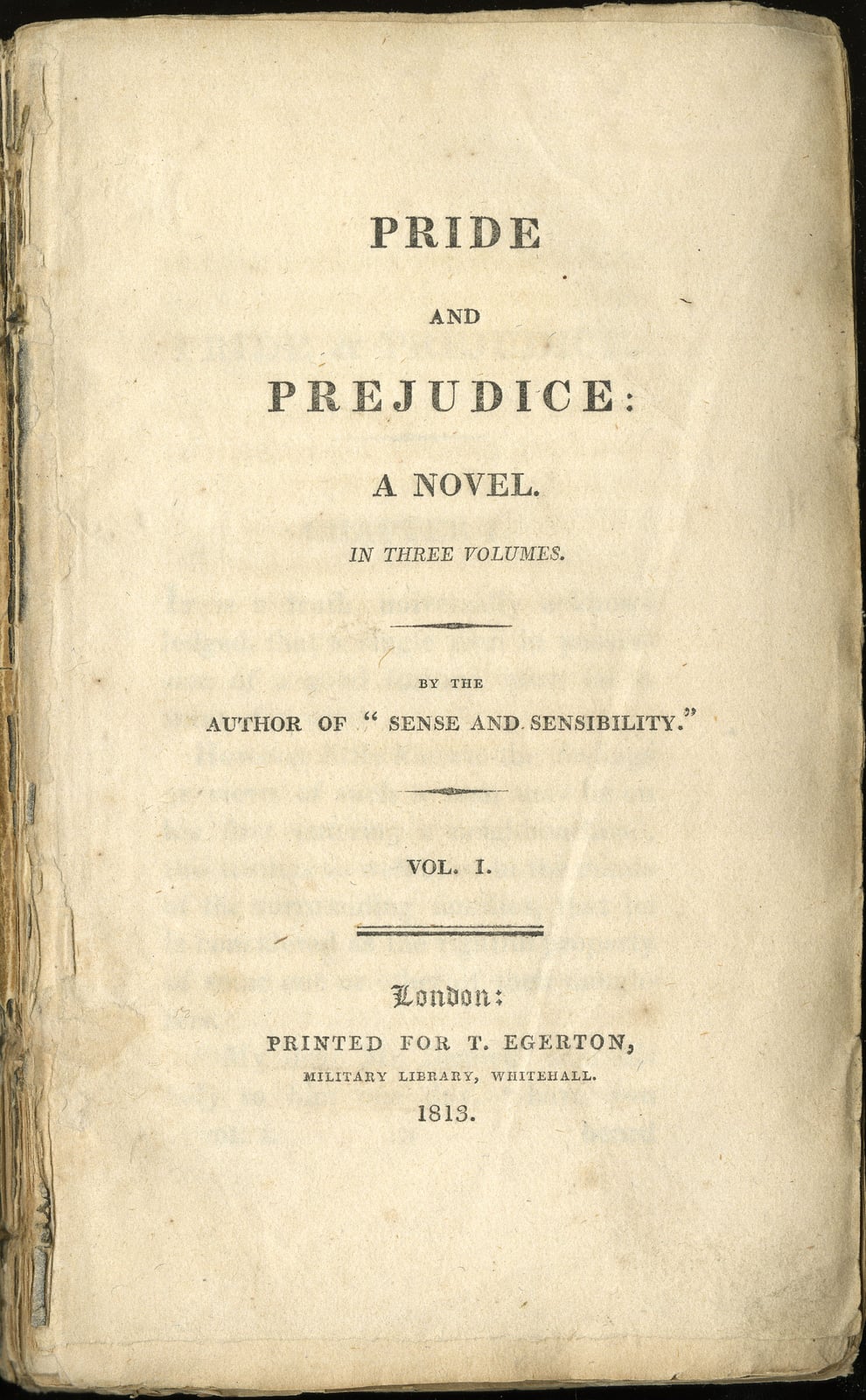
Pride and Prejudice Examines Marriage and Money
Jane Austen’s novel explores judgment, status and the economic pressures of courtship.
On 28 January 1813, London publisher Thomas Egerton issued the first three-volume edition of Pride and Prejudice, advertising it in The Morning Chronicle for eighteen shillings. The author was not identified by name on the title page, appearing simply as the author of Sense and Sensibility. Jane Austen had sold the copyright outright to Egerton for 110 pounds, seeking a definite sum after her father's earlier attempt to interest a bookseller had failed in 1797. The transaction proved exceptionally profitable for the publisher, as the initial print run quickly sold out, prompting a second edition in October of that same year and another in 1817.
Austen had drafted the original narrative, initially titled First Impressions, between October 1796 and August 1797 while in her early twenties. Historical details preserved in the text, such as rural military encampments formed before barracks construction was completed in 1796, locate the internal timeline to the period following the 1793 outbreak of war with France. Although no manuscript fragments survive of the earliest draft, some scholars have suggested that its use of letters points to an earlier epistolary form, although this remains a hypothesis. Austen undertook extensive revisions between 1811 and 1812, adopting the revised title perhaps to avoid confusion with other recent publications or echoing phrasing found in Fanny Burney's 1782 novel Cecilia.

Keep reading in Yester
Coming soon to the App Store
Keep following the story
Sources
Image: Jane Austen (1775-1817)