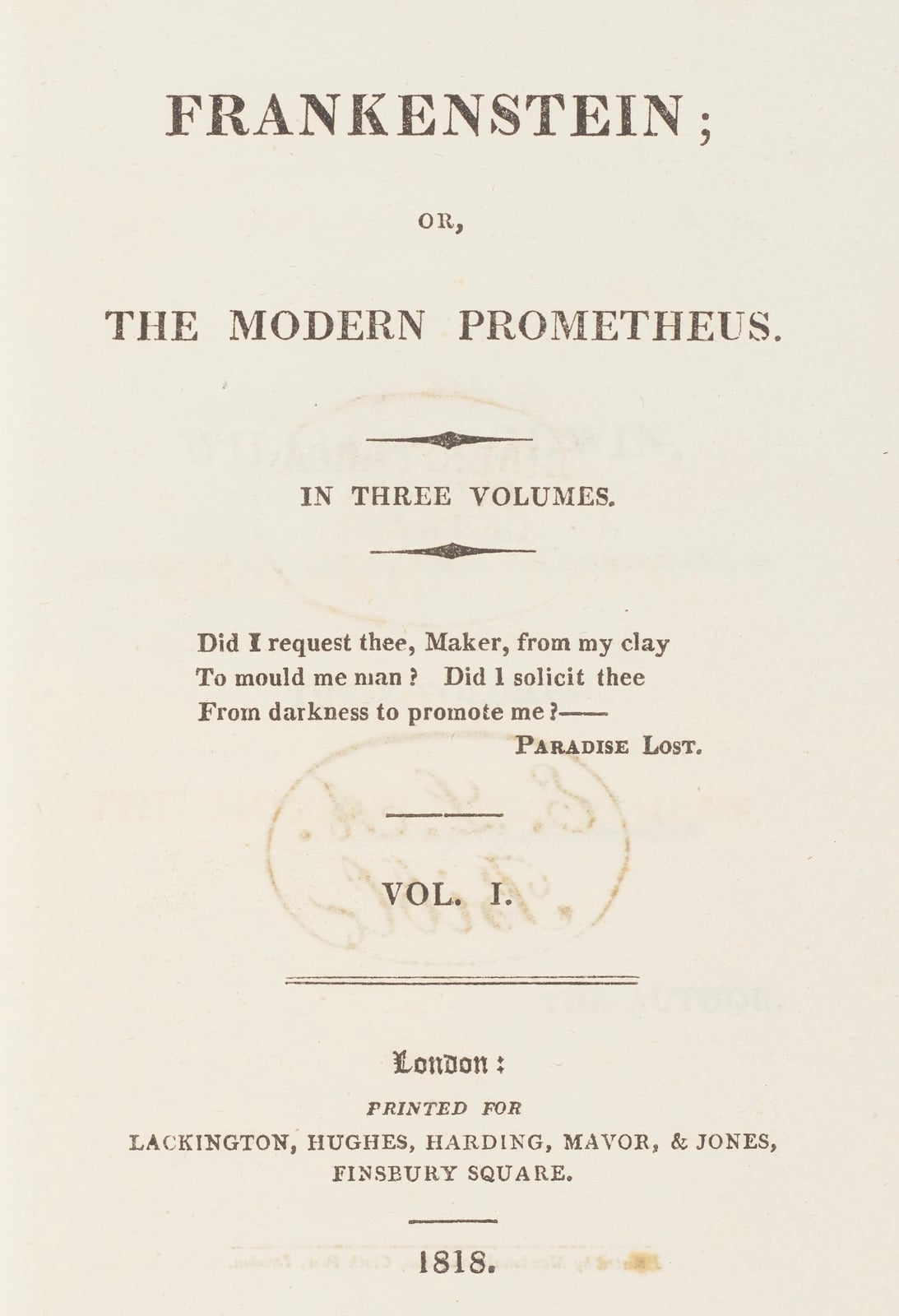
Frankenstein Asks What a Creator Owes His Creation
Mary Shelley’s novel connects scientific ambition with responsibility and exclusion.
During the cold, unseasonable summer of 1816, eighteen-year-old Mary Wollstonecraft Godwin stayed near Lake Geneva alongside Percy Bysshe Shelley and Lord Byron. Confined indoors by bleak weather, the company passed their evenings reading translated German ghost tales before Byron proposed that each person write an original horror story. Struggling initially to conceive a narrative, the author listened to late-night conversations surrounding the principle of life, the natural theories of Erasmus Darwin, and the experiments of Luigi Galvani. Following one of these late discussions, a waking vision of an ambitious student kneeling beside a revived, artificial figure provided the central spark for her work.
Shelley began drafting the narrative in Switzerland and continued composing it in Bath, expanding an intended short tale into a full novel with Percy Shelley's encouragement. Published anonymously in London on 1 January 1818 under the title Frankenstein; or, The Modern Prometheus, the three-volume first edition appeared in a print run of five hundred copies. The narrative followed Victor Frankenstein, a student from Geneva whose experiments at the University of Ingolstadt animate an assembled humanoid body. Immediately terrified by the waking figure, Victor abandons it, initiating a disastrous sequence of neglect, emotional anguish, and violent retaliation.

Keep reading in Yester
Coming soon to the App Store
Keep following the story
Sources
Image: Mary Shelley