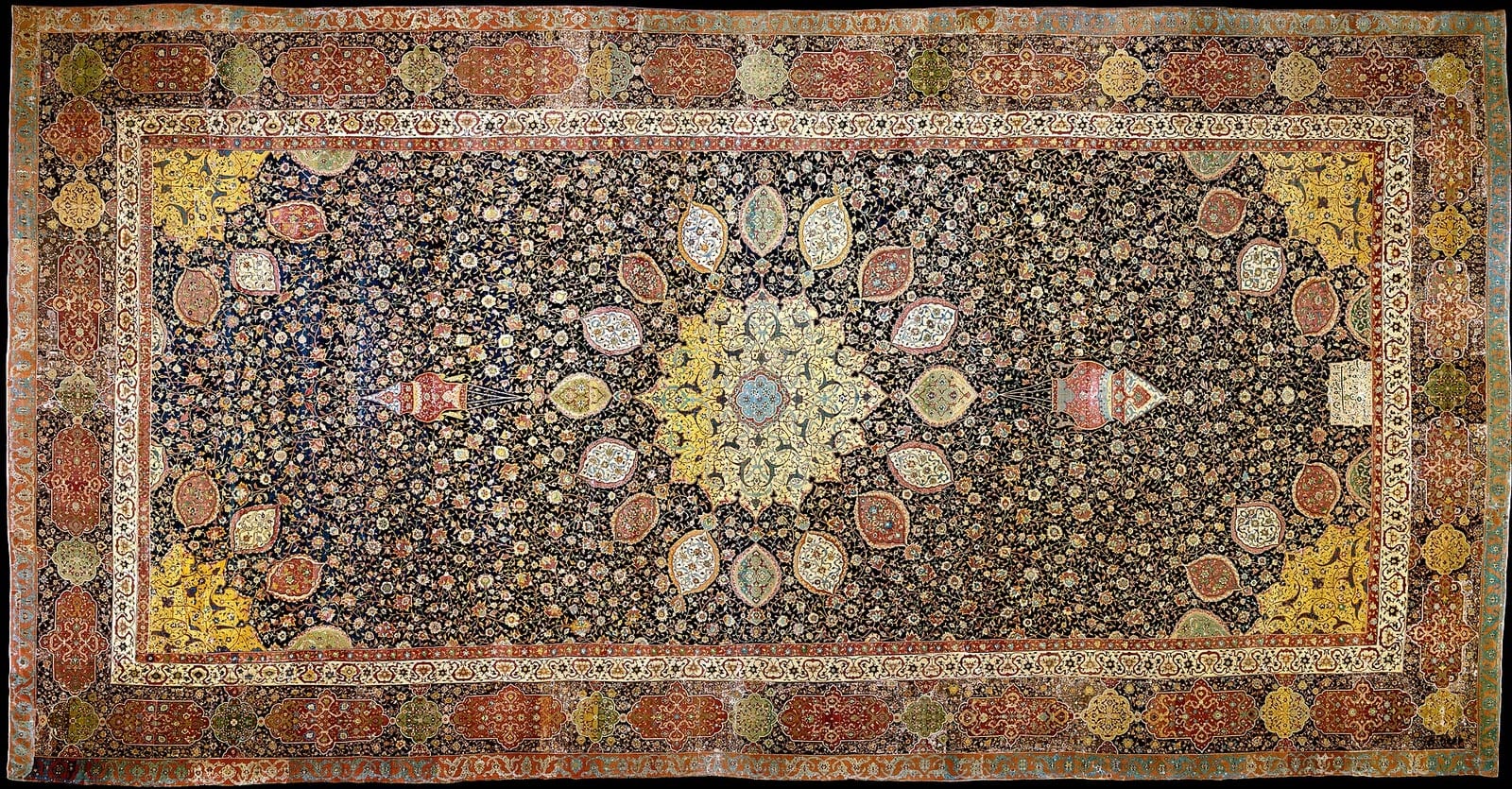
Weavers Complete the Ardabil Carpet
One of the world’s finest carpets was made for a Safavid shrine.
Around 1539 or 1540, weavers in Safavid Iran brought to completion a pair of extraordinary ceremonial textiles that rank among the most famous carpets in Islamic art history. Woven on a foundation of silk with a dense wool pile during the reign of Shah Tahmasp I, the larger and better-preserved of the two averages about 340 knots per square inch. A woven cartouche integrated into the composition records a verse by the Persian lyric poet Hafiz alongside the signature of Maqsud Kashani and the date 946 in the Islamic calendar, believed to represent the earliest dated inscription explicitly documented on any surviving Persian carpet.
The carpets were almost certainly a royal commission, but where they were woven is not known for certain; medallion designs of this kind are usually associated with Tabriz, the Safavid capital, and weaving the pair would have taken about four years. Their intricate surfaces reflect the unified visual style established by the Safavid royal workshops, where court artists developed interconnected ornamental motifs across manuscript illumination, architectural tilework, and luxury textiles. The overall scheme features an elaborate central medallion encircled by sixteen smaller pendants and set against a dark blue ground filled with swirling leaves, blossoms, and stems, all bordered by cartouches featuring decorative patterns and calligraphy.

Keep reading in Yester
Coming soon to the App Store
Keep following the story

Sources
Image: Unknown – production