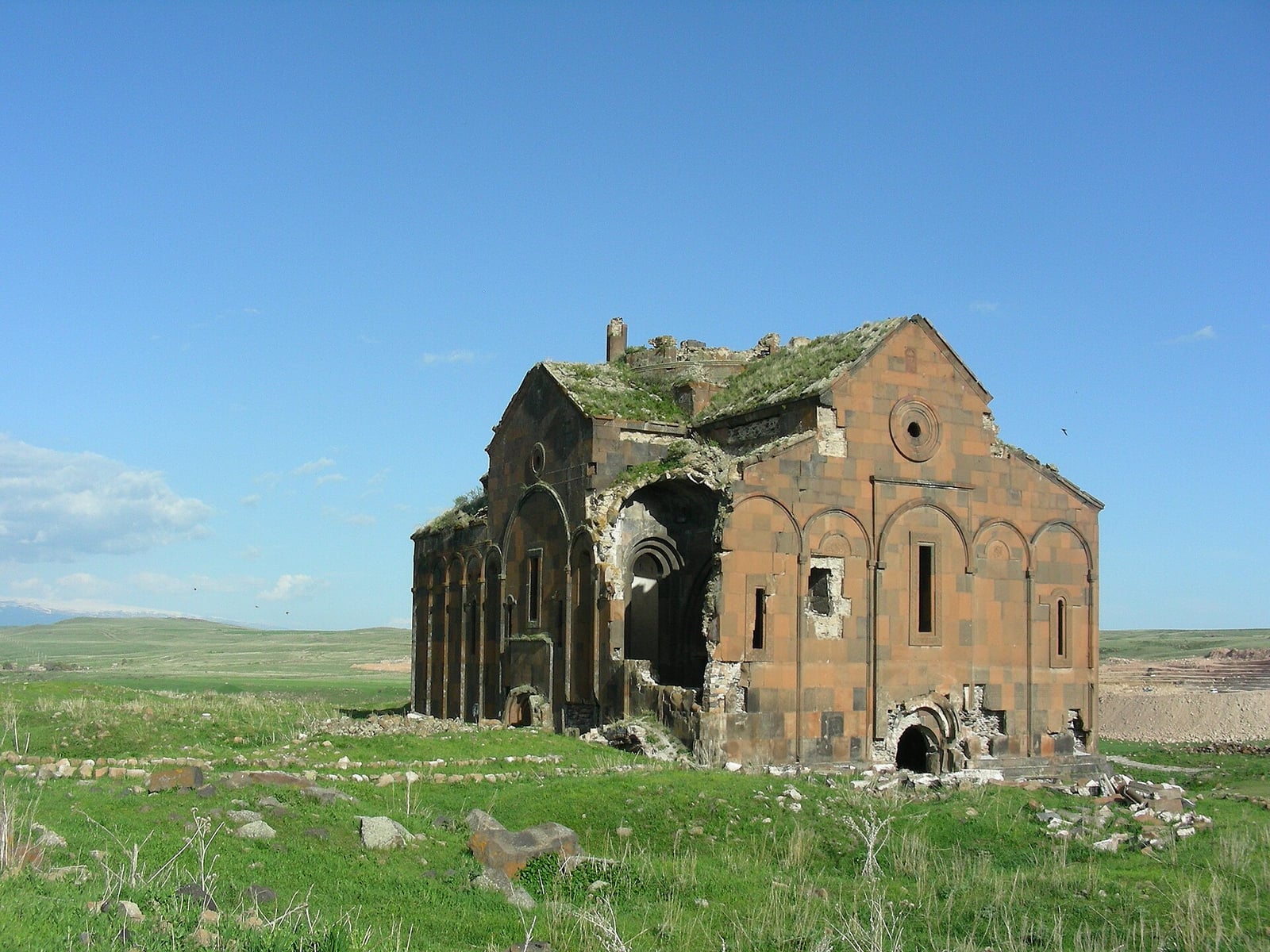
Armenia’s Kings Make Ani Their Capital
The “city of 1,001 churches” grew into a Silk Road metropolis.
In 961, King Ashot III moved the royal seat of the Bagratuni Armenian kingdom from Kars to Ani, selecting a triangular plateau roughly 1,340 meters above sea level. Naturally shielded along its eastern flank by the deep ravine of the Akhurian River and on the west by the Bostanlar valley, the hilltop had accommodated a stronghold of the Kamsarakan dynasty centuries earlier. Under Bagratuni rule, this defensive position grew into an expansive urban capital. By 992, the Armenian Catholicosate transferred its seat there as well, consolidating the settlement as the political and spiritual center of a realm that spanned substantial portions of contemporary Armenia and eastern Turkey.
Physical expansion accelerated during the late tenth century. King Smbat II initiated an elaborate line of double walls along the vulnerable northern approach, where nature provided no ravines, constructing high stone defenses punctuated by closely spaced semicircular bastions. Local volcanic basalt and tufa stone, easily carved in hues of rose-red, cream, and black, became the primary building material for public, domestic, and religious monuments. Craftsmen and architects erected palaces, bridges, bathhouses, and markets. The community also developed cliffside caves outside the fortifications, which likely served as an inhabited extension when the interior urban space reached capacity.

Keep reading in Yester
Coming soon to the App Store
Keep following the story

Sources
Image: Herbert Frank from Wien (Vienna), AT